

Making room for every voice
Good healthcare research depends on hearing from the full range of people it is meant to represent. Yet patients and providers who are recruited into a study often face barriers that have nothing to do with their interest in participating: mental, emotional, physical or logistical obstacles that make it harder to take part, fully participate or that shut them out of the process entirely.
There are three reasons that this matters:
Business. Researchers and the brands they serve want to understand and communicate with the full population of potential customers. People with disabilities represent significant purchasing power that is easy to overlook. Many healthcare companies need to speak with those using their products or services and the very conditions their products address often entail disabilities.
Research. A representative sample requires deliberately including populations that are otherwise underrepresented in traditional panels.
Ethics. Designing research that anyone can participate in, regardless of ability, is simply the right thing to do.
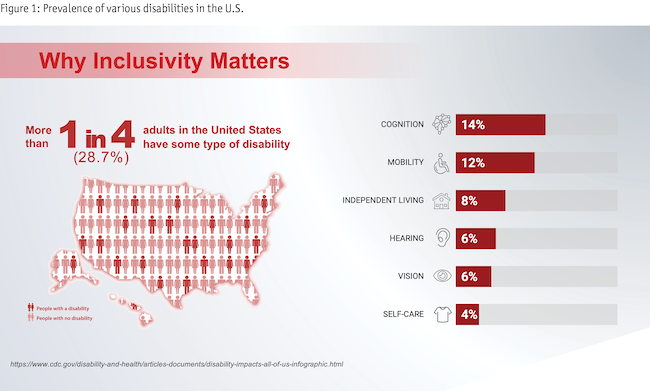
The scale of the opportunity, and the obligation, is substantial. According to the Centers for Disease Control and Prevention, more than one in four U.S. adults live with some type of disability: 13.9% report a cognitive disability, 12.2% a mobility disability, 7.7% an independent living disability, 6.2% a hearing disability and 5.5% a vision disability.1 For in-person research specifically, mobility challenges alone can create access issues for more than one in 10 potential participants.
The issue is not only prevalence but exclusion. Reviews of clinical research show that disability can still be used as an explicit or practical barrier to participation, sometimes without scientific justification. When those most affected by a condition are also the hardest to recruit or accommodate, the result can be a less representative sample and weaker external validity.5,6
The economic case runs in both directions. Working-age people with disabilities in the U.S. represent an estimated $1.3 trillion in disposable income and friends and family often steer away from brands that exclude people they love.2 Sixty-nine percent of customers with access needs will click away from a website they find difficult to use and 86% say they would spend more if there were fewer barriers to access.3 At the same time, this is a vulnerable population: People with disabilities are more than twice as likely to live in poverty and over three-quarters remain disconnected from the labor market. Many also contend with older technology and unreliable connectivity – real considerations for anyone designing an online study.
Understanding the barriers: visible and invisible
Some accessibility needs are immediately obvious – a person using a wheelchair signals a mobility need before a study ever begins – while many others are not visible at all and researchers may not learn about them until well into a project, if ever. Fine motor tremors, for example, often go unnoticed until a respondent is asked to complete a hands-on usability task.
A useful way to think about accessibility is not simply to ask whether a respondent has a disability but whether there is a mismatch between what the research asks them to do and what they can comfortably do. Severity and functional impact often matter more than the diagnostic label: a person with Parkinson's disease may converse easily but struggle with a long online questionnaire requiring precise mouse movements, while someone with dyslexia may participate easily in an interview but be disadvantaged by dense written material. In other words, accessibility begins with the research task, not the diagnosis.
Other conditions that can affect participation but are rarely visible up front include neurological conditions such as neuropathy or loss of smell and taste; cognitive conditions such as ADHD, dyslexia, intellectual disability or dementia; visual, hearing or speech impairment; mental health conditions; immune compromise, which can affect both the respondent and the people they live with; participation challenges such as incontinence or fatigue; and environmental sensitivities such as migraine or food allergies.
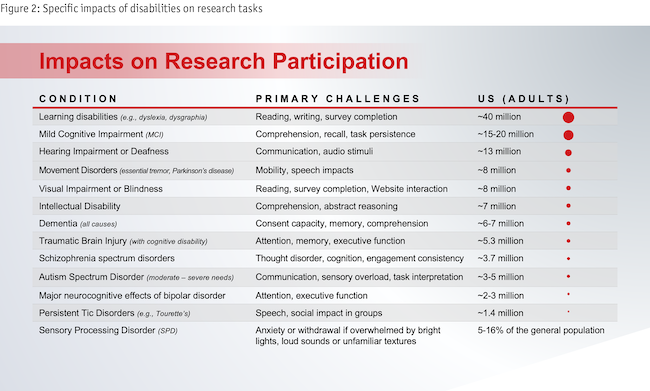
The scale of these conditions across the U.S. adult population is worth sitting with: Learning disabilities such as dyslexia and dysgraphia affect an estimated 40 million adults; hearing impairment or deafness affects roughly 13 million; movement disorders such as essential tremor and Parkinson's disease affect approximately 8 million, as does visual impairment or blindness; and dementia of all causes affects an estimated 6 to 7 million.4 Each carries its own primary challenges for research participation, from reading and survey completion to comprehension, recall and consent capacity.
It's also worth remembering intersectionality. Patients frequently manage more than one condition at a time and can carry a double burden when a disability intersects with another characteristic, such as a hearing-impaired respondent who is also not a native English speaker. Cultural nuance matters too: In some cultures, family members may speak for the patient entirely and researchers need to navigate that dynamic thoughtfully by including caregivers in the process where appropriate.
Case study: Crohn's disease. A client wanted an in-depth, day-in-the-life understanding of patients managing Crohn's disease, an unpredictable and, on a bad day, extremely debilitating condition. The original request was for in-home visits but the team recognized a problem: What happens if a respondent is having a bad day when the interviewer arrives, potentially spending much of that day in the bathroom? Rather than risk putting patients in an uncomfortable position, the team designed an asynchronous online activity series instead, inviting respondents to upload videos and photos and complete a series of projective exercises documenting how their days are affected and how they set up their home environments for success. The approach delivered the same richness of insight without asking anything intrusive of participants.
Recruiting and screening for inclusive research
Inclusive research starts at the design stage, not as an afterthought once a study is underway. Before finalizing a research approach, whether in-person or online, it helps to walk through the entire respondent journey and ask where a participant might encounter friction, then use screening questions to identify individual needs early. A useful rule is to adapt before excluding: if the barrier comes from the research method rather than from the question the study is trying to answer, first consider changing the mode, pace, format or support. The key is to ask functional questions rather than medical ones: instead of asking whether someone is visually impaired, ask whether a larger font would help them participate more comfortably or whether other accommodations would help. This surfaces real needs more effectively and lets research and recruiting vendors capture a segment of the population that is too often missed.
Incentives and financial considerations
Financial strain is common among people with disabilities and can be a strong motivator to participate, but compensation needs to be handled carefully. Incentives may interact with means-tested benefits or other financial circumstances, so researchers should avoid giving blanket assurances about their consequences and should provide clear information about payment arrangements. Technology is its own barrier for online research, too: older devices, poor Wi-Fi and a lack of adaptive technology can all make participation harder.
Case study: Parkinson's patient journey. Fully understanding a patient's journey with a serious condition typically calls for a 75- to 90-minute interview. For a recent study with Parkinson's patients, whose fatigue and tremors can worsen the longer a conversation continues, the team recognized that a session of that length was unrealistic. Instead, participants completed structured pre-work on an online bulletin board at their own pace, working in bits and pieces and taking breaks as needed, which meant the live interview itself could focus on filling gaps rather than starting from scratch. Live sessions were capped at around 60 minutes, with the option to pause and resume on a different day, and participants were invited to bring a caregiver to help carry the conversational load if they wished.
In-person research considerations
When research does take place in person, a handful of logistics deserve attention well before the day of the session. Transportation and parking matter: consider whether a respondent needs an escort into the building or whether reimbursing a family member to drive them makes more sense. Dietary needs matter too, from ensuring that snacks and beverages meet common restrictions like gluten-free diets to simply making sure participants are fueled and energized to participate.
For immune-compromised participants, contagion risk deserves a plan. Consider protocols similar to those used during COVID-19, including offering masks (with clear panels if a respondent relies on lip reading), hand sanitizer and a backup plan in case the moderator becomes ill. For those with mobility challenges, building accessibility should be verified in advance, not assumed. Is there a continuous accessible route from parking to the entrance? Can it be reached without stairs? Are doorways at least 32 inches wide? Are restrooms fully accessible? Is there a working elevator if needed?
A few field examples show how small adjustments make a real difference. For migraine research, replacing overhead fluorescent lighting, a common trigger, with soft lamps also created a more welcoming atmosphere. For incontinence or overactive bladder research, requesting the room closest to the restrooms and giving participants explicit permission to step out at any time reduced anxiety considerably. For diabetes-focused focus groups, swapping the usual candy and sugary soda for healthier snacks showed simple consideration for participants' health. And for an ADHD focus group, providing fidget tools/toys and markers for doodling improved engagement rather than distracted from it.
A word on support animals
Service animals and emotional support animals are governed differently and the distinction matters for research logistics. Service animals, almost always dogs (and occasionally miniature horses!), are individually trained under the Americans with Disabilities Act to perform tasks directly related to a person's disability: guiding someone who is visually impaired, alerting to an oncoming seizure or dangerous blood glucose level or providing mobility support. They are working animals, not pets, and anyone with a disability must be permitted to bring one into a research session.
Emotional support animals are different. They are prescribed by a licensed mental health provider for comfort and companionship but are not specially trained and, while protected under the Fair Housing Act, they do not carry the same public access rights. Because they are untrained pets, there is more potential for an unpredictable reaction to another animal, person or environment. A few safeguards help: confirm in advance whether other participants have severe allergies or a fear of animals; and if emotional support animals will be permitted, limit them to one per group and keep them separated in waiting areas.
The role of caregivers
Caregivers are often what makes participation possible in the first place and it is worth being deliberate about the role they will play. Some provide practical support, such as transportation or help completing a survey or joining an interview. If a caregiver is compensated for transportation, it is good practice to have them sign the same liability waiver as the respondent.
In other cases, caregivers contribute directly to the research content. In an exploratory study of patients who had received different heart valve replacements, many participants had experienced a sudden cardiac event and were unconscious for much of the diagnostic and treatment process. In those instances, caregivers, often a spouse or adult child, were essential in filling in those gaps. Caregivers can play a similar role in research involving conditions such as schizophrenia or substance use disorder, offering balance and perspective alongside the respondent's own account. When caregiver involvement is likely, it's worth writing surveys and discussion guides with that dynamic – and their participation – in mind from the start. It is important to distinguish these two roles: Helping a participant take part is not the same as answering for them. When caregiver involvement is expected, the protocol should be made clear when the caregiver is providing practical assistance, when they are offering their own evidence and whose perspective is being recorded.
Co-creation with patient advisors
Patient advisory boards offer another way to strengthen research design. Engaging patients who live with a condition to help review research instruments, screener questions, activities and protocols surfaces details a researcher might otherwise miss. Because these advisors are living with a condition on an ongoing basis, co-designing materials with them, rather than simply testing materials on them after the fact, tends to produce a noticeably more thoughtful study.
Adaptive technology
Respondents increasingly rely on adaptive technology to participate and research platforms need to be compatible with them. A participant using screen-reading software will have a far better experience if unnecessary text, logos and visual clutter are minimized in study materials. For moderators working with hearing-impaired respondents who use cochlear implants or hearing aids, slowing down, speaking clearly, facing the respondent to support lip reading and eliminating crosstalk all make a meaningful difference. Captioned video, screen-reader-compatible surveys, text-based alternatives and interviewer-administered options can preserve participation when the original mode creates a barrier. Where the mode changes, the accommodation should be planned, standardized and documented rather than improvised.7 It is worth asking any interviewing or survey platform directly for a list of the accommodations it supports.
Empathetic moderation
How a session is moderated matters as much as how it is designed. Creating a warm environment starts with projecting genuine appreciation for participants’ time and reinforcing that they are free to decline any question that feels too personal. Moderators can modulate pace, vocabulary and the length of check-ins to match a respondent's needs and should maintain a judgment-free atmosphere throughout. Sharing the purpose of the research often deepens engagement. For visually impaired participants specifically, a moderator offering a verbal description of themselves (and any materials being shown) is a small courtesy that is consistently appreciated.
From blanket exclusion to proportionate risk assessment
A further development is a structured approach to respondent risk assessment supported by a curated library of clinical, academic, social and cultural evidence.8 The important idea is not the technology itself but the shift away from treating vulnerability as a simple yes/no characteristic of the respondent. Participation risk is often contextual, time-dependent and specific to the research modality, so safeguards should be proportional to the actual risk rather than based on blanket exclusion.
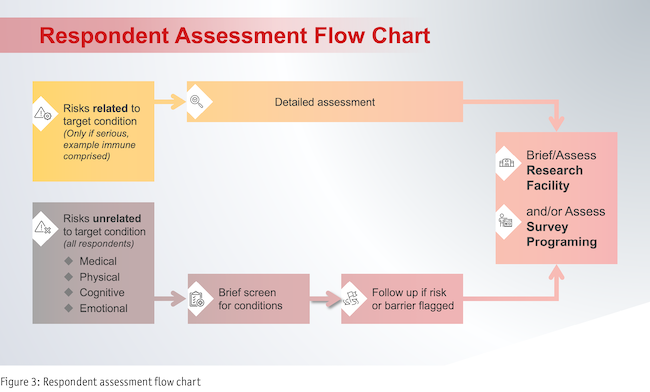
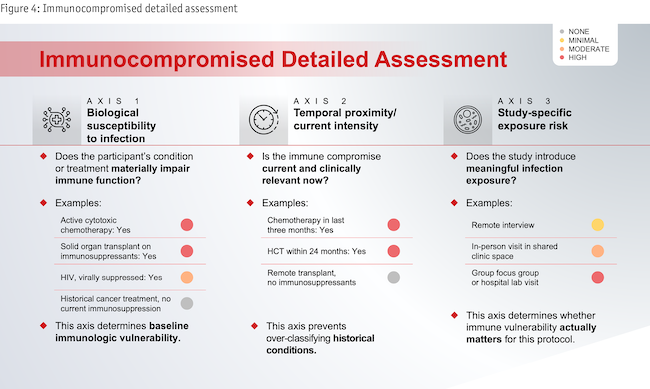
The assessment flow has two branches. The first addresses risks related to a study's target condition but only when that condition creates a meaningful safety issue, such as immune compromise. Assessment can be organized across three axes: biological susceptibility, which establishes a baseline of vulnerability; current intensity or clinical relevance, which prevents a remote history from being treated as present risk; and study-specific exposure, based on whether the research is remote, in-home, in a shared facility or in a group setting. The same respondent may therefore require different safeguards for an in-person facility study than for a remote interview.
The second branch screens for risks unrelated to the target condition and applies to all respondents: a brief structured screen incorporating validated measures where appropriate, covering cognitive and comprehension readiness, physical stamina and comfort, distress, anxiety and same-day substance or medication effects. These are used strictly as participation-readiness flags rather than as diagnosis. If something is flagged, a short follow-up aims to convert a moderate-risk respondent into one who can be comfortably and safely accommodated through: more frequent breaks; shorter or split sessions; a slower pace; written or larger-font materials; switching between phone, video or in-person formats; captioning; an interpreter; or a support person. The principle is simple: adapt before exclude, while retaining appropriate safeguards and local legal or ethical requirements.
Remove barriers
Designing accessible patient research is not a single checklist item but a mind-set that touches every stage of a study, from initial design through screening, logistics, moderation and follow-up. The objective is not to make every study identical for every respondent. It is to remove barriers that have nothing to do with the questions the research is trying to answer. A tremor should not prevent someone from contributing because a survey requires precise mouse movements; hearing loss should not exclude someone because a platform lacks captions; and fatigue should not remove the most affected patients because the discussion guide assumes a 90-minute session.
Accessibility also needs a budget. Interpretation, captioning, accessible transportation, additional moderator time, adaptive materials and compatible technology are much easier to manage when planned from the start than when treated as exceptions after recruitment begins.
When the barrier comes from the research rather than the respondent, redesigning the research is usually the better answer. These practices expand who can participate while improving the quality and representativeness of the data researchers collect. Supporting accessibility in research is good for business, makes for better research and is the right thing to do.
Editor's note: Tom Donnelly is a senior vice president at iMarketResearch. He has provided healthcare marketing research for over 20 years and has extensive experience across a broad range of therapeutic and MedTech areas. With a doctorate in cognitive science, he designs his research using a variety of methodologies informed by behavioral science.
Julie Leonard is vice president and qualitative practice lead for MarketVision Research, with nearly 30 years of experience in qualitative research, encompassing product development, consumer goods, pharmaceutical and medical device research across a wide range of methodologies. Leonard holds a B.S. in psychology from Xavier University and has completed continuing education work in facilitation, grief support and storytelling.
Kelli Rempel is principal and founder at HANA Worldwide, with 30 years of experience in market research and medical affairs spanning medical device, healthcare, technology, automotive and foreign policy. She holds a B.A. in international affairs from The George Washington University and is a named patent holder in the U.S., E.U. and Japan.
Andrea Casalini is a customer and competitive intelligence manager at Medtronic, Acute Care and Monitoring, with over 25 years of experience in healthcare strategy and market intelligence. She holds an undergraduate degree in biomedical engineering from Boston University and an MBA from Suffolk University.
Peter Simpson is a managing partner at Sarasota Ventures, with 35 years of experience in healthcare market research and assessment and healthcare decision-making. This experience follows a career holding senior positions in the forerunner to AstraZeneca.
Derek McCracken is director of marketing and outreach at Narrative Mindworks, an international narrative practices association. He has 11 years of experience in narrative medicine and holds an M.S. in narrative medicine from Columbia University.
References
1 Centers for Disease Control and Prevention. “Disability impacts all of us.” Retrieved from https://www.cdc.gov/disability-and-health/articles-documents/disability-impacts-all-of-us-infographic.html
2 Inclu City Calgary. “The business case for inclusive design.” Retrieved from https://www.inclucitycalgary.ca/post/the-business-case-for-inclusive-design
3 Sitecore. “A business case for inclusive digital design.” Retrieved from https://www.sitecore.com/resources/insights/digital-transformation/a-business-case-for-inclusive-digital-design
4 Prevalence estimates compiled from CDC and condition-specific national health surveys, as presented in Intellus Health Literacy Training IV materials, March 2026.
5 Schwartz, J. K., et al. “Inclusion of people with disabilities in research to improve medication adherence.” Patient Preference and Adherence 15 (2021): 1857-1866.
6 Camanni, G., et al. “Being disabled as an exclusion criterion for clinical trials.” eClinicalMedicine 64 (2023): 102286.
7 Wittich, W., et al. “Methodological approaches to obtaining informed consent and doing research with people with disabilities.” International Journal of Qualitative Methods 22 (2023): 1-12.
8 Sarasota Ventures, LLC., Accessibility Screening Tools (c) 2025.