
Giving ourselves a head start
Editor's note: Raghavi Ravi is a data scientist at Emma White Research, where she works on survey analytics, automation and AI applications for market research. She holds a M.S. in data science from Michigan State University. Find Ravi on LinkedIn. Emma White is founder of Emma White Research and a public opinion researcher with 20 years of experience helping public sector clients translate research findings into strategy and action. She holds an M.S. in survey methodology from the University of Michigan and is a member of AAPOR. Find White on LinkedIn.
Most research teams have a shared drive full of past questionnaires. Very few teams use it as well as they could.
Not because the documents are disorganized but because retrieving something specific from a collection of Word files requires knowing where to look – which project, which year and roughly where in the questionnaire. Without that prior knowledge, digging through the archive is slow, frustrating and often not worth the effort.
At our firm, we decided to do something about it. Over the past year, we built a tool in-house that makes our questionnaire archive searchable in plain English, not by file name or keyword but by meaning. Ask it how we have measured brand satisfaction across our studies and it tells you: exact question wording, response scale, audience group, study name and year, drawn from every document we have uploaded. This article explains why we built it, how it works and what it might mean for how we can use AI to enhance, not replace, the work we do as researchers.
Accessing the work we’ve spent years developing
We knew we were sitting on a valuable asset: years of carefully constructed survey instruments. Every questionnaire that has gone into the field represents real intellectual effort: deliberate question wording, tested response scales, carefully sequenced sections. But that accumulated know-how is locked inside Word files in our drives and getting to it is harder than it should be.
This impacted our work in a couple of ways:
- We were at times starting from scratch writing questions, even if it was a topic we had tackled before. Especially if newer staff were working on a project, they would not know where to look to find all the questions we had already developed and vetted.
- We sometimes lost comparability to past results because the questions we were using didn’t match exactly – and so we couldn’t tell whether the difference was time or if different wording drove different results.
We built a tool to solve this. To make a searchable questionnaire database, we had to first standardize the information into a format that could sort the relevant question data. Questionnaire documents consist of variously-structured components – individual questions, response options (if applicable) and metadata like audience, name of the study and year. We needed to reconstruct question numbers and hierarchy from Word files, where this information is captured by formatting rather than plain text. And since questionnaire documents are not naturally structured for machines to read, we had to define what a “unit of retrieval” should look like or, in other words, teach the tool how to determine the boundaries of an individual question with its response options and any programming instructions or branching logic if applicable. This allows it to return a full question with all relevant information as the result of a search.
To enable searching, the tool stores the questions from these documents in two forms. First, the question text, response options (if applicable), study name, audience, year and the source document itself are stored as structured metadata. Additionally, the questions are stored as an embedding, which is a numerical representation of their meaning. The user’s query is also converted into the same kind of representation and is then compared to stored question embeddings. The system then retrieves a set of the closest matches, along with their metadata and source references.
The final stage is the search function and retrieving results. A large language model pulls the results together, showing exact examples and, when useful, a summary of how the topic has been asked before. This AI-powered search tool lets us go beyond traditional search methods that rely on exact keywords. If you type "brand recognition" but the question in the archive says "brand awareness," a keyword search may miss it entirely. AI-powered search understands that those two phrases are likely describing the same thing and finds both. It can also summarize how a topic has been asked over time – not just a list of questions.
Every result links back to the original source so you can see exactly where it came from. We designed it to pull only from our documents and cite every source it draws on so we are not dealing with AI hallucinations or inventions.
The outcome
We can take all of our past questionnaire documents and feed them into a system that reads and understands them, not just as text, but as structured instruments with questions, response options and context. The system is searchable in plain English.
Instead of opening files one by one, we just ask the system what we are looking for. The system finds the relevant questions across the entire archive, tells us where they came from and shows us the exact wording.
Let’s say a researcher is building a proposal for a new brand health study. She knows our agency has run similar work before. She wants to know how brand perceptions have been measured in past projects: what the question wording was, what response options were used and whether it was asked differently to different audience groups.
This method retrieves all variations of how we had asked a question across multiple studies from Likert scales to matrix questions. This changes what is possible within a working day and it changes the confidence with which a researcher can design and refine questionnaires.
The question every research director will ask: What about client confidentiality?
A system like this can be designed to run within your environment, meaning client data stays within the boundaries you already maintain. Any tool that handles research data should fit your existing data governance framework and you should review any third-party data processing agreements carefully. This means that the material stays yours and the tool serves the team rather than the other way around. 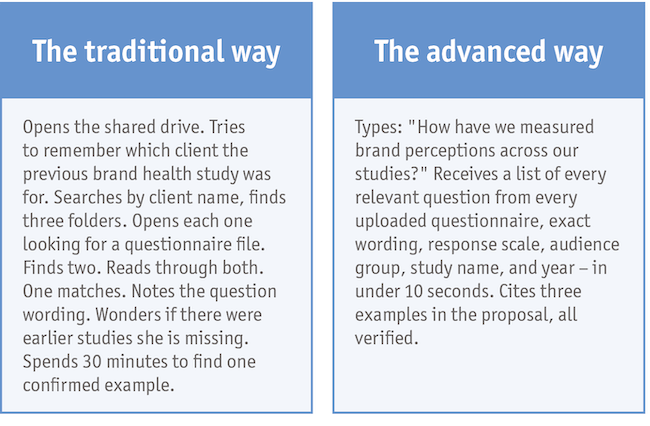
How to begin
At our firm, we started small.
Start with one client or category. We began with a single long-running client where we already knew the questionnaires well. This made it easier to evaluate the outputs the tool was returning before expanding further.
Treat the archive as a living resource. We made it a habit to upload each questionnaire at the end of a project. We believe that over time, this builds a more relevant library that becomes more useful with every study.
Be clear on what the system is for. Like most tools, its value depends on how it is used. The tool does not make any decisions; it instead finds what’s been done before. We then take the outputs and decide what to do next. It is very important to keep in mind that just because a question exists in the archive does not mean that it is the right choice for a new study. This distinction is important for maintaining research quality as usage scales.
What this tool changes
The most immediate impact is time. Researchers can spend less time digging through past studies or relying on memory. They can quickly see how similar questions have been handled in the past and build from that.
Over time, we think that this should improve consistency. When our team can easily get to past wording and response scales, they are less likely to introduce small variations by mistake which can make comparisons harder later.
It also changes how quickly new researchers can get up to speed. Instead of relying on institutional memory or knowing who to ask, they can see how the team has approached similar problems in the past.
This is a starting point. Systems like this could gradually extend beyond just questionnaires and into discussion guides, reports and other research artifacts.
AI as an operations tool, not a research replacement
The conversation about AI in market research often focuses on flashier possibilities – synthetic respondents, automated analysis, AI-generated surveys. While we believe it is critical that research continues to engage real people and not rely on synthetic data, there are overlooked places where AI tools can be an enormous aid to researchers by making research operations significantly more efficient and freeing time for work that can only be done by humans.
Finding a past question is not a glamorous problem. But it is a real one and it takes real time away from the work that actually requires human expertise. Finding questions, checking consistency and auditing methodology – these are exactly the kinds of tasks where AI performs well and where its limitations can be mitigated. We believe this creates a more connected view of how research is designed and executed with the help of AI.
For Emma White Research, building this capability in-house has shifted what feels possible during a working day. The same will be true for any research team willing to put in the work to make their questionnaire archive a more usable resource. The knowledge is already there. The question is whether you can get to it.