
The conversation around AI in market research has moved beyond experimentation. The question is no longer whether to use AI, but how to apply it for meaningful, reliable insights. The key challenge is understanding where AI adds value and where human expertise remains essential. Scale and speed can accelerate research, but producing more output faster is not the same as producing better insight.
At Bellomy, we’ve always approached AI through the lens of research expertise. AI-driven tools and methods are most effective when they're grounded in real business questions, informed by industry knowledge and guided by human judgment.
Human understanding is our epicenter. So, where does AI create the most value?
To explore this, Bellomy has a weekly, company-wide AI Exchange meeting where we spotlight employees’ use of AI. It allows our staff to evolve together and informs how we develop AI tools in-house. In assessing potential uses of AI, we ask ourselves three questions:
Does it make us faster? Not always. AI saves manual time, but analyzing, validating and applying our knowledge and judgment still takes work.
Does it make us better? Usually. It allows us to use our brains differently, in ways that are more valuable and lead to smarter outcomes.
Does it let us do things we couldn’t do without it? Yes, from making large volumes of information manageable to making research more accessible and actionable.
“Should we trust the results?” is also an important question, which we address by reviewing AI output and using our judgment as researchers. We also evaluate new AI models, monitor for AI bias and encode learning in AI skills, systematically capturing opportunities for improvement.
Data privacy and security are also paramount. Bellomy’s ISO27001 certification, annual SOC2 audit and internal AI governance ensure that we have strict policies governing AI usage and our proprietary AI tools are siloed and locked down from external exposure. They are rigorously tested, used by our staff and, in some cases, made available to clients after thorough vetting.
How do these principles translate into real-world use cases? Here are some examples:
AI for text analysis
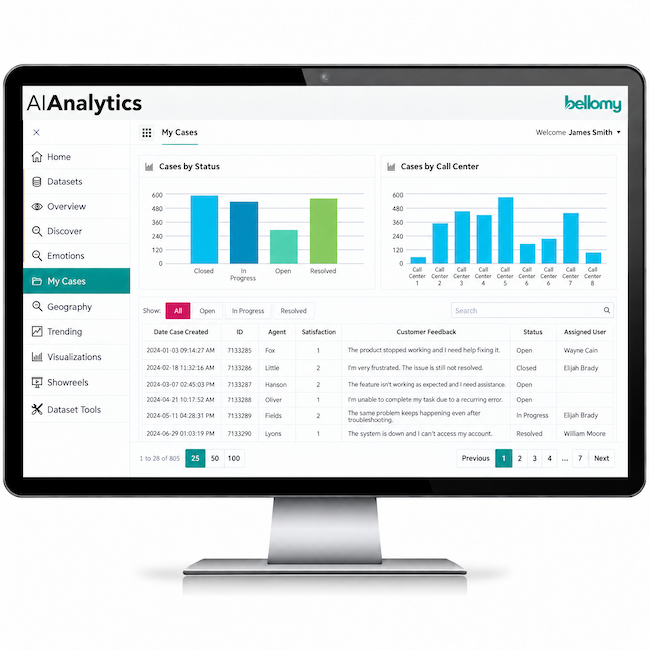
For large-scale CX measurement programs, the challenge is to rapidly find meaning across the deluge of open-ended survey responses, online reviews, service conversations and qualitative interviews, then identify patterns and nuances quickly enough to inform meaningful action. Researchers interpret those findings in context and translate them into clear takeaways that stakeholders can use to drive improvement.
AI tools also support early-stage discovery and exploration, accelerating secondary research and making large volumes of background information easier to consume.
AI for qualitative reporting
For focus groups and IDIs, Bellomy’s Qualitative Analyzer combines transcripts with discussion guides, research objectives and notes for more comprehensive, context-aware analysis. Moderators use it routinely to save hours and streamline analysis. The tool synthesizes themes, surfaces illustrative quotes and develops an initial reporting structure, while an AI chat feature supports further exploration.
AI for dynamic probing in surveys
Researchers know the frustration of seeing a vague or confusing open-ended response and wishing they could ask a follow-up question or two. Used thoughtfully in data collection, AI makes that possible.
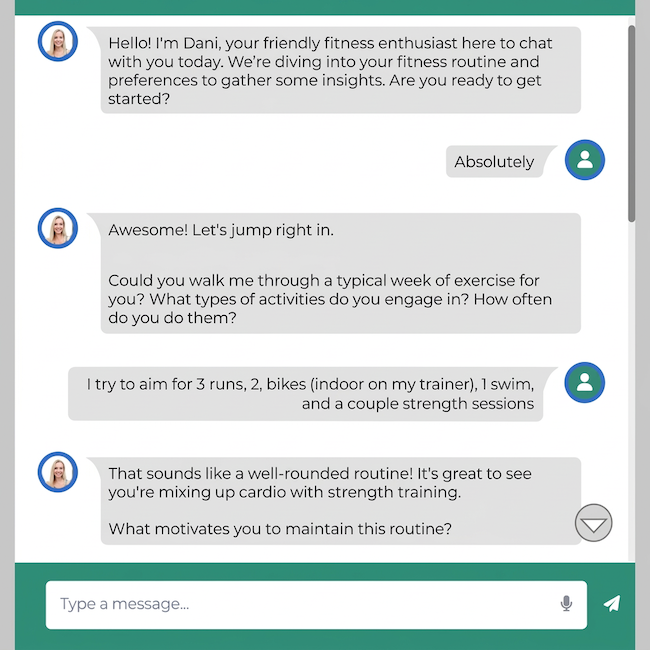
Bellomy’s AI-moderated interview tool supports chat-style conversations with human respondents. Following a researcher-developed guide, the AI moderator adapts its probing within defined parameters, allowing teams to conduct qual at scale.
But human expertise shapes the experience: researchers develop the guide, set boundaries, test the moderator and evaluate early interviews to ensure they’re delivering the appropriate depth and focus.
Bellomy’s Open Ends with AI Probing brings the same dynamic follow-up approach to survey open-ends.
With both approaches, AI-assisted analysis organizes responses, while researchers interpret feedback in context and determine what it means for the business question.
Simulate your audience for quant and qual
There are situations where conducting research is prohibitive due to time, budget or audience access constraints. Bellomy has been conducting proof-of-concept studies with several clients using simulated audiences to predict human survey responses and market outcomes. Simulated audiences are AI-generated representations of people designed to model how specific audiences may think and behave.
A key differentiator is that Bellomy doesn’t train them using survey data. This not only protects our clients’ data but also reflects how we approach simulated audiences: we model them on how people behave, not how they say they behave.
Bellomy combines demographic and contextual information with behavioral science principles to account for the motivations and constraints that shape decisions. This creates more realistic, representative simulated audiences to supplement research with humans.
Research with simulated audiences can help teams explore possibilities, challenge assumptions and sharpen thinking. It can inform next steps but should not be considered as human evidence.
AI personas for qualitative exploration: Chat with your target market
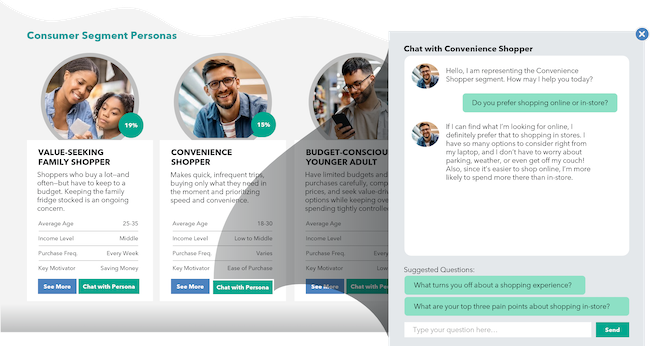
AI can also make existing research easier to revisit and use. Bellomy creates AI personas that represent audience segments as a whole, as well as enhanced synthetics based on individuals. Through Bellomy-provided microsites, stakeholders can interact with personas and ask questions as they arise.
For one client, a synthetic microsite has become a regular tool across teams. Stakeholders have used it to gather initial reactions to product descriptions, campaign ideas and packaging language. The microsite has also helped newer team members learn about the target segments by chatting with personas, leading to increased value and efficiency in their research with humans.
It’s important to remember that most AI tools require rigorous security and governance review. An experienced partner like Bellomy can help organizations navigate that process while protecting their data and setting appropriate boundaries for use.
Conclusion
This year, Bellomy celebrates 50 years of human-led research to help companies make good decisions. That experience shapes how we approach AI today: grounded in the principles of sound research, open to the clear benefits of AI and confident in the value only human expertise can provide. AI expands what’s possible; researchers determine what’s meaningful. That partnership is what turns AI capability into research value.