
Digging beyond the surface
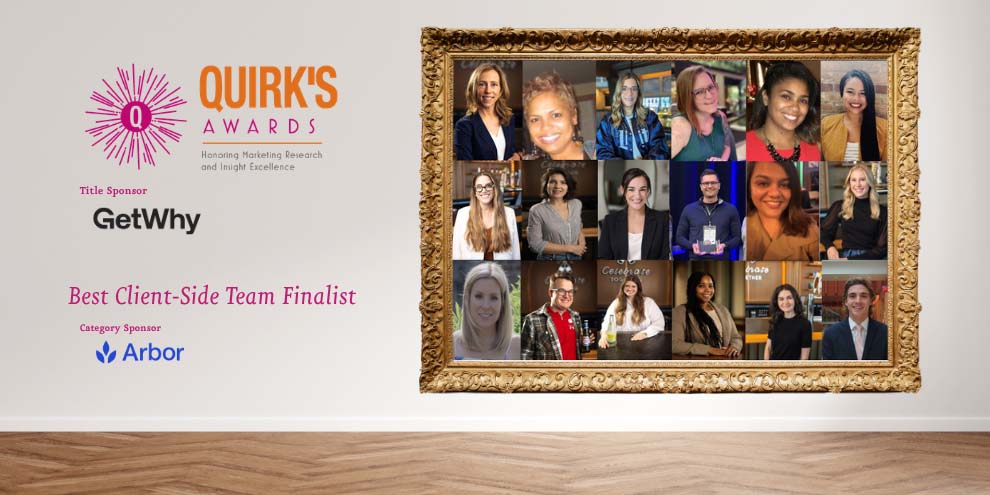
Editor’s note: Molson Coors Beverage Company, U.S. and Canada Commercial Insights is a finalist of the 2026 Best Client-Side Team award, a category in the Quirk’s Awards. The winners of the awards will be announced on November 17 during a virtual celebration. To find out more about the awards, visit QuirksAwards.com.
The alcohol category is evolving at a rapid pace. No team knows this better than the Molson Coors Beverage Company, U.S. and Canada Commercial Insights team, a finalist for the 2026 Best Client-Side Team award. The team leans into speed and agility to ensure the company stays at the forefront of the insights industry. By focusing on an inclusive view of its consumers, the team has been able to weather various storms facing the alcohol category and gain invaluable information to help design solutions.
Kelsey Kemp, director of innovation and Beyond Beer insights, Jessica Brown, director of brand and strategic and enterprise insights and Elizabeth Oates, VP of commercial insights, from Molson Coors Beverage Company, U.S. and Canada Commercial Insights team were asked questions pertaining to their team and how they work, uncovering the intricacies of teamwork in research.
What is one thing your team does to ensure your insights are influential in your organization’s decision-making?
Kelsey Kemp: The alcohol category is evolving at a rapid pace and to support our brands’ efforts to match that speed we have been challenged with providing robust insights at a faster rate. Essentially, we need to ensure we are working at the speed of our business in order to influence it.
Our team leans in with trusted partners to provide quick-turn solutions that meet our needs, including AI capabilities that evolve our standard testing process. Our insights team has developed a committee that evaluates vendor capabilities across our established partners as well as newly introduced vendors to identify opportunities to learn more about new, creative solutions that could fill gaps within our toolkit.
With a focus on speed and agility, new capabilities have been at the forefront of our search, and through that exploration we’ve been able to execute pilots that span across methodologies. Leaning into new solutions has resulted in earlier consumer touchpoints that drive learnings and optimizations for our creative campaigns, packaging refreshes and innovation launches to strengthen our in-market success and maintain a competitive advantage for our brands. This approach affirms the seat at the table for insights in the midst of category evolution.
Describe a challenge your team has faced in the last year.
Jessica Brown: One of the biggest challenges our team has faced is navigating a beverage landscape changing faster than traditional category definitions can keep up. Health and wellness, moderation, evolving alcohol occasions, shifting social connection, new alternatives and shifting consumer trust are changing what people drink, when they drink and why.
Rather than react to each headwind independently, we created Project Jupiter as a strategic compass for the future of beverage.
Project Jupiter helps us get beyond surface-level insights by starting with shared human needs rather than demographic labels alone. We combined foresight, cultural and social signal analysis, expert perspectives and quantitative research with more than 3,000 legal-drinking-age consumers across the U.S. and Canada.
Our sample was balanced across age, gender and region, and we examined important audiences including Gen Z, newcomers, early adopters and alcohol consumers. This allowed us to understand both where needs converge and where meaningful differences emerge.
The result is a richer, more inclusive view of consumers that helps us design beverage solutions around enduring motivations while still recognizing the cultural, generational and regional nuances that make those needs come to life differently.
How do you ensure you are getting past surface-level insights across all beverage consumers despite generations, ethnicities and geography?
Elizabeth Oates: At Molson Coors, we’ve learned that getting beyond surface-level insights requires more than asking people what they think today.
It requires understanding who they are, what they do, why they do it and where culture is headed next. That’s why we’ve intentionally built an insights ecosystem that combines multiple sources and methodologies.
We lean into multisource synthesis that spans everything from deep ethnographic work that immerses us in consumers’ lives to large-scale quantitative analytics-based work that help us understand behaviors, attitudes and future opportunity spaces.
We don’t look at generations, ethnicities or geographies in isolation. Instead, we seek the human needs, occasions and motivations that cut across those dimensions while also respecting what makes each audience unique.
This approach means we're not simply describing consumers. Rather, we're creating a more complete view of who consumers are today, who they're becoming tomorrow and how our brands can earn a meaningful role in their lives. It allows us to guide decisions that serve current consumers while positioning brands and portfolios for future growth.
All in, we are working hard, in partnership with stakeholders and suppliers, to ensure we are pushing our business into the future.