
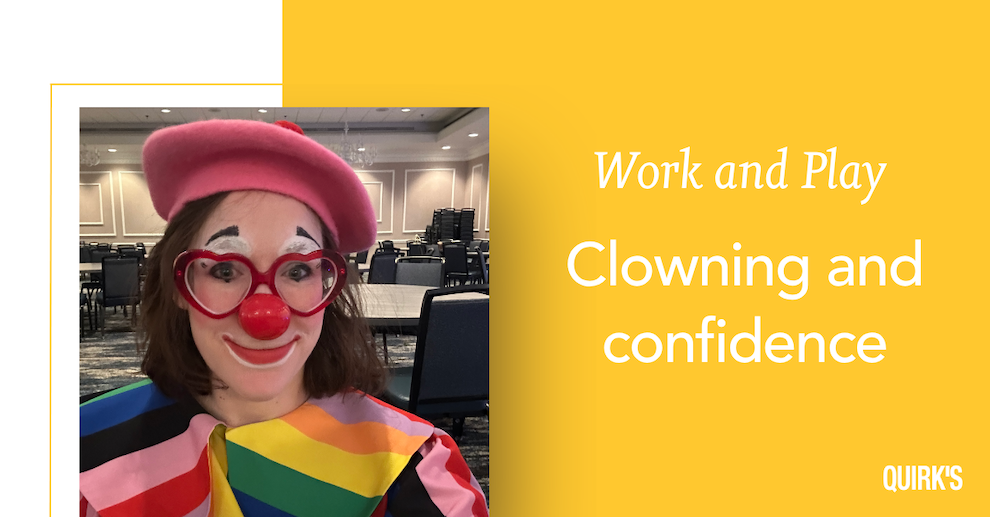
Q&A with Angie Meltsner
Editor’s note: Nancy Cox is the founder/principal at Research Story Consulting, LLC, Kansas City, Mo., with over 30 years of experience in effective writing and research methodologies. She holds a Master of Liberal Arts in business admin and management, and a Bachelor of Science in journalism. Find Cox on LinkedIn.
In this ongoing series with research thought leaders, discover how the research community plays and how that plays out in their work life. In the Venn diagram of work and play, what happens when they overlap?
Angie Meltsner is the founder of research studio Tomato Baby. Her education includes a Bachelor of Arts in marketing from Michigan State University and business studies at Aalto University, Helsinki. She has completed courses in semiotics including Advanced Semiotics Masterclass from The Market Research Society (MRS). Meltsner is a member of the World Clown Association and Clowns of America International. She has attended the Northeast Clown Institute plus completed (and actively takes) clowning workshops, classes and performances, most often at The Rockwell theater.
Hello Angie Meltsner, Founder and Principal Insights Consult at Tomato Baby
What is the play in your life?
My main form of play is clowning. I never thought that I’d find clowning, the philosophy/theory and the actual practice, so fascinating or that I’d find so much joy and humor. I love that making people laugh can come from anywhere but especially from failure. A lot of clowning comes down to accepting failing at whatever you’re trying to do.
I first heard of clowning through writing. I took a cultural-criticism workshop where the teacher offhandedly mentioned clowning, a style of alt-comedy, as a way to really understand your body and as a kind of anarchistic improv. That stuck with me as I’ve seen people post about improv helping with their work. I searched “clown class near me” and much to my delight there were classes starting in a few days, in my neighborhood.
Then I found myself writing about my clown classes in my “The Artist’s Way” morning pages – what was funny, what was nerve wracking, how I felt. One day when I was reflecting on work, I wrote, “What kind of job can I have that means I won’t have to go on LinkedIn ever again?” and I made the connection – clowning! That’s how I got into kids’ clowning. I do begrudgingly recognize that LinkedIn is a good tool as a professional researcher.
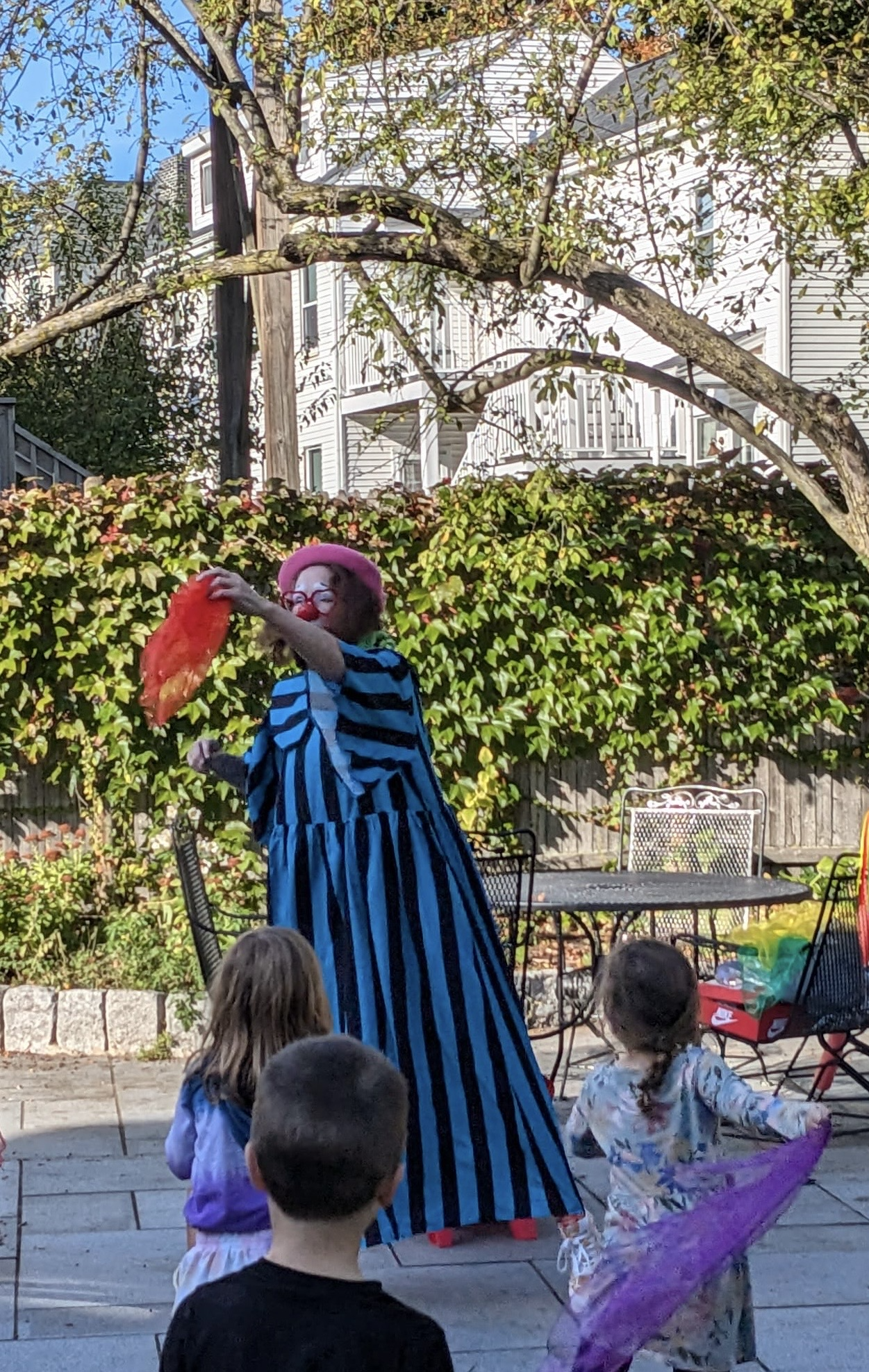
Now, I’m Plums the Clown! I’m a children’s entertainer clown for birthday parties and events. Red nose, colorful costume, balloon animals, magic tricks and all. When I started, I also had a built-in audience to test material — my now seven-year-old daughter and her friends. My daughter is a critic, for sure, but she is also my biggest fan.
I still take the clowning comedy classes, no red nose or makeup. Think of Lucille Ball in “I Love Lucy,” she’s a comedic clown. She’s solving problems in the most absurd ways possible with a lot of physicality. She’s wholeheartedly committed to her ideas and has this sense of eternal optimism. We love her for that.
Both styles of clowning are about being silly and having fun. It differs from acting or improv as there’s no fourth wall. You acknowledge the audience, you make eye contact, they help inform the performance. You’re constantly checking in with them – are they silent but intrigued? Losing interest? Laughing at you? To be a clown, you must be comfortable with people laughing AT you. That can be scary! But that’s what you’re there for.
What gets the biggest laughs from kids are the silliest, simplest things done in big, over-the-top ways. Kids love it when I’m carrying too many things and I keep dropping something. The kids like to feel like they’re smarter, cooler than me. Four-year olds are my best audience for my Plums’ material.
Adults are harder. In class, an idea I think is funny and plan for often doesn’t work. Sometimes if I do make my classmates laugh, I don’t really know why. So I’ll do the same exact thing again until it doesn’t work anymore – that is the clown way. The less I think the better I do because a clown is not supposed to be clever or smart.
How has your play influenced your research work?
Clowning has made me more playful, creative and confident. I’ve always tried to creatively interject lightheartedness or silliness when there is a sliver of opportunity to do so, but now I’m even more committed. The confidence I’ve gained from clowning spills over into everything. I accept that even as a researcher who knows her material, I will never know everything about my client’s business or the category I’m working in. It’s OK not to be the smartest person in the room — a clown should be the stupidest!
Clowning has also made me a better listener. A clown is always listening to hear the audience laughing … or not. There’s a clowning class exercise where you’re on stage with the goal to walk forward across the room, but you can only step forward if you make people laugh. If no one laughs, you step backwards. You’re very focused on listening because hearing even the slightest laugh, you can step forward. Funnily enough, you often get a laugh when taking a step back, because the audience likes to see you recognize that failure.
An unexpected work bonus is a whole new sphere of subculture I can integrate with cultural insights. For example, Connor Storrie, one of the stars of “Heated Rivalry,” has brought more attention to the craft because he talks about the influence of his clowning training on his acting. Clowning shows are getting attention on platforms like YouTube and Netflix, while live clown show runs, like Natalie Palamides’ “Weer,” are selling out. So are clown workshops and classes, even in Boston. Now I’m asking how does clowning filter into brands or my research? How are people who are not clowns looking for and finding joy in the world? How does clowning relate to the kidulting movement like adult summer camp?
I’ve fully nerded out on clowning as a field of study including the history, archetypes and semiotics. I’ve learned there’s a lot about status, how playing with status is a fun way to get laughs when you’re with other clowns. For example, clown makeup and costume traditionally signals hierarchy — the full whiteface, think sad Pierrot with the ruffled collar, that’s the highest status clown. They’re not getting a pie in the face. But the lower status Auguste clown with the white just around the eyes and mouth? That’s my Plums clown type. I’m getting the pie in the face.
What would you tell readers who want to know more about your area of play?
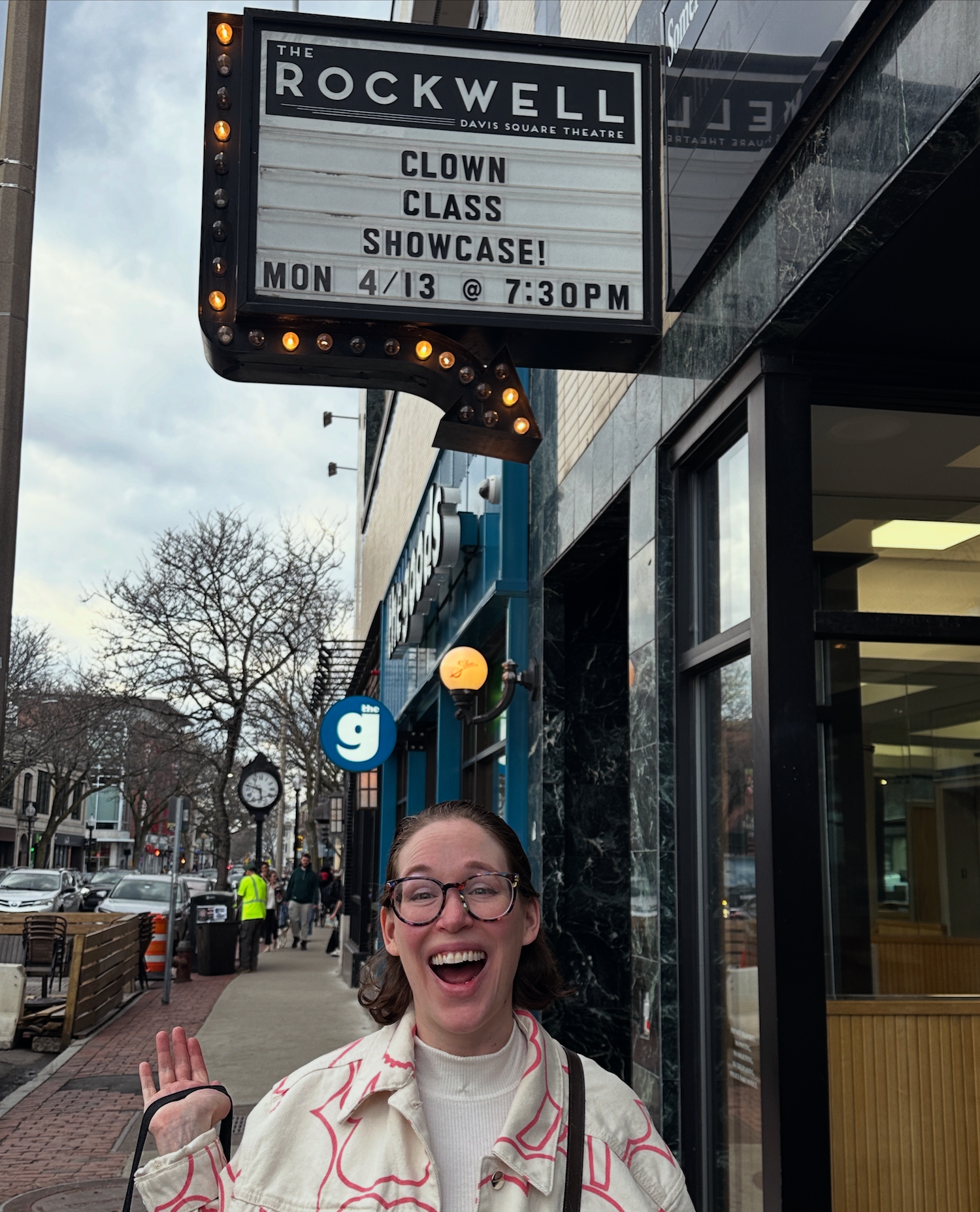
If you’re wanting to take a clown class, do what I did – search “clown class near me.” There’s a big variety of workshops and classes. You might take a class one day a week for eight weeks or find a one- or two-day workshop. Clowns touring their shows sometimes offer a workshop the day before and/or after the performance.
There are so many reasons to take clown classes. Yes, you’ll learn some practical skills such as being comfortable on stage but you’ll also get the chance to accept failure, embrace vulnerability, practice listening, be stupidly silly, play and have fun!