Editor’s note: Kent Rogers is a senior project director for St. Louis-based Maritz Marketing Research Inc.’s Agricultural Division. This article originally appeared in the 1995 CASRO Journal. It is reprinted here with permission.
Marketing researchers must often provide perceptual maps, or maps of a marketplace that provide insight into relationships between criteria relevant to important decisions. The following discussion focuses on one type of perceptual map - correspondence analysis.
Correspondence analysis is an exploratory method of data analysis that visually displays relationships between categorical variables. As such, it is highly suited for showing association between elements of cross-tabulated variables as points on a map.
Small distances between points indicate high association, while large distances indicate low association. Correspondence analysis is most useful in displaying relative strengths and weaknesses and provides a strong framework for presenting conclusions. It is also useful as a preliminary method of investigating patterns in data.
Keep in mind that correspondence analysis is an exploratory tool, because it is an aggregate procedure. It operates on a summary matrix of data (the cells in a cross tabulation). In contrast, disaggregate methods, such as factor analysis, operate on respondent-level data. With correspondence analysis, information on individual differences is lost. Statistical significance, while available based on a chi-square distribution, is not an issue because there is no initial variance within cells.
Correspondence analysis provides a useful alternative in interpreting data that is not conducive to disaggregate methods of analysis.
Since correspondence analysis is designed to analyze data within a contingency table, data requirements are flexible. For instance, it can be used with binary coding (where attributes are checked "yes" or "no").
Correspondence analysis can also be helpful with scales that have a narrow range of response. If responses are heavily clustered around the top points on a scale, as is frequently the case in satisfaction research, then the application of methods such as factor analysis or multiple regression may lead to disappointing results.
How does correspondence analysis work?
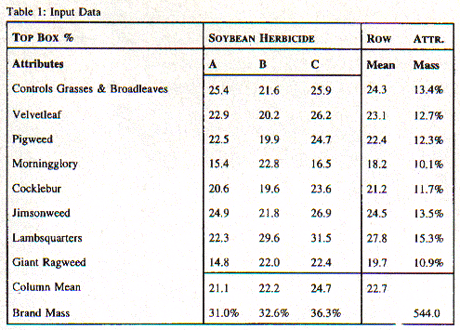
Table 1 shows sample data that lends itself to correspondence analysis. It is a table of top-box performance scores for three soybean herbicides, rated by growers on several attributes related to weed control. The columns show scores by brand across attributes, while the rows show score distributions on particular attributes across each brand. These row and column distributions are called profiles. They represent the row or column categories, which are called elements. It is association among these elements that correspondence analysis portrays.
 Correspondence analysis balances the row and column profiles and displays each as points on a map. Each element has a mass associated with it, which is the relative overall response frequency. The mass and the shape of the distribution determine the location of an element’s point.
Figure 1 shows the results of correspondence analysis for the sample data. This solution was produced by Mapwise, one of several programs available for correspondence analysis. In the plot, associations among the three soybean herbicides, and individual weed control attributes are apparent. Relationships among attributes are also displayed.
The solution
The solution starts by using the average row profile (across attributes) and the average column profile (across brands) to find a centroid, or a center of gravity, to serve as a benchmark for the map. The map is centered around the centroid. Distances from individual points are minimized to this centroid, creating a common point of reference allowing us to compare distances between points.
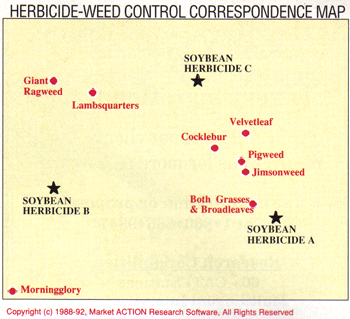 n interpreting the sample map, brands are described in terms of the attributes that are closest to or farthest away from them. First notice that the three brands are far apart on the map, indicating that customers may have unique perceptions of each.
Also, notice that the attributes "morningglory," "giant ragweed," and "lambsquarters" are located apart from the rest of the attributes. This suggests that these weeds may have unique properties that impact customers’ perceptions.
A brand’s relative strength or weakness is implied by its proximity to attributes on the map. A short distance implies relative strength, and a large distance implies relative weakness. To illustrate this point, observe the position of Herbicide A in relation to "controls both grasses and broadleaves."
Looking at the data for this attribute, Brand C is rated higher than Brand A. Why is the attribute located next to Brand A? The rating for Brand A for "controls both grasses and broadleaves" is over four points higher than the column mean for Brand A, while the rating for Brand C is only one point higher than its respective column mean. Therefore, Brand A is relatively stronger on this attribute than Brand C, and this strength is depicted by closer proximity on the map.
As mentioned earlier, it is important for correspondence analysis users to keep in mind the exploratory nature of the analysis and the qualitative nature of the conclusions that can be drawn. Correspondence analysis is best used as a visual framework for discussion of results or creating hypotheses about the data.
In fact, the best way to use correspondence analysis is in conjunction with other analytic techniques. A correspondence map can provide a context of association in which to visualize information from other sources.
For instance, correspondence analysis can be combined with vulnerability analysis. Showing associations between brands and attributes provides a convenient backdrop for discussing the potential effects on the market of brands vulnerable on certain attributes.
Correspondence analysis can serve as a display alternative, or it can be used in conjunction with charting techniques. For instance, with radar charts we can view multiple attribute ratings for a group of products. Correspondence maps focus on the association of brands and attributes, while radar charts show the absolute levels of attribute ratings.
Correspondence analysis is also useful for summarizing conclusions. By plotting associations among the most important elements of a study, a correspondence map can serve as a visual framework for emphasizing study implications at the end of a presentation.
So, if you are wondering whether correspondence analysis is appropriate for your situation, just ask yourself if it will contribute to your point. The ability of correspondence analysis to reduce a complex data matrix to a simple plot displaying marketing variables as related points on a map offers a unique advantage for research users. If a researcher keeps limitations firmly in mind, the use of correspondence analysis can be a valuable enhancement to the analysis of a study.