
Lady Boomers talk up Kraft, other brands
Baby Boomer women (ages 43-62) talk about Kraft more than any other packaged goods food brand, according to research results released by Rodale’s Prevention magazine, in partnership with the TalkTrack study, conducted by New Brunswick, N.J., research company Keller Fay Group. Right up there with Kraft, Folgers is the brand that Boomers are more likely to talk about in comparison with younger women.
The difference between the young and the not-so-young is also significant beyond what coffee is in your cup. The study’s tracking of a year’s worth of online and offline conversations determined that Boomer women have higher-quality word-of-mouth (WOM) than younger women do; that is, the conversations are more credible, and Boomer women are more likely than younger women to pass on what they hear to others, to seek additional information and to actually purchase the products talked about.
In fact, Boomer women had higher purchase intent than younger women for 14 of the 15 product categories tracked, the only exception coming in media and entertainment. The most positive WOM from the Boomers occurred in beauty and personal care, where they surpassed younger women in all six quality criteria measured: recommendation, credibility, pass-along, additional info-seeking and purchase intent. The top talked-about brand in the category was Olay, followed by Dove, Avon, Pantene, Suave, Bath & Body Works, Mary Kay, Crest, L’Oreal and Revlon.
Food was also a highly-ranked category. Following Kraft, the most talked-about packaged goods brands by the Boomer women were Stouffer’s, Campbell’s, Lean Cuisine, Kellogg’s, Tyson, Weight Watchers, Gerber, Healthy Choice and Betty Crocker.
Overall, in comparison with younger women, Folgers was followed by Olay, Avon, Walgreens, Pantene, Kraft, Lipton, JC Penney, CVS and Olive Garden.
 Feeling hassled? You’re not alone!
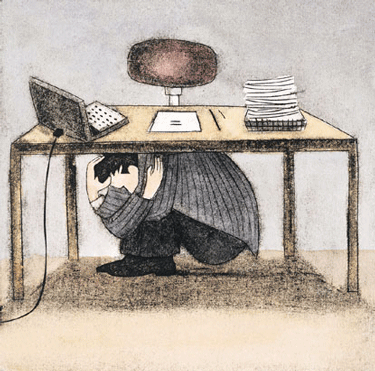
Rising prices are a major hassle in Americans’ daily lives, as 82 percent of Americans say they have been experiencing them, an eight-point leap from 2006, according to The Harris Poll from Rochester, N.Y., research company Harris Interactive. Suffice it to say, hassles cause stress, and some appear to cause more stress than others.
Just under half of Americans say they have experienced trouble sleeping and have concerns about health in general. Other woes experienced by more than one-quarter of Americans include not having enough money for basic necessities (35 percent), illness of a family member (29 percent), being lonely (27 percent) and having too much information to process at one time (25 percent). With only two exceptions (abuse of personal privacy and problems with work), women are more likely than men to have experienced each of the daily hassles on the list.
Certain demographic groups have more stress than others. One-quarter of Americans say they have experienced a lot of stress, and geography may factor in as fewer Midwesterners experience a lot of stress than their Eastern counterparts (22 percent versus 32 percent). Generation X has the most stress among the generations (33 percent); three in 10 Hispanics say they have a lot of stress compared to 26 percent of whites and 21 percent of African-Americans; and one-third of those with children in the household say they experience a lot of stress while just 23 percent of those without children say they experience a lot of stress.
Burger King skivvies top 2008’s most laughable line extensions
What do Burger King underwear, Kellogg’s hip-hop street wear and Allstate Green insurance have in common? They all were voted among the worst brand extensions of 2008, according to Kenneth Hein’s December 12, 2008, article “BK Boxers Leads Pack of Worst Line Extensions,” in Brandweek.
TippingSprung, a New York Research company, polled almost 700 Brandweek readers and other marketing professionals online about 2008’s flurry of line extensions. Among the other duds: Coca-Cola’s RPet clothing at Wal-Mart, a Playboy energy drink and the Disney Sleeping Beauty executive fountain pens, priced at up to $1,200.
TippingSprung has been conducting the survey for five years. In past years, Precious Moments coffins, Hooters airlines, Cheetos lip balm and Salvador Dali deodorant won the dishonor of being selected for the list.
This year a number of factors, namely the rise of green marketing and the fall of the economy, helped shape some of the marketers’ selections. Allstate Green insurance was spotlighted as a prime example of greenwashing (overstated or misrepresentative green claims made by marketers), according to three-quarters of respondents. The program offers paperless statements (like most institutions) and a $10 donation to an unspecified organization.
Likewise, Coke’s RPet clothing line, made from recycled bottles, suffers from the fact that its plastic packaging is viewed as being a big part of the problem. Almost 58 percent of respondents viewed the RPet line as more greenwashing than green. The Sleeping Beauty pen was selected by a third of respondents, followed by the Porsche Design Kitchen and its $100,000 price tag.
Still, the Burger King underwear was selected as the single most-inappropriate line extension, according to 45.5 percent of those polled. “Marketers are so in love with their brands that they think consumers are as well and will go to the lengths of wearing their brand name on their underwear,” said Laura Ries of Ries & Ries, a Roswell, Ga., brand consultancy.
Kellogg’s hip-hop street wear was second worst (22.8 percent), followed by Kanye West’s travel site (kanyetravel.com).
Of course, not all of the product rollouts were bad. Campbell’s V8 Soup was selected the top beverage extension. Nearly 77 percent of marketers said it was a good idea. It is worth noting that the beverage category is notorious for its misses, as illustrated by 2008’s flops, including Rolling Stones Icewine, Dr. Dre sparkling vodka, the Playboy energy drink and even Twinings coffee.
Coppertone sunglasses and Mr. Clean performance car washes were named the best brand extensions, according to 31.2 percent and 25.7 percent of respondents, respectively.