
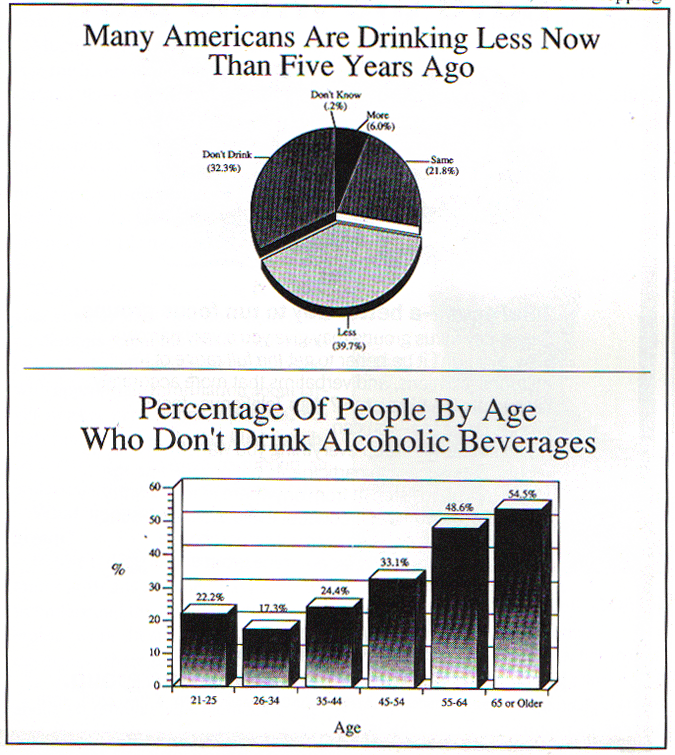
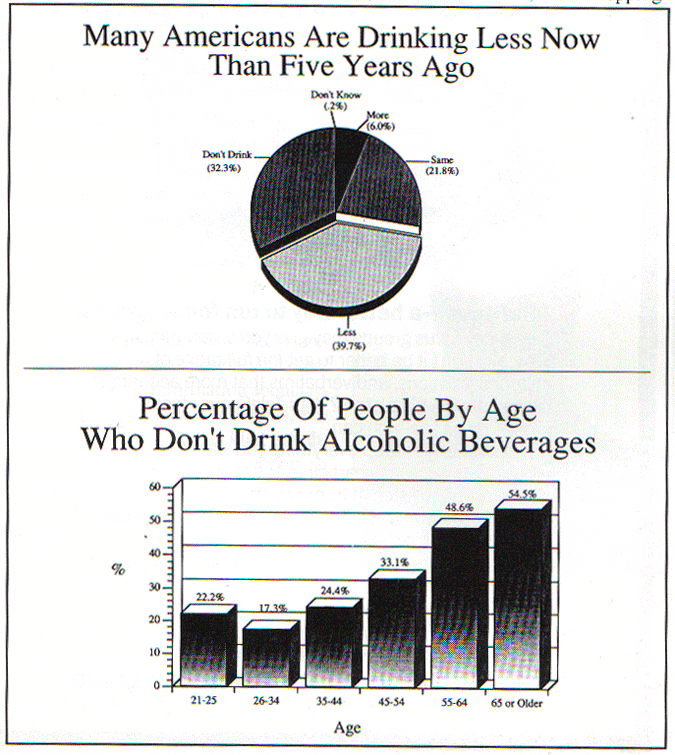
Survey shows that Americans have reduced consumption of alcohol
Results from a survey conducted by Maritz Marketing Research Inc. show a large number of Americans have reduced their intake of alcoholic beverages in the past five years. Overall, 40% are drinking less, while only 6% disclose they are consuming more alcohol than in 1986. According to the telephone survey, conducted nationally, 44% of men and 35% of women are drinking less. About one-third of the population doesn't drink at all, including 24% of men and 40% of women.
"Drinking is down across all ages," says Beth Nieman, research manager at Maritz. "In fact, after reaching age 26, there is a trend toward not drinking at all. Seventeen percent of 26-34 year-olds don't drink - which increases to 24% of those 35-44, 33% of those 45-54, 49% of those 55-64, and a whopping 55% of people 65 or older."
Campaigns aimed at curtailing drunk driving are working according to the majority (78%) of those who participating in the survey. Seventeen percent rate programs that target reduced drunk driving "very effective." Most (61%) think they're "somewhat effective." Both men and women agree the campaigns are working.
When it comes to non-alcoholic (NA) beers, most Americans (54%) are unaware they're available. At the same time, 23% who've heard of NAs can't name a specific brand. "Only the new entrants into the market, Sharp's and O'Doul's, have a significant awareness level," Nieman says, "which is probably a direct result of their investment in advertising. Here's how the brands ranked among Americans who are aware of NAs:
- Sharp's (9%)
- O'Doul's (6%)
- Moussy(1%)
- PabstNA (1%)
- Kaliber(1%)
Men are more aware of non-alcoholic beers than women (51% compared to 41%). Generally, the younger the person, the more familiar he or she is with NAs. For example, the majority of people (60%) in the 21 -25 age group are aware of non-alcoholic beers, compared to 56% of those 26-34,47% of those 35-44, and 38% in the 45-54 age group.
When interviewers asked respondents who were aware of non-alcoholic beers if they have ever used them to reduce their intake of alcohol, 12% said yes. A greater number of men (14%) than women (9%) have used NAs to cut consumption of alcohol.
Teens say they respond to environmental themes in advertising
Teenagers claim they are most likely to purchase one product over another when an environmental theme is used in advertising. This is one of the findings in a new study by Teenage Research Unlimited (TRU), Northbrook, Ill. Its survey of 2,128 persons, aged 12-19, explores the continuing impact of teen consumers.
When asked which advertising strategy would be most persuasive, 82 percent of teens said they would be likely to purchase one product over another when an environmental safety claim is made. In fact, 49 percent said they were "very likely" to make a product choice based on an environmental theme.
This finding is consistent with teens' attitudes and behavior towards the environment. In fact, 86 percent of teens say that caring about the environment is "in," 63 percent of teens regularly recycle cans and bottles, and 48 percent look for "environmentally friendly" products.
"More teens than ever are not only concerned about the environment but are actively doing something about it," says Peter Zollo, TRU president. "Teens view purchasing environmentally safe products as a way of making an environmental statement."
Other advertising strategies that will persuade teens to purchase one product over another include: quality claims (37 percent very likely); lifestyle claims (34 percent very likely); health/nutrition claims (26 percent very likely); and fun claims (21 percent very likely).
The study projects that today's 27.1 million teens will spend $82 billion on products and services for themselves and their families in 1991, representing a 3.5 percent increase over last year. This increase is a result of teens spending more of their own money vs. family money. Teens will spend $54.9 billion of their own money (an 11 percent increase) and $26.9 billion of family money (an 8 percent decrease) this year.
Teen earning power is also up from 1990 - a 6.5 percent increase. Teens in 1991 are projected to earn $94.7 billion compared with teens in 1990 who earned $88.9 billion.Males and females spend approximately equal amounts of money total. Females spend more family money than males ($24 a week vs. $18), and males spend more of their own money ($41 vs. $34). The reason for the difference: females do more family shopping and males are more likely to be employed.
As expected, older teens spend sig-nificantly more money than younger teens. Eighteen- and 19-year olds spend $101 each week compared to $60 for 16- and 17-year olds and $37 for 12- to 15-year olds. More than 70 percent of teens maintain a savings account and nearly half of 18- and 19-year olds have checking accounts.
Few plan to purchase new car soon
A recent TELENATION survey by Market Facts, Inc., 1000 adults were asked "Does anyone in your household intend to purchase a new vehicle in the next six months for personal use?" Only 12% indicated that a new vehicle purchase was planned, while 86% answered "no", with 2% in the "don't know/refused" category.