
Credit card holders lack confidence in the economy
When asked to identify which of five factors would encourage them to spend more and help boost the economy, nearly a third (30 percent) of respondents surveyed by Visa U.S.A. said a five percent increase in salary would be most encouraging. The survey of 1,000 credit cardholders was conducted for Visa by The Gallup Organization. Only 12 percent of respondents said a five percent reduction in state or federal taxes would help. As few as 10 percent of respondents felt a reduction in credit card interest rates to 14 percent would most motivate them to spend.
The study revealed that credit card owners still lack confidence in the economy; 62% of respondents said the economy is worse now than six months ago. Only 23 percent felt economic conditions were better today than six months ago. Age and household income affect confidence levels with adults 34 and under and individuals from higher income households ($50,000 or more) feeling more optimistic than other groups. The study also revealed that more than half of the respondents were insecure or only somewhat secure about their household's economic status.
The study also probed cardholders on their attitudes toward credit cards. Nearly three quarters of respondents felt that having a credit card was somewhat important to them. In fact, 40 percent consider a multi-purpose card to be extremely or very important.
When asked to rate eight possible reasons for owning a credit card, cardholders cited use in emergencies as the most important reason (78 percent). Emergencies were also chosen by the larger proportion of respondents when asked to choose among seven usage situations for which multi-purpose cards were most valuable (33 percent).
Half of all cardholders questioned report decreasing their total household debt in the past six months. Nearly half (49 percent) of those using a Visa or MasterCard in the past three months reduced their bankcard debt compared to six months ago.
Reflecting their uncertainty over the economy, over half of bank cardholders surveyed report using bankcards less frequently now than six months ago, while slightly under half plan to use them less often in the next six months. Far fewer individuals (31 percent) in the 55 and over age group plan to reduce spending on credit cards.
Rack 'em up: billiards growing in popularity
According to the Billiard & Bowling Institute of America's National Billiards Participation Study-1991, 39.2 million Americans over the age of six played billiards once or more during 1991 and 10.3 million played the sport 'frequently' (25 days or more).Billiards continues to rank as a popular activity in the U.S., placing just behind basketball in the number of general participants. Only bowling, freshwater fishing, and camping have significantly more participants. With 10.3 million frequent players in 1991, billiards surpassed bowling to become the top-ranked recreational activity by this criterion of frequency. Since 1987 the number of new participants has grown to 5.8 million, a 26% increase.
The growth in billiards participation since 1987 is attributable to growth among less frequent players (under 12 days per year) +14.7%, the 35-54 age group (+22), members of households with $50,000+ income (85%) and residents of the Western and Northeast regions. Among states having over four million inhabitants, Wisconsin and Minnesota have above average per capita participant rates.
Women cite most-hated manners infractions
According to a new nationwide survey conducted by Victoria magazine, today's etiquette infractions have taken on a distinctly modern twist. At the top of the list of the most glaring examples of bad manners is when people "do not use their directional signals when driving," said 66 percent of the all-women poll. It is enough to make an Emily Post devotee lean on her horn.
Clearly the backlash of technology and our frenetically paced lifestyles have affected our perceptions of what constitutes "good manners." The telephone company's "call-waiting" feature, for instance, took fourth place on Victoria's roster of rudeness. Forty-nine percent of the women call it a frequently encountered example of poor form. "Too many items for the express line" offend 34 percent of those surveyed. People who "steal parking spaces" and who "cut in line" are an affront to 21 percent and 16 percent, respectively, of those polled.
Other examples of scurrilous behavior from the survey include: People who "do not pick up after their dogs," encountered by 37 percent of the women; "asking one's age, salary or weight" angers 30 percent of those surveyed; and people who "don't return phone calls" irk 21 percent.
Although Barbara Bush and Nancy Reagan have owned up to "recycling gifts," 23 percent of those polled frequently encounter the practice and condemn it. "Passionate displays of affection" still disturb 24 percent of the women polled. But the oft-scorned cigarette smoker actually received a break in the survey: Smoking was one of the least offensive displays of bad behavior, with 1.3 percent of the vote.
Some of the conventional displays of bad manners are as popular as ever. When someone "interrupts or does not listen" was the second most frequently encountered offense, said 60 percent. "Not saying please and thank you" ranked number three in impolite behavior, with 55 percent of the vote. And "not showing up after accepting an invitation" is still a social sin to 33 percent.
Study examines opinions on raising a family
A study of attitudes about the family by Glendale, Calif.-based Barna Research Group, Ltd. show that four out of ten Americans feel that "raising children these days is probably not as much fun as it used to be." Twenty-one percent agreed strongly with this, and another 20% agreed somewhat. Twenty-two percent disagreed somewhat, and 32% disagreed strongly that parenting has lost some of its pleasure.
People between the ages of 18 and 46 - those in the dominant child-rearing years - were not as likely to see parenting as less enjoyable than it used to be, compared with older adults. However, there were no differences in opinion between those who were raising (or had raised) children, and childless people.
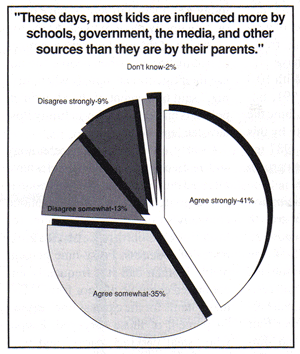
One of the perceived problems with parenting today is that many people believe outside sources have more influence on kids than parents do. Most Americans feel that "these days, most kids are influenced more by schools, government, the media, and other sources than they are by their parents."
Another potential problem parents face today is a simple lack of time. Apparently, most Americans see this as unfortunate, because they believe that "to raise children properly, a parent must spend a lot of time with each child every day." Forty-six percent of the respondents agreed strongly with this, and another 26% agreed somewhat. Again, the youngest and oldest respondents were the ones most likely to feel strongly about this issue.
Even though most people felt a lot of time is needed to raise a child, they were really more concerned with the quality of the time spent than the amount. Fifty-six percent felt strongly that "it is more important that a parent spend quality time with a child than spend a lot of time with the child." Another 27% agreed somewhat with this.
A common response by parents to being in a dual-career household or having a lack of time is to place children in daycare. Many Americans, however, have concerns about the effect this has on a child. Thirteen percent agreed strongly, and 19% agreed somewhat, that "enrolling a child in a good day care facility can leave long-term, negative effects on the child." Only 28% disagreed strongly with this attitude. Older adults were more concerned about daycare' s effects on kids than were other Americans.
Another challenge facing parents is the shift in the family structure. One study estimated that almost half of all kids born between 1970 and 1984 will have lived in a single-parent household by the time they are 16. Americans were split on the fairness of this type of arrangement to the kids.
Twenty-one percent of the survey respondents agreed strongly that "it's not fair to a child to be raised in a household in which its parents are not married and both living in that home." agreed somewhat with this. Thirty-fourpercent disagreed somewhat, and 23% disagreed strongly. Older respondents and people with kids were particularly likely to agree with this statement.
Execs worried about health care, economy
Managing health care costs are dealing with a changing economy have become nearly as important to the nation' s top business executives as cutting government regulations and taxes, according to a new national survey by Newstrack Executive Tape Service, Blackwood, New Jersey.
While 54 percent of the 361 CEOs and other senior executives surveyed listed regulation and tax cuts among the top three challenges facing U.S. businesses, 52 percent also listed dealing with a changing economy and 50 percent cited managing health care costs and issues.
The survey also found that 29 percent of those studied believe cutting the federal deficit should be the top priority of the nation's next president. Some 21 percent said the new president should focus on more business deregulation. Fourteen percent said tax reform should be the top priority.
"It's clear that the nation's business leaders remain deeply concerned over government regulation hindering the growth of their businesses," says Don Bagin, Newstrack president. "But there is a growing concern about the ability of businesses to keep pace with rapid economic changes, as well as the devastating cost increases and growing complexities of providing health care for workers," Bagin says.
Looking inside their companies, 31 percent of those surveyed cited building and keeping employee loyalty as today's top business challenge.
VCR/TV ownership high in Hispanic households
A large majority of U.S. Hispanic households have more than one television set and a VCR, with RCA and Panasonic having strong positions in both categories, according to a study conducted by Market Development Inc. (MDI), San Diego.
The MDI Hispanic Poll indicates that 99 percent of those polled have at least one television set, with over two-thirds having at least two. Nearly three-fourths of households with a television also have a VCR, though less than one in five has one.
RCA appears to be in a particularly strong position, as it is tied with Zenith (20% apiece) for the lead in the television-ownership category and was the second-leading brand (behind Panasonic) in the VCR-ownership category with 10 percent.
The number of television sets and VCRs owned by a household is strongly related to household income level. Households with over $40,000 in annual income are more than twice as likely as those with under $15,000 to have three or more television sets and are almost four times as likely to own two or more VCRs.
The strong relationship between income and multiple-unit ownership explains why Hispanic households in Miami, where income is highest, are much more likely to have three or more televisions (i.e., 40% vs. 28% for the second-place market, San Antonio). It also accounts for the fact that Spanish-dominant respondents, whose incomes are somewhat lower, are much more likely to live in single-television households than English-dominant respondents (i.e., 37% vs. 22%).
According to the MDI study, the num-ber of television sets and VCRs in a household is also related to household size, especially among higher-income respondents. Among households with incomes of $40,000 or more, those with four or more people are about twice as likely than those containing two persons or less to own three or more televisions and two or more VCRs.
"The relationships between income, household population, and multi-unit television and VCR ownership in our study mirror those found in surveys among the U.S. population as a whole," says Roger Sennott, general manager of Market Development, Inc. "For example, nearly half of total U.S. households with children have three or more television sets, compared to less than a third of the total population."
The poll also asked respondents whether and from whom they would seek advice from when buying con-sumer electronic equipment such as a television or VCR. Though 72 percent of those polled said they would seek advice, the tendency to seek advice was more common among females (80%) than males (62%). Of those who said they would seek advice, gender and birthplace were the variables that had substantial impact in determining the source of such advice. Foreign-born females were more likely to seek advice from personal acquaintances than from expert sources (75-47 percent), but U.S.-born males exhibited just the opposite tendency (46-69 percent).
Both groups also differed dramatically in the type of personal acquaintances and expert sources they would consult before making a purchase decision. Foreign-born females are almost four times as likely to seek advice from family members rather than friends. U.S.-born men were almost equally likely to consult a family member or friend. Foreign-born females who said they would seek advice from expert sources were more than five times as likely to seek it from an individual (e.g., a salesperson), as opposed to an impersonal source (e.g., Consumer Reports magazine). U.S.-born males who favored the advice of an expert source, preferred the advice of a salesperson to that of, for example, Consumer Reports, 47-32 percent.