
Men most likely to put off Xmas shopping
If it's the night before Christmas, you can bet that someone you know is dashing breathlessly through shopping malls and discount stores trying desperately to finish their holiday shopping. And according to a Maritz AmeriPoll, it's most likely a man. Of the more than 56 million Americans doing some last-minute shopping on Christmas Eve, 56 percent are men.
A well-organized 30 percent of survey respondents say they finish their holiday shopping at least two weeks before Christmas; 23 percent are done between one to two weeks early, and 14 percent finish up in the two to six days before Christmas. The rest either wrap it up by December 24th (28 percent) or are still stalking the aisles on Christmas - or later (5 percent). As a general rule, the older you are, the earlier you get your shopping done.
This last-minute purchasing phenomenon is not without its original good intentions. Most Americans (83 percent) say they generally begin shopping for gifts at least one month before Christmas: 31 percent start one to two months ahead, 22 percent two to four months, 12 percent four to six months, and 18 percent begin six months or more ahead. There are those, however, who start and finish their holiday shopping less than one week before Christmas (5 percent) - and they're twice as likely to be men. Those who begin buying earliest (six months or more before) tend to be age 55 and older.
Consumers search for that perfect gift through a variety of resources, but most popular by far are department stores (72 percent make holiday purchases there) and shopping malls (71 percent), the latter being the most popular with the age 18-24 set. Other sources include:
- discount stores such as Wal-Mart or K-Mart (56 percent);
- catalogs (44 percent);
- specialty shops and boutiques (35 percent);
- handmade/homemade gifts (22 percent);
- Internet shopping (8 percent).
Of some note, frequency of Internet shopping was fairly steady across age groups (there was a drop-off among those 65 and over), but increased steadily across income lines, from 4 percent in the $25,000-and-under income range to 14 percent in the over $65,000 category.
Many retailers bank on consumers spending that little extra on something for themselves while they're buying for others. Nearly 61 percent of holiday shoppers say they make unplanned purchases for themselves when out shopping for gifts. Respondents estimate they spend an average of $118 on unplanned purchases for themselves during the holiday season. Men tend to be more impulsive than women, spending an average of $132 on unplanned personal purchases, compared to $103 for women.
Maritz AmeriPoll is conducted by St. Louis-based Maritz Marketing Research. Results are based on telephone interviews with American adults. Accuracy of the results is within ±3.09 percent.
U.S. companies welcome as smoke clears from F1 racing
When the European Union directive banning tobacco advertising finally clears the smoke from Formula 1 auto racing sponsorship, American companies may find a clear road ahead in the race to build brand awareness.
With a Formula 1 championship race scheduled to take place in America next year, just how would European Formula 1 fans react to the idea of American companies sponsoring the sport? Over four-fifths (82 percent) of European F1 fans questioned in a study conducted by Performance Research Europe indicated that involvement in the sport by American companies would be either "very" or somewhat appropriate." Performance Research Europe is a division of Performance Research, Newport, R.l.
However, this doesn't mean that any U.S. company with money to spare can succeed or would be welcome in Formula I. When European fans were asked during aided questioning which companies best fit with their image of FI racing, over three-quarters (78 percent) cited beer brand Budweiser, making it the company most often-mentioned. followed by Coca-Cola (77 percent), IBM (77 percent) and American Express (72 percent). The brands that failed to impress these fans included Cadillac and Sears.
The research also suggests that American companies already involved in U.S. motorsports such as NASCAR will find the European Formula 1 fan different from brand-loyal American racing fans. Studies by Performance Research conducted in America over the last 14 years have found that an average of 72 percent of NASCAR fans would "almost always" or "frequently" choose a brand or product associated with their sport: among European Formula 1 fans this figure stands at 28 percent. In fact, more Formula 1 fans indicated that they would "almost never" choose the Formula 1 sponsor (32 percent) than indicated that they would either "almost always" or "frequently" do so.
More consistent with American motors ports sponsorships was the finding that over half (55 percent) of European Formula 1 fans reported that their impression of sponsor companies had "improved" as a result of the sponsorship. In addition to this it made them feel sponsor companies were "more innovative" (58 percent) than companies that are not sponsors.
American companies who are looking to enter Formula 1 in order to raise awareness levels can also take comfort from the finding that currently, the top three most often-mentioned sponsors during unaided questioning are tobacco companies, all of whom will have left the sport under the European Union directive banning tobacco advertising, likely to be introduced in July 2001 and completed by 2006. Benson & Hedges was mentioned by 83 percent of respondents, helped no doubt by British fan loyalty to Jordan team driver Damon Hill. Following B&H came Marlboro (52 percent) and West (31 percent).
E-stores rule holiday shopping
E-stores, not real-store Web sites, will be the beneficiaries of this season's on-line holiday shopping bonanza, according a holiday shopping study of nearly 5,000 Americans with Internet access conducted by Westport, Conn.-based Greenfield Online. Seventy percent of consumers on the Internet plan to do some or all of their holiday shopping on-line. But when surfing for gifts hits high gear in November and December, nary a major department store nor big-name catalog retailer is likely to be among the top on-line destinations for holiday e-commerce. The top Web sites on-line gift buyers say they plan to visit are virtual businesses only, with no physical store presence. The top three that ranked way ahead of other Web destinations are: Amazon.com (68 percent): CDNow.com (45 percent); eToys.com (43 percent).
The percentage drops sharply to ToysRUs.com, the fourth-ranked e-commerce site and the highest ranked brick-and-mortar retailer, named by 28 percent. Macys.com was cited by a mere 10 percent and was the only department store scoring even that. Virtual stores also outpaced famousname catalog sites like LLBean.com (at 20 percent) or a specialty clothing store like the Gap.com (at 16 percent). Of course, these companies mainly sell clothing, which still is not as widely purchased on-line. The study found that 19 percent plan to buy clothing on-line, compared to 47 percent who plan to buy the top online gift - CDs. Books closely followed CDs as the second-most popular item people will shop for online, with toys and games predicted to challenge computer software for third place, according to the survey.
While the main reasons people say they will do holiday shopping on-line relate to convenience and avoiding crowds, 60 percent believe they can find the lowest price on-line and 44 percent expect to be able to purchase those hard-to-find items using the power of the Web. Price, guaranteed delivery and customer service are the most important factors that will keep on-line customers happy with their purchases. Some 47 percent worry that they will not be able to return some concern about credit card safety.
The holiday season would not be complete without the exchange of greeting cards. This year 13 percent plan to buy cards on-line and most will avoid writer's cramp by sending them electronically.
The Greenfield Online Home for the Holidays shopping study was ilelded in July to 4,849 respondents drawn from the company's research panel. The data was weighted by age, gender and region to represent the total Internet population.
On-line pets stores keep customers purring
Although the Internet has yet to capture the attention of most Internet pet owners, satisfaction among those who are buying from on-line pet stores bodes well for the future success of the industry.
According to research from Port Washington, N.Y.-based NPD Online Research, almost 30 percent of Web users who have visited an Internet pet store purchased on-line. Among those buyers, over half reported being very satisfied with their on-line buying experience, and almost all intend to shop again on-line.
NPD found that most buyers of Internet pet supplies were female. According to the survey, women made up 68 percent of all Web-related sales. Females also spent more money on their pets on-line, about twice that of males. "Americans have a great affinity for their animals, so it comes as no surprise that the Internet is tapping into this market," confirms Pamela Smith, vice president of NPD Online Research. "We found that most Internet pet owners discover online pet stores while browsing the Web. However, due to the current blitz of pet site advertisements, traffic and sales should increase substantially."
Despite the wide selection of pet products available, toys were the most popular of Internet pet store purchases. Forty percent of owners polled had bought toys for their pets on-line. Edibles were also popular, as 31 percent confirmed buying food and 30 percent treats. Non-food accessories were purchased by 26 percent of shoppers, and health products by 17 percent. Almost half of all buyers reported spending up to $25 during an average visit, while 37 percent spent between $25 and $50.
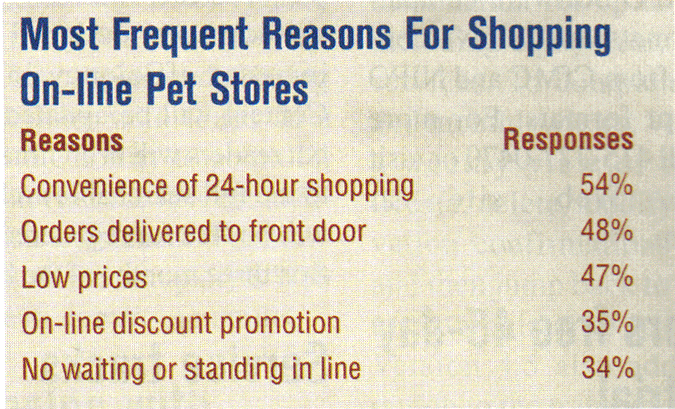
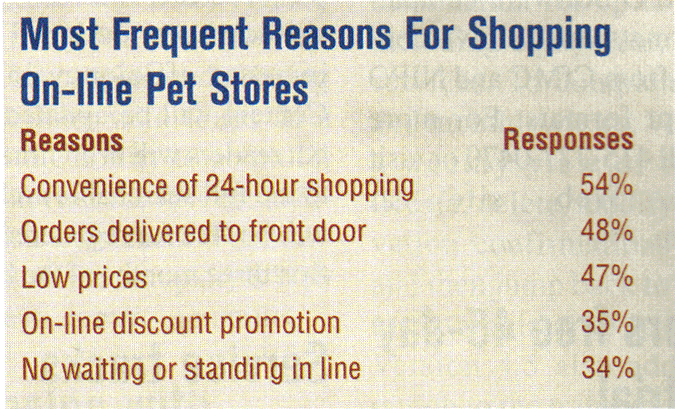
According to NPD, convenience was the main reason for buying pet supplies off the Web. Three of the top five reasons for buying on-line reflected a saving of time and effort including more suitable shopping hours, effortless delivery and avoidance of lines.
Petsmart.com was the most frequently visited on-line pet store, according to NPD. Fifty-two percent of survey participants visited petsmart.com, while 36 percent frequented pets.com. Other popular sites included petopia.com (15 percent), pets warehouse. com (9 percent) and petstore.com (8 percent).
The NPD on-line pet store survey was conducted as part of the NPD Online Research omnibus survey. Two thousand and nine individuals from NPD's Online Panel, a Web representative sample of individuals prerecruited to participate in surveys, responded to the questionnaire in late September.
Do ads lead us to surf, browse or buy?
Is Internet advertising effective? Are Web users paying attention? What types of Internet ads are working? A survey of 1,000 adults across the U.S. from Eisner & Associates, a Baltimore advertising firm, found that Internet users are not very likely to respond to an ad on the Internet (what are usually called banners). In fact, more than four-fifths (83 percent) of regular Internet users either do not pay attention to the ads at all, of spend just a few seconds on the advertised Web site.
The survey shows the target audience most attractive to many advertisers - those with household incomes of more than $50,000 - is least likely to pay attention to ads on the Internet. In terms of traditional advertising (TV, print, etc.), the survey results show Internet users are more likely to search for a company's Web site after seeing an ad that simply lists its Web site address at the end of the ad, rather than an ad which is devoted to only promoting the Web site. Moreover, those who are exposed to a Web site address after visiting a retail location are more likely to visit that Web site than a Web site for a company that does not have a retail location and conducts business on the Web only.
"Consumers have been conditioned to buy merchandise in stores for hundreds of years," says Abe Novick, vice president of Eisner. "It's going to take a while to change the paradigm. Even though we're seeing Web-only enterprises successful today, the survey suggests that existing retailers, who've been building equity with consumers for years and who do things right on the Web, could have in advantage over start-up companies that do business only on the Internet."
The survey of 1,000 Americans was conducted by Bruskin Goldring and is accurate ±4 percent. The sample proportionality represents the U.S. population.