
Savings and loan associations worry many consumers
A study by Opinion Research Corp. reveals that most of today's consumers see savings and loan associations as being less attractive than banks on several dimensions, and a vast majority are reluctant to entrust their savings to an S&L. These findings reflect the severe and prolonged economic and political battering that the savings and loan industry has suffered in recent years. Federal efforts to bail out the industry, coming on the heels of a series of fraud allegations and well-publicized bankruptcies, may actually have compounded the public's negative image of S&L's.
Few consumers - only one in five - would choose to save with an S&L if they could find a bank willing to pay the same interest rate. This preference may condemn the S&L industry to a self-defeating cycle of paying imprudently high interest rates to compensate savers for the perceived higher risk of an S&L account. And these higher interest rates could further undermine the financial stability of the industry.
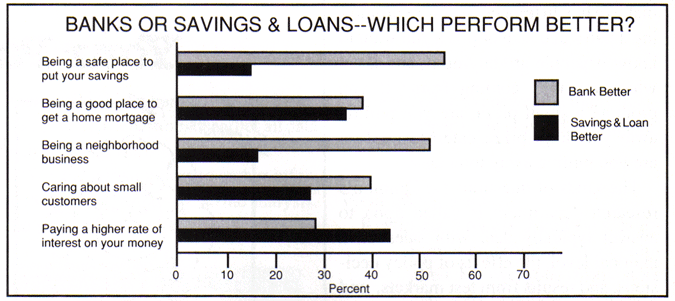
The public attitudes underlying consumers' preferences are not encouraging for the S&L industry. Consumers are four times as likely to believe that a bank is a secure place for their savings as they are to consider an S&L a safe haven for their money. Consumers also rate banks higher than S&Ls for caring about small customers, being a neighborhood business, and by a slim margin see banks as being a better place to get a home mortgage.
Consumers do see savings and loan institutions as paying higher interest rates than banks, but this perception is at best a double-edged blessing for the S&L industry. Higher interest rates imply higher levels of risk for many consumers, and in any case it is extremely unlikely that most S&Ls can pay the premium rates that most consumers now demand for investing in a savings and loan account.
Consumers say that an S&L interest rate on savings would have to be 3.3 percentage points higher than a bank's in order for them to invest their savings in an S&L. Almost one consumer in ten say they wouldn't entrust their money to a savings and loan no matter what level of interest was offered.
The uneasiness is also pervasive among the 26% of all consumers who currently hold a savings account with an S&L. This group, while not as negative towards the industry as consumers as a whole, harbors some serious doubts about the stability of S&Ls and often offers only tepid support for S&Ls when comparing them with banks. Only one-quarter of S&L customers believe that S&Ls are safer places for their savings than banks are, compared with one-third who believe that banks offer greater safety than do S&Ls. While most S&L customers are not concerned about the safety of their own S&L account, one-quarter (28%) are concerned about security and one-tenth of them (9%) have seriously considered closing their accounts.
These safety concerns are offset by S&L customers' perceptions that S&Ls are better than banks at providing home mortgages, caring about small customers and offering high interest on savings. However, if a bank paid the same rate of interest, as many S&L customers would choose to place their savings there as would select an S&L. The savings and loan industry thus has, at best, a loose grip on its current customer base, while it faces an extremely difficult task in at¬tracting new customers.
Survey finds mail order offers convenience, satisfaction
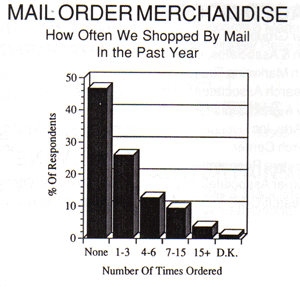
A Maritz AmeriPoll found that 52% of the respondents ordered merchandise by mail at least once in the past year. 25% said they shopped by mail 1-3 times, 13% said 4-6 times, and 10% said 7-15 times. Four percent of respondents averaged over an order per month, shopping by mail more than 15 times in the past year.
According to the survey, men are not as likely as women to order merchandise by mail. Overall, 47% of men purchased an item by mail in the previous 12 months, compared to 57% of women. Twenty-three percent of men used mail order 1-3 times, as did 29% of women.
When asked what items they're most likely to purchase through the mail, respondents who shop by mail listed over 17 categories, ranging from books to toys. Forty-two percent of women, and 31 % of men, said clothing is the item they're most likely to order - making it number one overall. Next came books and magazines, followed by records or cassettes. Home decorations and kitchen merchandise rounded out the top five items on the list.
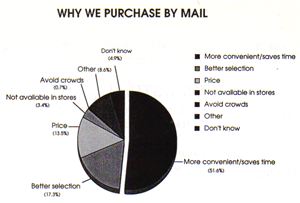
Over half of those who shop by mail said the reason they did so is because it saves time or is more convenient. Another 17% said they were able to obtain a better selection of merchandise. Fourteen percent told interviewers they use mail order because of better prices. Only 1% of respondents said they shop by mail to avoid crowds. Almost twice as many men as women listed price as a reason they order by mail; conversely, more women than men said they use mail order because of convenience.
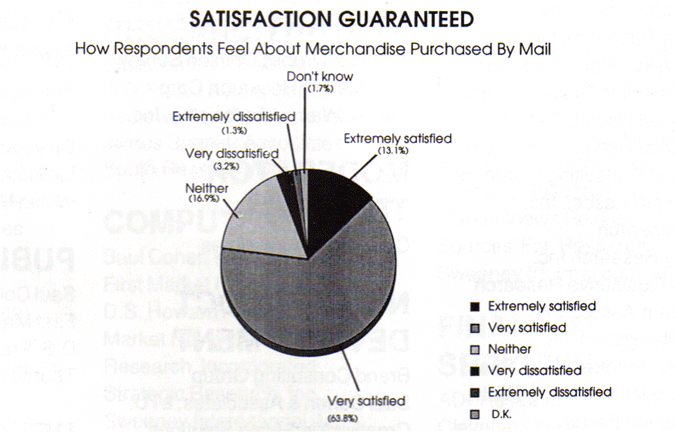
Apparently, most people who shop by mail are happy with their purchases. An overwhelming 77% said they were extremely or very satisfied with their purchases. Seventeen percent were neither satisfied nor dissatisfied. Only 5% of consumers were very or extremely dissatisfied with their orders.
But even those with such high satisfaction ratings, the frequency with which Americans order by mail doesn't seem to be increasing. The survey shows that of all respondents, 22% ordered by mail less often in the past year than in the previous years. On the other hand, the majority (58%) ordered about the same, and 16% ordered more frequently than in previous years.
A miraculous story
According to a recent OmniTel survey conducted by R.H. Bruskin Associates, seven out of ten adults believe in miracles; when asked, "Do you believe in miracles?" 69% of all adults answered "yes." 75% of women believe in miracles, while only 62% of men do. Looked at by age, the results show that 67% of 18-24 year olds, 71% of the 25-64s, and 62% of those 65 or over believe in miracles.