
Study segments business travelers
Four specific traveler groups account for 90% of all affluent frequent business travelers, according to a study, Frequent Business Travelers: A Study of Markets and Media 1991-92, just released by Erdos & Morgan/MPG, New York City.
The four groups: Prime Time, Seasoned Activists, Routine Business, and Premier Class are distinguished by their attitudes toward business travel, the degree of influence they exercise over their amount and class of travel, and their travel plans and preferences.
Prime Time travelers have consider-able discretion over how they spend their time and money. They represent 1.6 million individuals, or about 17.5% of all frequent business travelers. Prime Time travelers tend to be self-employed or work for small-size companies - they are more flexible than other business travelers and get to enjoy some personal time while pursuing company business. They average eight business trips a year and spend a total of about $5,600 a year on those trips.
Seasoned Activists, on the other hand, take an average of 16 business trips a year and are frequent flyers. They have developed a loyalty to certain travel services providers, among them: American Express for the credit card, American Airlines as preferred air carrier, and Marriott, Embassy Suites, and Hyatt as hotel providers. Representing about 15% of all affluent frequent business travelers (1.4 million individuals), their per capita expenditure on business travel is about $ 1,500 per month.
The Routine Business group makes up two-fifths (40.9%) of all frequent travelers - a market of nearly 3.7 mil-lion people. Travel schedules tend to be set by their employers, and they express relatively little brand loyalty toward airlines. The very size of this group of travelers makes them important to marketers and although their companies make the decision on some big-ticket travel expenditure items, they are likely to be open to a variety of approaches, particularly in regard to immediate-reward items.
The Premier Class, by far the richest market for travel services providers, represent 1.5 million individuals or 16.3% of all affluent frequent business travelers. They take an average of 25 business trips a year, spending almost $28,000 annually. They are the most frequent hotel and car rental patrons and the heaviest users of business equipment while traveling, including facsimile equipment, airline lounges and cellular phones. The Premier Class is also characterized as having moderate loyalty to hotels they are familiar with, being heavy users of frequent flier mileage tie-ins and having the highest incidence of American Express Gold Card membership.
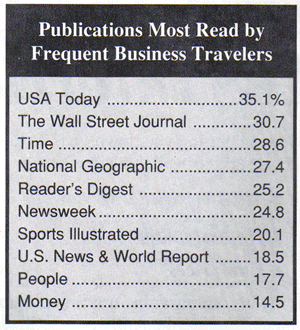
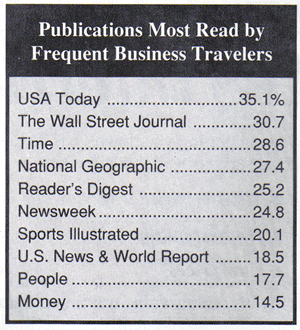
Also reported in the survey are print media and TV program preferences among frequent business travelers. Overall, USA Today, The Wall Street Journal, and Time are print media reaching the largest number of frequent business travelers.
Of the TV programs measured, the top five capturing viewership among frequent business travelers are: 60 Minutes (47.7%), 20/20 (39.0%), ABC World News Tonight (36.5%), Evening News-CNN (29.8%), and NBC Nightly News (27.3%).
Consumers express feelings toward Japanese products
A market has always existed in the United States for foreign-made goods. Swiss watches, French perfume, German optical goods, and many other imported products have been eagerly sought by the American people. But the import picture has recently been overshadowed by the spread of goods from Japan. Japanese companies in recent years have won a large share of the American market in automobiles, TV sets, VCRs, radios, stereos, camera, computers, motorcycles and other products.
How do Americans react to this peaceful invasion of our shores? Is this trading trend welcomed or is it seen as a threat to this country's economy? How are Japanese products perceived? Are they considered equal to U.S. goods in quality? Is there any resistance to Japanese products?
To study these matters, Bruskin As-sociates, Edison, New Jersey, conducted a national study of American ownership of and attitudes toward Japanese products. This new study complements an earlier study of 1972, allowing for the direct comparison of data. The material presented in both studies was obtained through AIM, an omnibus service offered by Bruskin Associates.
Some highlights:
- Japan, far more than any other country, is identified by American adults with the problem of foreign trade competition. Nine-tenths of Americans, (91%), name Japan as a country which sells products in the United States. Taiwan is named by 58%; no other country by over 40%. Two-thirds of Americans (65%) cite Japan as a country owning factories in the United States; no other country is named by more than 17%.
- Americans today are much more aware than in 1972 of individual Japanese products, makes and brands. Almost all (93%) can name one or more makes of Japanese automobiles (versus 63% in 1972); two thirds (63%) name one or more brands of Japanese cameras (versus 19% in 1972). Awareness of Japanese TV sets, motorcycles and radios has sharply increased. The best known Japanese product names are Toyota, Honda, Nissan, Mitsubishi, Sony, Panasonic, Kawasaki, Yamaha, Nikon and Minolta, all mentioned by 25% or more of the people.
- Ownership of Japanese products has increased; 57% of American families now own one or more Japanese products (versus 47% in 1972). Thirty-eight percent of families now own a Japanese television set or VCR; 25% own a Japanese camera, 21% a Japanese automobile.
- Practically all owners say they would repurchase the Japanese items which they now own. Of the 10% who own a Sony TV or VCR, 9% would repurchase; 8% own a Toyota car, 7% would repurchase; 8% own a Minolta camera, 7% would buy again.
- Americans' perceptions of Japanese product quality have changed dramatically since 1972. Almost three-fourths of the people (73%) now rate Japanese products excellent or good in quality (vs. 49% in 1972). Over a third, (37%) now say Japanese quality is better than that of American products (vs. only 12% in 1972). Only one-sixth (16%) now rate Japanese quality poorer than American product quality (vs. 39% in 1972).
- In both studies, the current one and that of 1972, favor toward Japanese products has been found to be highest among higher income people, the more educated, and younger people. These groups have spearheaded the shift in American attitudes and habits.
Among higher income people, 82% now rate Japanese products excellent or good (against 65% among the lowest income group). Among college educated, 85% now rate Japanese products excellent or good (versus 60% among those not finishing high school). Among people aged under 35, 75% now give Japanese products these high ratings (versus 68% among people aged over 50).
All of the current quality figures for Japanese made products are 20 or more points higher than the levels of 1972.
Among higher income families, 69% now own Japanese products (vs. 45% among the lowest income families). Among college educated, 71% now own Japanese products (vs. 39% among those not finishing high school). Among younger American families, 65% now own one or more Japanese products (vs. 43% among older families).
- Six Americans in seven, 86%, say that competition from foreign products is now an important problem confronting the United States. Americans have mixed feelings about foreign companies maintaining factories or buying property in the United States. Over half, 57%, feel favorably about foreign companies having manufacturing facilities, but only 27% feel favorably about them purchasing property and buildings, such as Rockefeller Center.
- More often than not, Americans feel favorably toward Japan as a country (61% feel very or somewhat favorable). Japan, however, ranks only in the middle among the different countries of the world. Canada ranks first with 94% favorable, while most European countries score between 77% and 89%.
Study uncovers what's important to Americans
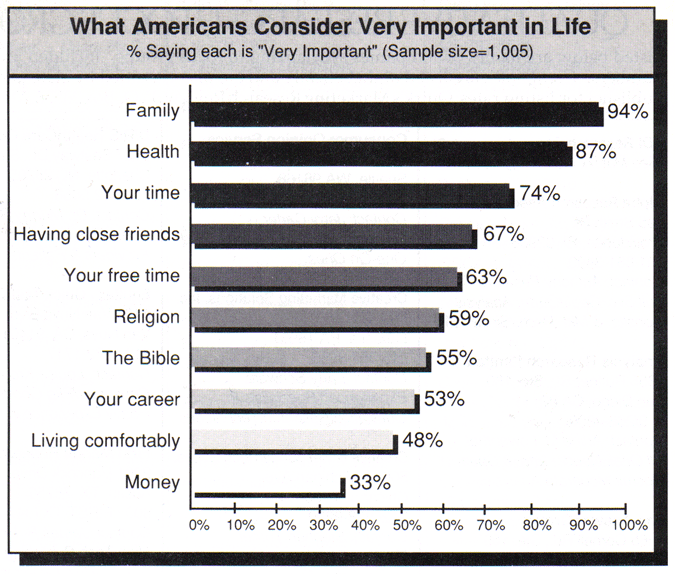
What's important to Americans - time or money? Family or friends? Health or career? In a national survey of adults, over 1,000 people were asked what is important in their life. The study, conducted by the Bama Research Group, Glendale, Calif., tested the importance of ten different areas of life.
The most important? Family. Ninety-four percent of all Americans said family is very important to them. Another five percent called family somewhat important, with only a handful of people calling it "not too" or "not at all" important. Although a vast majority of every population subgroup analyzed in the study felt their family is very important, there seems to be a connection between family and religion. The people who were least likely to consider family as very important were those who did not attend church, did not consider religion very important, did not read the Bible regularly, etc.
Second in importance is health. Eighty-seven percent called this aspect of life very important, while 12% felt it is somewhat important.
In the battle between time and money, time was the clear winner. Seventy-four percent felt their time is very important to them, while only 33% considered money very important. Twenty-three percent said their time is somewhat important to them, while 3% considered it not too or not at all important. Money was considered somewhat important by 55% of the respondents, not too important by 10%, and not at all important by 2%.
There were some significant differences in the importance various types of people placed on money. Men placed a slightly greater importance on money than did women. Blacks were more likely to consider money very important in life than were whites or Hispanics. People who had attended or graduated from college were less likely to see money as very important than were people who had not attended college. The age group most likely to emphasize the importance of money was Baby Busters (18-24 years old), while the group least likely to consider money very important was older Baby Boomers (25%).
Possibly the most significant difference, though, was a difference that did not appear. People from lower, middle, and higher income households tended to place equal importance on money in their lives, with no statistically significant differences according to income levels.
Two-thirds of the respondents (67%) called having close friends very important, while 27% considered this somewhat important. Interestingly, this was particularly important to people over the age of 54, and to women, while blacks tended to see this as less important than did whites or Hispanics. People who were religiously involved (i.e. read the Bible regularly, consider religion very important, attend church) often placed a higher level of importance on close friends than did other respondents. Americans also place a premium on their free time, as 63% considered this very important, and 31% saw it as somewhat important. Wealthier Americans were especially likely to see their free time as very important, and lower-income respondents were less likely to view this aspect of life as key.