
Julia Roberts most popular movie star
Each December since 1993, Rochester, N.Y.-based Harris Interactive has asked a cross-section of adults who their favorite movie star is. In 2001, for the first time, a female star, Julia Roberts, topped the list. She was followed by Tom Hanks, who moved up from number six in 2000, and Harrison Ford, who was the nation’s favorite star in 1998, 1999, and 2000.
In 2000 Julia Roberts was in fourth place, and the year before that she was number eight.
The other stars in 2001’s top 10 were Mel Gibson (down from number three in 2000 to number four), Sean Connery (up from number 10 to number five), John Wayne (down from number two for the 1998-2000 period to number six), Clint Eastwood (down from number five to number seven), Denzel Washington (down from number seven to number eight), with Robin Williams and Sandra Bullock in positions nine and 10, respectively.
The biggest changes since 2000’s poll were: Sean Connery up five places to number five; John Wayne down four places to number six; Tom Hanks up four places to number two.
Bruce Willis (number seven in 2000), Arnold Schwarzenegger (number nine);and Robert DeNiro (number 10) all drop out oft.he top 10, as Robin Williams and Sandra Bullock moved in.
When different segments of the population are analyzed separately, Julia Roberts is in first place with women and Hispanics, and she shares first place with Harrison Ford in the key movie-going crowd aged 18-29. Tom Hanks is number one among men and whites; and Denzel Washington is the favorite among African-Americans. These are the results for The Harris Poll of 1,065 adults surveyed online nationwide between November 9-14, 2001.
Americans on a mission to lose 20 pounds
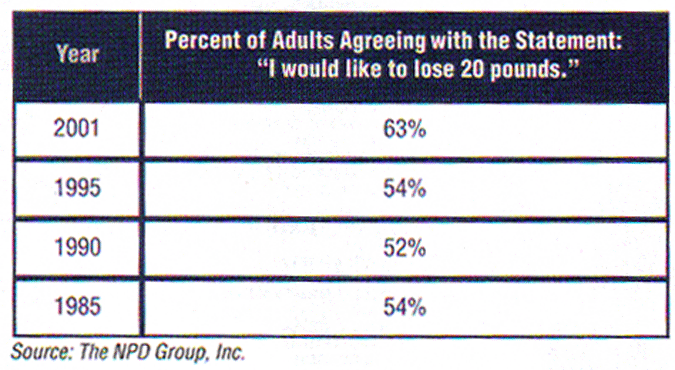
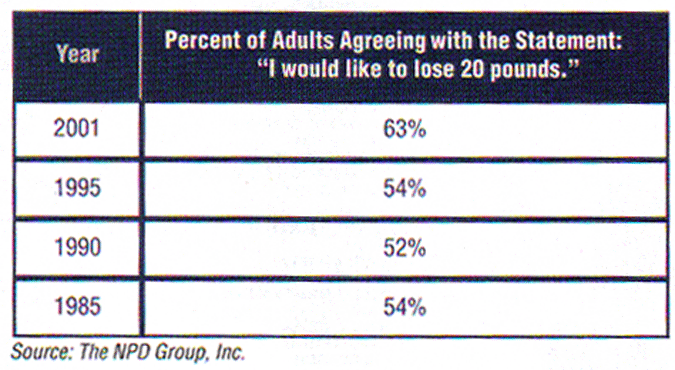
Nearly two-thirds of American adults want to lose 20 pounds, according to Port Washington, N.Y., research firm The NPD Group, Inc. This is an all-time-high percentage from the respondents in The NPD Group’s Annual Report on Eating Patterns in America.
Respondents were asked to agee or disagree with the statement, "I would like to lose 20 pounds."
"During the ’80s and ’90s, Americans tried to eat their way to better health with all the new lowfat, low-sodium, low-everything products offered to them. During that time, however, the percent of people who wanted to lose 20 pounds did not decline," says Harry Balzer, vice president of The NPD Group, Inc. and author of the report.
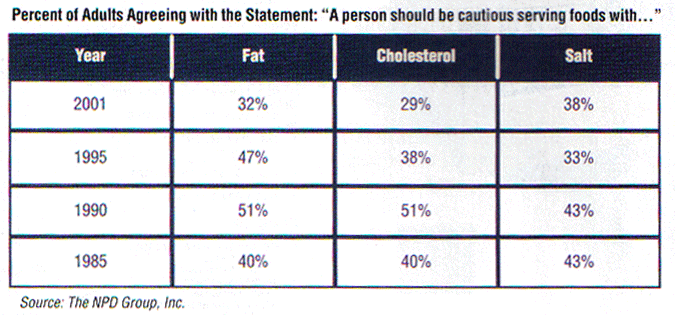
Even though weight is on the minds of more Americans, Eating Patterns in America respondents are less concerned with fat, cholesterol, salt and other nutritional issues than they were in the ’90s.
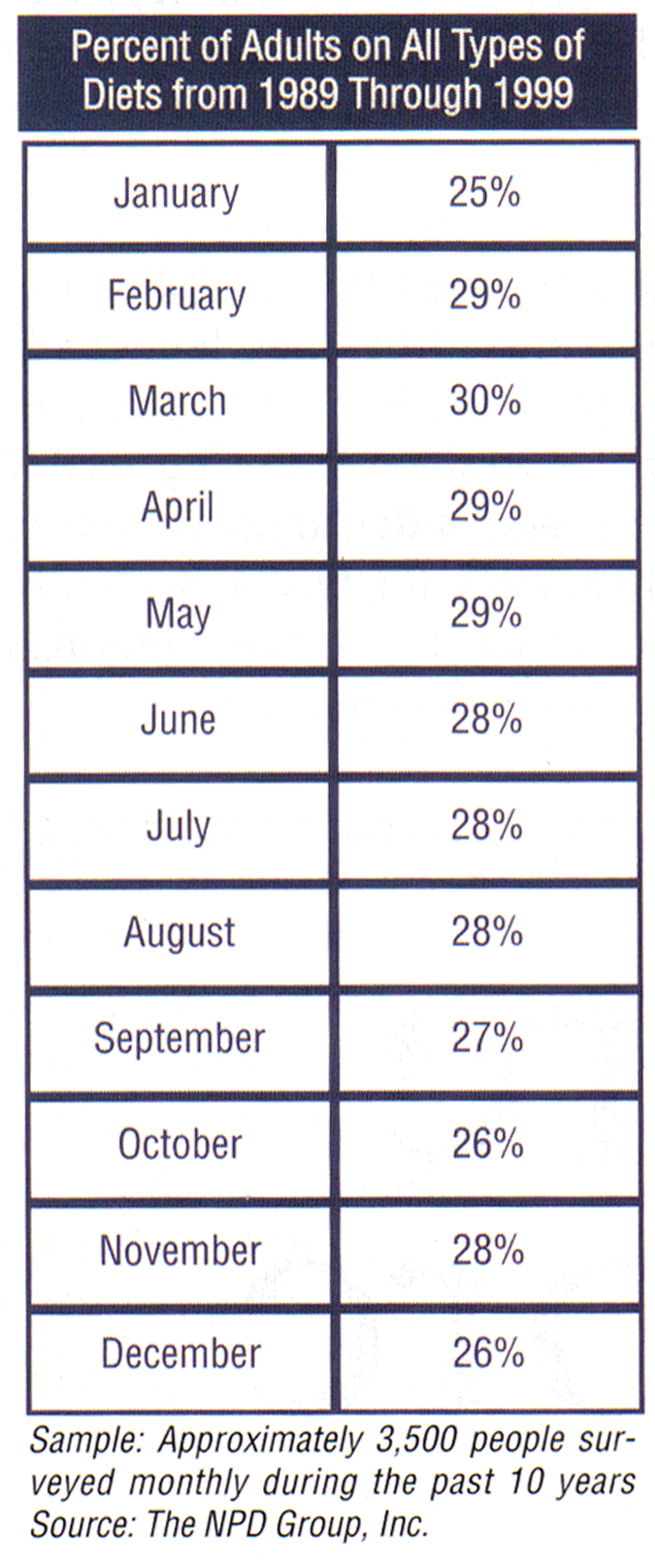
"I think Americans have come to realize that the most pressing health issue is the most obvious - our weight," says Balzer. Yet despite their resolve to lose weight, Americans aren’t likely to begin this year on a diet. Eating Patterns in America respondents’ monthly diet habits during the past decade show January to be the least likely month to be on a diet. March is the month when people start to get serious about changing their eating patterns. Balzer speculates: "Perhaps the drop in dieting in January is because Americans like to start the year thinking that they will get in shape and begin exercising more. By March, they find it’s easier to lose weight by cutting back on their food intake."
The NPD Group’s 16th Annual Report on Eating Patterns in America is based on the results of over 30 research studies conducted by NPD, including the dally food and beverage consumption of 5,000 Americans. The studies used for this analysis included proprietary dally food diaries, retail sales, kitchen audits, restaurant sales, food safety concerns, appliance and cookware sales, nutritional concerns, and others.
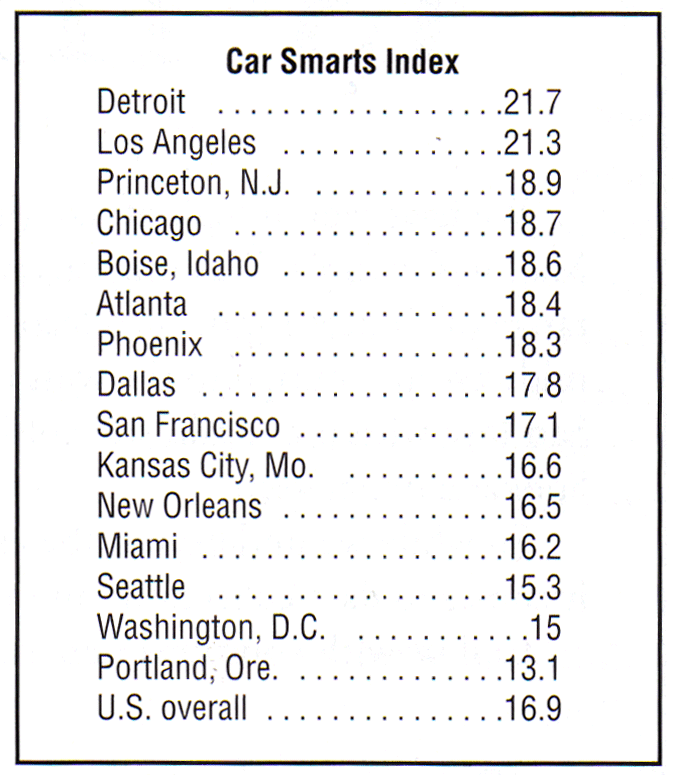
Detroit leads in car-shopper savvy
If you were an auto dealer, where would you like to sell cars and trucks? Stay away from Detroit and make your way to Portland, Oregon.
In a study of car-shopper savvy in 15 cities as well as a national sample, it is not surprising that Detroit new-vehicle shoppers prove to get the best discounts, haggle the most, have high vehicle knowledge and use the Internet to fred the best deals and make product comparisons.
At the other end of the spectrum, Portland new-car shoppers receive the smallest discounts, are second-worst (behind Seattle) in terms of haggling and vehicle knowledge and barely above national average in terms of Internet usage.
"Being an Oregon-based company, I would have preferred to see Portland do better," says Art Spinella, vice president and general manager of CNW Marketing Research in Bandon, Ore. But Portland residents are known for being self-absorbed and more than a little arrogant - the perfect attributes for high dealer profits."
The Car Smarts Index is constituted from an analysis of new-vehicle prices in each city, actual transaction prices, typical discounts, the amount of haggling shoppers perform, depth of vehicle knowledge and use of the Internet for collecting vehicle information.
G’day indeed: Australians among most optimistic people
Australians, along with New Zealanders and Canadzans, are among the most optimistic people on the planet with regard to the year 2002. However, for the second consecutive year, respondents from Kosovo were the most likely of 62 countries surveyed to think the year 2002 will be better than last year, according to the 2001 Gallup International Survey. Eighty-three percent of Kosovars surveyed said they think 2002 will be better than the previous year, with 65 percent of New Zealanders, 54 percent of Canadians, and 54 percent of Latvians also saying they expect 2002 to be better. Australians (53 percent said they expect 2002 to be better) ranked fifth overall on the measure a!ong with Denmark (53 percent), with former Cold War rivals the United States (52 percent) and Russia (52 percent) seventh. Other nations among the 10 most optimistic about 2002 included Norway (51 percent) and Sweden (49 percent).
Respondents from Japan (11 percentexpect a better year in 2002) and Turkey (13 percent) were the least likely to predict 2002 would be better, with respondents from Zimbabwe (14 percent), Bolivia (14 percent), Poland (14 percent), the Netherlands (15 percent) and Austria (16 percent) also among the least likely to be optimistic about 2002. Respondents from Turkey (68 percent) and Zimbabwe (68 percent) were the most likely to expect 2002 would be worse than last year. Respondents from Bolivia (56 percent), Poland (51 percent), Hong Kong (50 percent), and Mexico (48 percent) were also among the most likely to predict 2002 would be worse.
Asked specifically about economic prosperity in the coming year, citizens of most countries were more pessimistic about the coming 12 months than they were a year ago. Seventeen of the countries surveyed showed an increase in their expectations for economic prosperity, with 37 countries showing a decrease in expectations for prosperity, and eight countries that were steady or did not ask this question last year. Importantly, 35 percent of respondents from the United States (up 20 percent) predicted that 2002 would be a year of economic prosperity, while 23 percent (up 7 percent) predicted a year of economic difficulty. "
On the other hand, Japan ("prosperity" - 4 percent; "difficulty" - 54 percent) and Germany ("prosperity" - 11 percent; "difficulty" - 56 percent), numbered among the nations where more respondents expect economic difficulty than economic prosperity. Kosovo (64 percent expect economic prosperity) was the only country surveyed in 2001 that showed a majority of citizens expect 2002 to be a year of economic prosperity. Respondents from Poland (3 percent) and Japan were the least likely to expect economic prosperity followed by the Netherlands (5 percent), Lithuania (6 percent) and Finland (6 percent). Australia (14 percent, up 3 percent from a year ago) ranked an equal 38th on this issue, along with Bulgaria and the Czech Republic. New Zealand (26 percent, down 10 percent) ranked 13th. Respondents from Zimbabwe (65 percent expect economic difficulty in 2002) and Poland (59 percent), on the other hand, were the most likely to say they expect economic difficulty in 2002.
When respondents from the world’s flash points were asked if they expect 2002 to be a peaceful year, free of international discord, a troubled year, or one that is about the same as last year, 48 percent of Americans, 43 percent of Israelis, 51 percent of Indians, and 40 percent of Pakistanis predicted a troubled year in 2002. Austrians were the most pessimistic of all the countries, with 64 percent expecting 2002 to be a troubled year, followed by Germany, Spain (both 61 percent) and Mexico (58 percent). In Australia, 53 percent (up 14 percent since 2000) believe 2002 will be a troubled year while 10 percent (up 2 percent) expect a more peaceful year than 2001. Half of all respondents in the United Kingdom and 54 percent of New Zealanders predict 2002 will be a year filled with much international discord. Once again, Kosovars are the most optimistic about 2002, with 40 percent of respondents expecting it to be a peaceful year.
Retailers struggled to respond to customers’ e-mails during holiday season
New York-based research firm Jupiter Media Metrix reports that brick-and-mortar and online-only retailers struggled to respond to customer service e-mails quickly during the 2001 holiday season. According to data from a December 2001 Jupiter Customer Service WebTrack, just 30 percent of all retailers tracked resolved basic customer service requests online within six hours. While this is a slight improvement over the previous quarter’s 27 percent, Jupiter analysts advise retailers to concentrate on retaining customers acquired during the holiday season by reaching out to those that bore the brunt of slow response.
"Santa might be relaxing now, but retailers can’t," says David Daniels, Jupiter senior analyst. "The implications of unsatisfying online service remain particularly harsh. These are peak return and customer service weeks for retailers to focus on retaining holiday shopping customers. Retailers must scrutinize online customer service response times, contact center service levels and staffing resources."
Jupiter’s WebTrack data indicate that while a greater percentage of onlineonly retailers (33 percent) responded to customer service e-mails within six hours than brick-and-mortar retailers (28 pement) did, online-only retailers were less responsive overall. According to the WebTrack, 40 percent of online-only retailers took more than three days to respond or did not respond to e-mails at all, compared with 28 percent of brick-and-mortar retailers in the same category.
A majority of consumers (57 percent) polled in a November 2001 Jupiter Consumer Survey said that the speed of a retailer's response to customer service e-mail inquiries would affect their decision to make future purchases from the particular Web site. Jupiter analysts have found that the impact of poor customer service online cascades across channels. According to the survey, 53 percent of consumers said they would be less likely to buy again from a retailer's offline store if they had an unsatisfying experience with the online store. Only a mere 3 percent of consumers surveyed indicated that online service would not affect their future purchases or that they would continue to buy from the merchant regardless of price.
"It's time for retailers to focus on the basics and invest in critical e-mail customer service automation systems. A recent Jupiter Executive Survey found that only 43 percent of Web sites have an e-mail automation system. This in part explains this season's lackluster online customer service performance," Daniels says.
Instead of issuing deep dollar discounts to appease disgruntled customers, retailers must explain to customers the changes they are implementing to improve the quality of service. Jupiter analysts advise retailers to invite customers to contribute to this process by using Web-based surveys to collect customer feedback and capture individual preferences. Furthermore, retailers should use customer interaction records and historical response time data as an attribute to earmark the profiles of customers that had a sub-par shopping experience. According to Jupiter analysts, this data can be used to fuel personalized marketing campaigns at a later date just for this audience.
Methodology: In December 2001, Jupiter measured the Web sites of 250 leading companies in the automobile, business-to-business, consumer packaged goods, finance, health, music, retail, and travel industries. The sites were selected based on a mix of Jupiter's judgment of the most important and representative Web sites in each space, and the Media Metrix 100 most popular sites for October 2001. The observation data were logged in a large, longitudinal WebTrack database that Jupiter began building in 1996.
For the November 2001 Jupiter Consumer Survey, Jupiter designed and fielded a survey to online consumers selected randomly from NPD consumer panels. A total of 2,110 individuals responded to the survey. Respondents received an e-mail invitation to participate in the survey with an attached URL linked to the Web-based survey form. The samples were balanced by a series of demographic and behavioral characteristics to ensure that they were representative of the online population. Demographic weighting variables included age, gender, household income, household education, household type, region, and market size. Additionally, Jupiter weighted the data by AOL usage, online tenure, and connection speed (broadband versus dial-up), three key determinants of online behavior. In this survey effort, Jupiter worked with NPD on the technical tasks of survey fielding, sample building, balancing, and data processing. For more information visit www.jmm.com.
California businesses still cite energy costs as top concern
About two-thirds of California businesses polled say that they have a "generally negative" feeling about deregulation in the state and more than 80 percent cite the cost of energy as a top concern, according to a recent survey conducted statewide.
The survey also revealed that more than three-quarters of businesses polled are displeased with the suspension of direct access on September 20, 2001, by the California Public Utilities Commission. Under California's original electric deregulation plan, a direct-access provision allowed business and residential customers to purchase electricity from alternative energy service providers outside of their local utility, typically at a lower price.
In the wake of the suspension of direct access, 77 percent of businesses polled say energy efficiency now is "very important" to them and many are actively seeking out companies to develop potential energy-saving opportunities in diverse building types and locations. In addition, they are seeking help from energy service providers to implement strategies that will allow them to capitalize on cost-control measures, energy-pricing opportunities and reduced market risk.
Market Strategies, a Detroit marketing research firm, conducted the survey October 29-31, 2001, polling energy management professionals from the manufacturing, transportation, retail, public administration, education and health care industries. Commissioned by Sempra Energy Solutions, a San Diego-based retail energy services company, the survey focused on businesses throughout the state with an annual electric bill of about $500,000.
"It's understandable that businesses are now struggling to cope with the re-regulation of the California electricity market and suspension of direct access," says Mark Camack of Market Strategies. "The survey shows that customers are exploring their options in energy-efficiency improvements as the principal way to control their energy costs."
"Clearly, California customers know that controlling their energy consumption is critical to the bottom line," says Bob Dickerman, president of Sempra Energy Solutions. "The survey demonstrates that, with companies now facing fixed market prices and no ability to secure their own commodity deals, they need to focus on making changes that reduce consumption - changes that pay off very rapidly."
Some improvements businesses can implement for quick savings include substituting antiquated lighting systems with newer, more efficient ones and replacing standard electric motors with premium-efficiency motors on equipment, such as exhaust fans, water chilling and heating pumps, and vacuum and pool pumps. Large businesses also can utilize real-time controls on equipment, such as heating, ventilation, refrigeration and air-conditioning systems, elevators and escalators.
"Executives responsible for energy management understand that the more precisely they can control and forecast power needs, the easier it is for them to save money," says Dickerman. "By implementing energy-efficiency programs today, companies will be better positioned to make the right decisions, when direct access returns to California."