
They'd rather do it themselves
A study by Maritz Marketing Research, Inc. shows that 91% of Americans take on do-it-yourself (DIY) projects every year. Women are as likely to tackle a project as men. According to the survey, 21% of people spend more than $900 a year on do-it-yourself projects. Fourteen percent lay out $301-900, with 33% spending up to $300.
"Based on their expenditures, there seem to be two distinct groups of do-it-yourselfers," says Beth Nieman, research manager at Maritz. "On one hand, is Mr./ Ms. Tinker, who takes on a few smaller jobs requiring little or no knowledge. On the other, is Mr./Ms. Fix It, who may handle multiple projects during the year and is undaunted by skill level required." The survey shows that the latter category is dominated by men, but 13% of women are included as well.
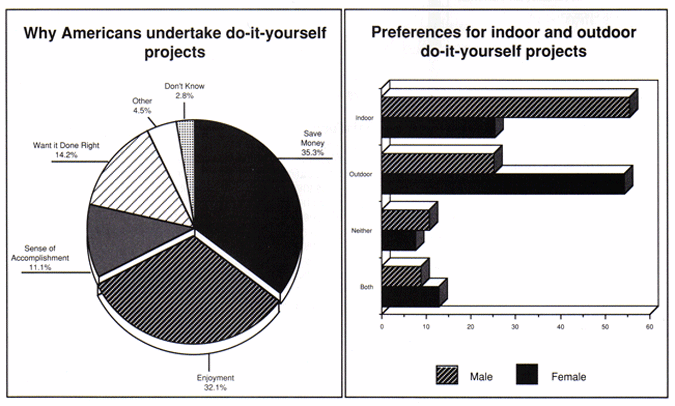
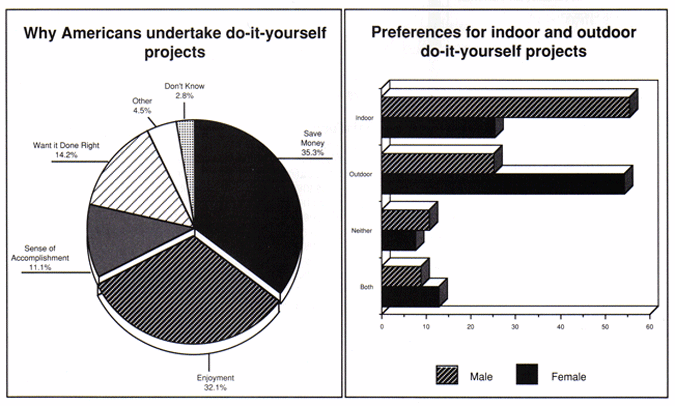
There are many reasons why Americans love DIY projects. Not surprisingly, saving money tops the list, with 35% of the vote. However, pure enjoyment can't be underrated - it was mentioned by 32% of do-it-yourselfers. In fact, women rate enjoyment higher than saving money as a motivating factor.
A third important motivator is wanting the job done right. Seventeen percent of men and 11% of women either don't trust repairmen, or believe they can do the job better themselves. Last on the list is a sense of accomplishment, mentioned by 10% of men and 13% of women.
For the 9% of people who don't try DIY projects, the main reason is a lack of time (31%). Seventeen percent feel they are too old to undertake projects, and 14% don't own their own property. Other reasons include health (12%) and a lack of skill or knowledge (6%).
The location and type of project you prefer probably has a lot to do with your sex, according to results of the survey. For example, 54% of men prefer outdoor projects, such as landscaping or house painting. Conversely, 55% of women prefer indoor projects, particularly those involving the kitchen.
When it comes to specific projects, men and women still can't seem to agree. Fifty-five percent of women undertaking outdoor projects are most likely to choose gardening, compared to 30% of men. Forty percent of men prefer landscaping. Kitchen are favorite indoor projects for 45% of women, but the clear preference of men is the family room (28%).
Despite the fact that DIY projects are popular, the survey shows a slow rate of growth for the industry. Thirty-two percent of people are doing more projects now than a year ago, but they're mostly offset by the 26% doing fewer projects. Thirty-nine percent of people are doing the same number of projects as they did a year ago.
Hospital stay for bypasses down 17% in the 80s
A new set of data confirms that cardiac bypass surgery, one of the most common major operations performed, has seen a strong downward trend in length of hospital stay (LOS) over the last 10 years, reflecting the general pattern of U.S. hospital care.
The 1989 LOS by Diagnosis and Operation, just released by the Commission on Professional and Hospital Activities (CPHA) shows that the national average stay for cardiac bypass surgeries has declined by 17% from 15.3 days in 1980 to 12.7 days in 1989. According to a CPHA spokesperson, the decline in cardiac by¬pass LOS is greatest in the North Central region of the country; data from hospitals there show a 22% decline throughout the decade.
This year's analysis shows the overall U.S. length of stay - for all diagnoses and operations - to be down a tenth of a percentage point from the 1988 figure; from 5.7 days to 5.6. The national average was 6.7 days in 1980.
The reasons for the decline in cardiac bypass LOS are the same, in general, as the factors driving the overall decline, says the spokesperson: improvements in medical technique and technology, coupled with the impact of prospective payment for Medicare and its focus on efficient utilization of resources.
The CPHA LOS data are available from Ann Arbor-based Healthcare Knowledge Resources, the organization responsible for producing and delivering products and services based on CPHA data.