
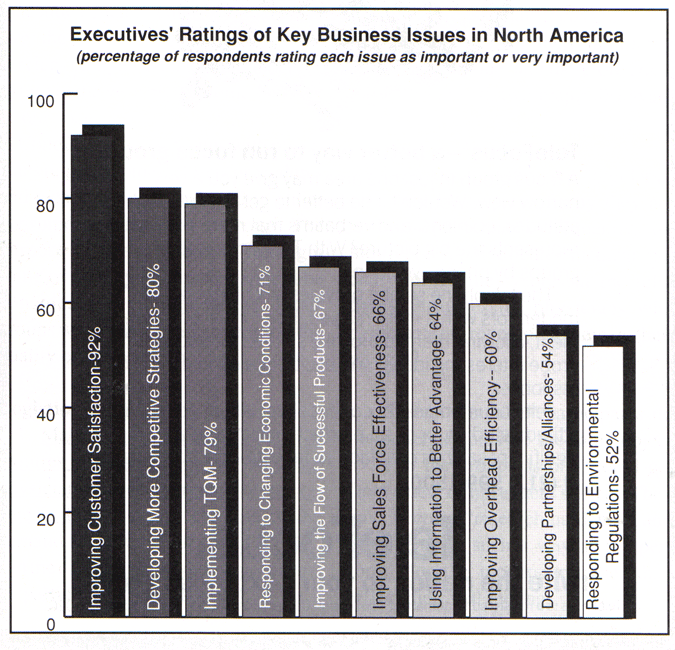
Executives identify key issues for North American firms in future
International management and technology consulting firm Arthur D. Little, Inc. conducted a nationwide survey to determine the important issues for North American businesses in the next five to ten years. Interviews were conducted by Opinion Research Corporation in August of this year with 270 executives in nine industries: automotive, chemicals, financial services, industrial electronics, metals, pharmaceuticals, telecommunications, travel and tourism, and utilities. Of the 270 respondents, 58 percent were vice presidents and above, while 33 percent were managers and directors.
When asked to rate the importance of 16 specific business issues, 92 percent of the respondents rated "improving customer satisfaction" as important or very important, while 80 percent and 79 percent listed "developing more competitive strategies" and "implementing total quality management," as important or very important, respectively.
The three most frequently cited concerns facing companies in the next five to ten years were "international competition," followed by "coping with government/environmental regulations" and "hiring qualified people."
Tamara J. Erickson, a vice president of Arthur D. Little and managing director of its North American Management Consulting Directorate, says that it's no surprise that the key issues of the 80s will remain the critical issues of the 90s. "The burden of finding, hiring, and retaining appropriately qualified people will be a predominant obstacle to American competitiveness in the 1990s. As with customer satisfaction, giving priority to employee satisfaction will be important to dealing effectively with these concerns."
Eighty-four percent of the respondents believe technology will become much more relevant to businesses in the 90s.
"Financial restructuring" and "restructuring the organization" were the least-mentioned specific issues of importance to today's businesses, tallying only 13 percent and 22 percent, respectively.
Supermarket pharmacies snare shoppers
A new study finds that supermarkets with pharmacies are enticing shoppers to pur-chase personal care products and non-prescription medications in the supermarket. Among consumers who regularly shop food-drug combination stores, 52 percent claim they usually purchase personal care products and 56 percent buy non-prescription medications - compared with 37 percent and 39 percent of those whose primary supermarket has no pharmacy. The study, titled "Consumer Attitudes Toward Supermarket Pharmacies," was conducted by Food Marketing Institute (FMI) - a Washington, D.C.-based non-profit association of food retailers and whole-salers - and Johnson & Johnson.
The FMI study's objective was to provide information to guide pharmacy marketing and merchandising. It involved focus groups in three major markets, a national telephone survey of more than 600 pharmacy customers and a survey of pharmacy directors in 65 food-drug retail companies.
In general, food-drug combination store shoppers more often rate their store's health and beauty care (HBC) and over-the-counter (OTC) medications section better than those who shopped stores without pharmacies. More than half (56%) consider the food-drug combination's HBC/OTC section more convenient to shop, compared with 45 percent of shoppers in non-pharmacy supermarkets. Stores with pharmacies also receive higher overall ratings than those without pharmacies. More food-drug combination shoppers (78 percent) give highly favorable ratings to their stores, compared with seven in 10 non-pharmacy store shoppers.
The food-drug combination stores are also more likely to give their supermarkets highly favorable ratings on offering a wide range of services and departments - 82 percent, versus 53 percent of the shoppers in stores without pharmacies. The same holds true for rating the store progressive and up-to-date - 80 percent, compared to 65 percent of the non-pharmacy store shoppers.
Those who buy HBC/OTC products at the supermarket do so mainly for convenience, and the food-drug combination store shoppers are even more likely to recognize this convenience benefit than those who shop at stores without pharmacies. The study found that half of food-drug combination shoppers say they use the store pharmacy at least sometimes. About one in five (21 percent) have almost all their prescriptions filled there.
Most shoppers (73 percent) who use supermarket pharmacies cite convenience as their main reason. Many indicate they have prescriptions filled as they are doing their other shopping. Use of the pharmacy contributes to the shoppers' image of the store. About two-thirds (64 percent) feel the pharmacy makes the store a better place to shop, with nearly half (46 percent) saying it's much better.
The pharmacy report also reveals the attitudes of pharmacy directors from food-drug combination stores. It shows that the majority (71 percent) believe service is the key factor in attracting and retaining pharmacy customers. Pharmacy directors also consider convenience and the personal relationship between customers and pharmacists to be "extremely important."
Factory outlet shopping popular with affluent women
A study by Response Analysis Corp. found that affluent women will go out of their way to shop at a factory outlet center. The study was conducted by the Princeton, New Jersey-based research firm for a property management company to profile the most likely consumers for a factory direct outlet center in the Princeton area. Its findings were reported in a recent issue of The Sampler, the Response Analysis newsletter.
Factory outlets offer brand name merchandise to consumers straight from the manufacturer without the department store markup. The most likely candidate to frequent a factory outlet is 35 to 54 years old, married with children, employed full-time, with a household income of $50,000 or more. While this describes the majority of women who shop at factory direct outlets, those in other categories say they readily shop at outlet malls or at discount clothing stores such as Marshall's, TJ Maxx, or Loehmann's.
Almost two-thirds of the shoppers say they are familiar with and have shopped at factory direct stores. Women surveyed who live in and around Princeton - an affluent area - say they feel that shopping in their area is too expensive. Factory direct shopping is not only acceptable to the upscale consumer, it's in demand. "Even women in affluent communities want to shop at factory direct outlets," says Jim Fouss, president of Response Analysis. "The perception of value to the shopper is key."
Twenty-seven percent of those surveyed say they perceive a much greater value at factory direct stores, 52% recognize some value in spending at factory direct stores, 9% say factory direct stores offer the same prices as department stores, and 12% don't know.
At a factory outlet mall, shoppers want name brand stores that represent quality to them. Respondents say they most want stores such as Ann Klein, Eddie Bauer, and Nine West, among others. For these names, shoppers will travel.
The survey reveals that 44% of the women asked say they will travel up to 30 minutes to get to a factory direct outlet. Thirty-four percent say they will travel up to 60 minutes to shop. Ninety-four percent of the women say they travel in their own cars to shop, with 5% traveling with afriend and 1% taking public transportation.
An outlet mall or cluster of outlet stores proves to be a destination in itself; the women surveyed say they are not interested in the setting or historical attractions in the same area. They complain that they do not like to shop in areas congested with traffic or plagued by a lack of parking space. They routinely visit outlet malls once a month and spend an average of $140 each visit (total yearly expenditure $1,680).
Americans say they'll spend their green to keep things green
According to a recent Simmons Study of Media & Mar-kets, Americans say they are willing to spend more to protect the environment. The study found that 62% of Americans would pay increased sales tax to preserve wilderness and wetland areas. More than 70% indicated they would pay more to improve the quality of drinking water. In addition, the study indicates that nearly 60% of the consumers would pay a higher purchase price for a brand of tuna fish from a company that protects dolphins when catching tuna.