
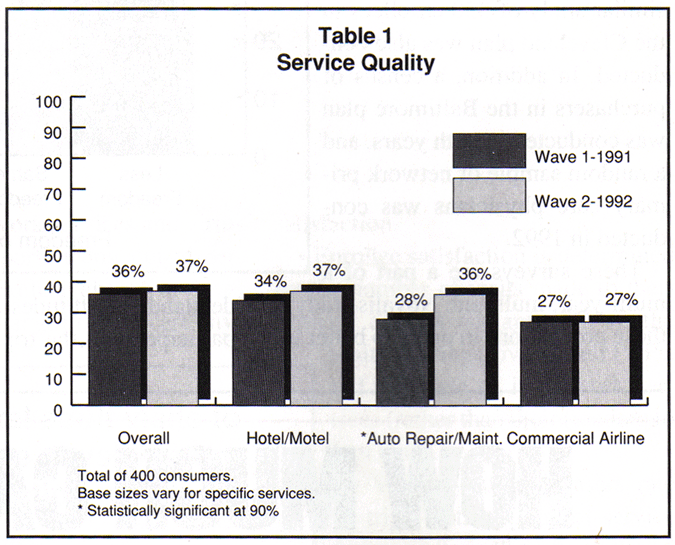
Consumers feel overall quality has improved
According to the 1992 National Quality Index (NQI), American consumers say that the overall quality of American products has improved over the past three years, but service quality continues to lag, with the exception of auto repair and maintenance. Also, while consumers acknowledged improvements in product quality, responses reveal that they were not more satisfied.
The results are part of a national consumer survey conducted by Dallas-based Quality Strategies, a M/A/R/C Group company, to track consumer expectations and perceptions of American products and services, according to Corinne Maginnis, president of Quality Strategies.
"We asked 400 consumers to share their feelings with us about several important aspects regarding products and services," Maginnis says. "Our questions focused on (1) whether consumers have noticed improvement in service and product quality, (2) their satisfaction regarding the quality of specific types of American products and services, and (3) the number of consumers who are aware of total quality management (TQM)." Respondents were asked to comment on quality in general as well as the quality of specific products and services:
- Products: new automobiles, new household appliances, frozen food items
- Services: commercial airlines, car repair and maintenance, hotels/motels
With regard to service quality, consumers were asked to rate the quality of American-made products and services that they had purchased in the past 12 months compared to the quality of similar products and services three years ago. While auto repair and maintenance jumped from 28% to 36%, hotels/motels showed only a slight increase, from 34% to 37%. Commercial airlines showed no increase and remained at 27%.
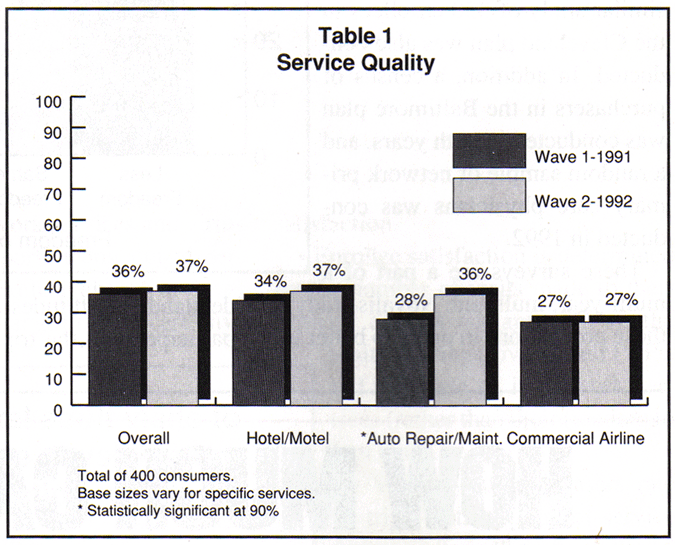
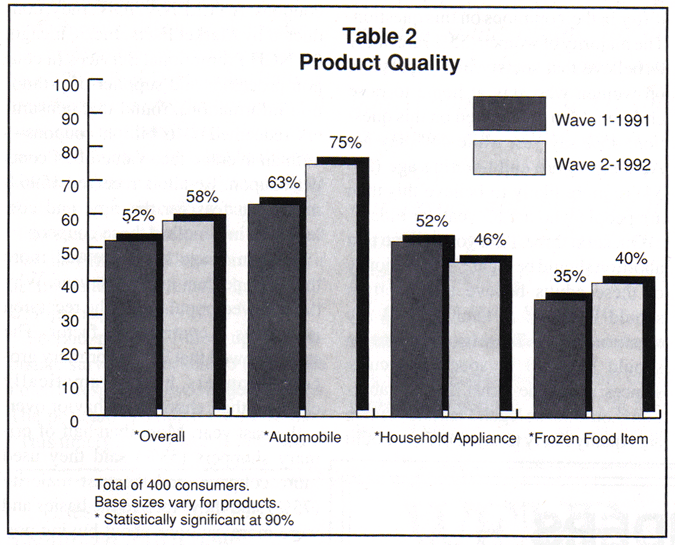
Fifty-eight percent of consumers perceive an improvement in product quality, which is a significant increase over last year's 52%. Among people who recently purchased a new American-made automobile, 75% believe American-made automobiles have improved over the last three years, much greater than the 63% in 1991. Maginnis says this strong positive response may be attributed to the many quality programs undertaken by several automobile manufacturers during this time period. A significant increase in perceived quality also exists among consumers who purchased frozen food items, which rose from 35% to 40%.
According to Maginnis, this may be the result of increased attention to providing "healthy" frozen dinners, a greater variety of items and improvements in the ability to provide fast, "fresh" frozen foods.
Consumers did not, however, recognize improvement in the quality of their household appliances. Only 46% of consumers who purchased American-made household appliances in the 12-month period perceived improvement in quality, down from 52% last year. Consumer opinion of quality improvement in the last three years shifted from "improved" to "stayed the same." According to Maginnis, this reflects the perception that the overall quality of American-made household appliances remains static. The stagnancy may be attributed to increased competition which has caused manufacturers to focus on lowering production costs rather than on designing a quality product.
Generally, although consumers believe product quality has improved since 1991, they are not necessarily more satisfied. When consumers were asked, "How satisfied are you with the overall quality of American products and services today," there was virtually no change from last year's responses, in spite of a perceived increase in quality; 81% are satisfied with product quality and 69% with service quality.
"This may be an indication that the heightened awareness of quality improvement efforts in America has influenced the average consumer's perspective on acceptable product and service quality," says Maginnis. "With each new purchase where quality improvements are implemented, consumers' expectations continuously increase. As in our 1991 study, the 1992 NQI reveals twice as many consumers are dissatisfied with services as with products."
The benchmark NQI survey was completed in October of 1991 with 400 consumers ages 18 to 65. The 1992 second year survey includes the "66 years or older" age group o better represent all purchasing consumers. As the quality movement continues to permeate the work place, more consumers are hearing about TQM - 22% in 1992 versus 14% in 1991. Although the awareness increased, the percentage of consumers employed by companies actually involved in the principles of TQM decreased by 11%.
Fax usage up at businesses
Regular fax users at U.S. Fortune 500 companies report increased dependence and usage of fax machines, receiving 50 documents a day. On average each document received was six pages long, according to a Gallup Organization international study of fax usage and applications among Fortune 500 companies and Financial Times 1000 companies in the U.S., Canada, and Great Britain. The study was commissioned by Pitney Bowes Facsimile Systems Division.
When asked approximately how many documents they faxed a day, respondents at Fortune 500 companies reported an average of 40 documents sent by fax. On average each document sent was five pages long.
Fifty-two percent of regular fax users at Fortune 500 companies said their usage of fax machines has increased in the last 12 months. Only four percent of respondents at Fortune 500 companies said their fax usage had decreased.
According to the study, only approximately one-half of the respondents in all three countries said that their fax machine had plain, regular stock paper. Among the respondents who currently did not have plain paper fax machines, 53% of the U.S. respondents said they wanted such a machine.
Study looks at attitudes towards women's issues
Has the women's movement had an impact on attitudes about women in politics, on the job and their right to abortion? Opinion Research Corp. of Princeton, New Jersey, asked three questions about women's issues to 1005 households nationwide during a CARAVAN telephone survey. The first question was: "Is it possible for a woman to be elected president of the United States within the next 20 years?" Women and men are as likely to say yes (44%) as to say no (45%); an additional 10 say they don't know. As a group, women are neither more optimistic nor more pessimistic than men in their belief of seeing a woman become president in 20 years.
Question two: "Do you believe that women who stay home to raise children feel pressure from society to have a job at the same time?" Women and men differ in their opinions on this question. The majority of women (55%) are likely to believe that society places pressure on women who stay at home to raise children. Men are divided on this question: 45% say yes, while 44% say no. Adults who are child-rearing age (18-54) re more likely to believe this than are people who are 55 years or older.
Question three: "Do you believe that abortion should be legal?" The majority of these adults believe that abortion should be legal. A total of 58% say legal, including 7% who say abortion should be legal in specific circumstances; about one-third (35%) say abortion should not be legal. Men and women are equally likely to say abortion should be legal. Educational attainment is related to attitudes about abortion. The higher the education level obtained, the more likely the individual is to believe that abortion should be legal.
Shoppers say they're using more coupons
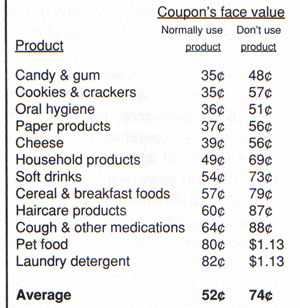
Coupon usage has increased more than five percent in the last year. Why the renewed popularity? The recession is seen as a contributing factor. The study showed that 94% of primary grocery shoppers have dramatically changed their shopping behavior over the past year. More than half of primary shoppers (53%) said they used more coupons, and the vast majority (75%) said they stuck to the basics and were more cautious about buying premium-priced items.
How to make this more cautious consumer try something new? The survey found that users need to see an increase of 42% in the value of a coupon to try a brand they don't usually buy. On average, consumers expected a 52 cent face value for brands they usually buy, but said they'd expect an average 74 cent value to make another brand attractive.