
Consumers hail user-friendly packaging
Packaging research from The Consumer Network, a Philadelphia research firm, shows that consumer
perceptions of food and beverage packaging have shifted dramatically. Instead of seeing packaging as a necessary evil, consumers see desirable packages as a reason to purchase, and packages they don’t like as a reason to avoid products they might otherwise choose.
Triggering the shift is a critical mass of consumer-friendly packages that relieve widely experienced frustrations, delight the eye, or fit into busy lifestyles with new levels of convenience and flexibility.
Over 70 percent of the 1,600+ responses to The Consumer Network’s packaging questions were able to cite specific packages that had significantly improved in the last year or so. Over 65 percent were able to cite packages that still needed improving and the kinds of improvements they hoped to see.
Twist-off closures on juice cartons were the most widely noted improvement, followed by personal-size milk bottles, the zipper-closures now on dozens of products, and no-spill (sports-cap) water bottles.
Fewer spills and easier opening are the most wanted packaging improvements. Consumers also applaud ergonomic packages shaped to fit the hand (so far mostly in cleaning and dishwashing products) and eye-pleasing graphics such as those on the Arizona Tea bottles, which have changed consumer ideas of the possible and desirable.
Many consumers think that all gable-top milk containers should have spouts or yield to alternative kinds of user-friendly and more convenient packages. They see soft drinks as failing to keep up with needs for smaller sizes, hand- and mouth-fit, reclosing, fizz retention, and sturdier bottoms. They like plastic but miss the cold-keeping attributes of glass.
A majority of respondents says that packaging improvements are needed in sugar and flour (80 percent), drugs in pill and tablet form (68 percent), crackers and cookies (61 percent), chips (58 percent), canned soft drinks (58 percent), cereal (57 percent), milk (55 percent) and two-liter soft drinks (50 percent).
The research also shows wide interest in packages that can be harmlessly composted or put in the garbage disposal, packages that can be stored anywhere from fanny packs to desk drawers, and packages that go beyond now-standard tamper resistance to indicate abuse that sometimes causes damaged or broken contents.
Packages that notify consumers when leftovers have gone bad also have wide appeal. They would be a boon to millions of consumers who regularly suffer from refrigerator crowding and leftovers gone bad.
Latin America jumps on the Web
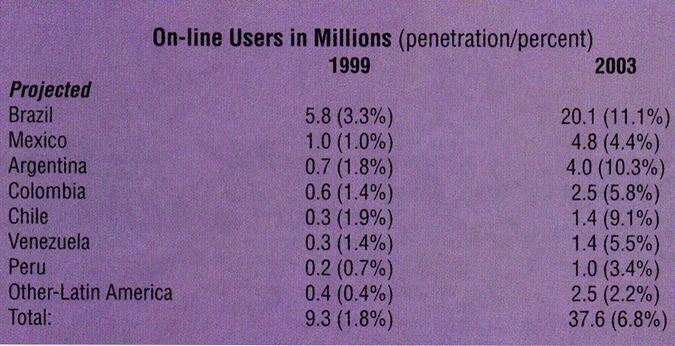
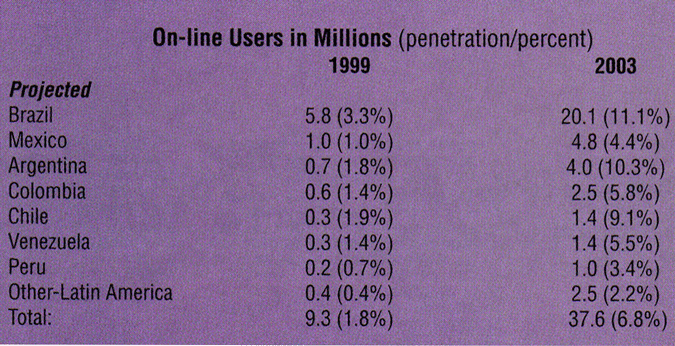
Jupiter Communications, a New York Internet commerce information firm, projects that more than nine million on-line users in Latin America logged on by the end of 1999, and the number will increase to 38 million in 2003 - this projected increase of nearly 50 percent annually marks it as the region with the highest expected growth rate internationally, exceeding that of the U.S., Europe, and Asia.
Jupiter's research on Latin America shows that the on-line population will continue to grow at a rapid rate, with the majority of the nine million on-line users within the region concentrated in Brazil, Mexico, and Argentina. However, penetration within the region will remain low, reaching a projected 6.8 percent of the population in 2003, highlighting the numerous challenges and opportunities that this market presents.
Credit card users seek low rates, not prestige
Consumers are responding to platinum credit card offers for low rates, not perceived prestige or rewards programs, according to a study conducted by Tampa, Fla.-based PSI Global. The firm’s 1999 study of the U.S. card market found that 51 percent of households opening a platinum account in the last year said a low rate was the most important factor in their decision. This compares to 27 percent who cited a low interest rate among those opening a gold account and 20 percent opening a standard account.
"In general, the marketing power of low interest rates far overshadows high potential credit lines, rewards and enriched enhancements as drivers of platinum account openings," says Gregory Weed, a PSI vice president responsible for card industry research. "Platinum cards have not developed as an upper-end of the market so much as they have fostered a rate-sensitive franchise that cuts across income groups."
While platinum ownership skews to upper-income brackets, interest rate is the most important factor in account acquisition at all income levels. Specifically, the PSI research found that interest rate was the most important factor to 48 percent of households with annual incomes of more than $75,000; 57 percent among the $50,000 to $75,000 category; and 34 percent among those under $25,000.
Among all platinum account openers, a higher credit line was important to only 5 percent. However, the PSI study found that among those with incomes of less than $25,000, about 9 percent wanted more credit. In contrast, just 1 percent of account openers with incomes above $75,000 said more credit was important.
Just 1 percent of new account openers cited enhancements (purchase protection, extended manufacturers’ warranties, free collision/damage coverage on rental cars) as the most important reason for opening an account. Rewards are more important to upper-income consumers and gold account openers.
Consumers do not think that platinum card services are superior to gold or that gold services are superior to those Of standard cards. "Thirtysix percent of card owners think there is no difference between platinum and gold cards, andnearly half are neutral. Any perceived difference that does exist cannot be ascribed to prestige imagery or privileged service. This holds true across income groups and across owners of the different platinum brands - American Express, Discover, MasterCard and Visa," Weed says.
Consumers respond to DTC ads
A report from BioInformatics, Inc., a Bethesda, Md., market research and consulting firm, shows strong consumer receptivity to direct-to-consumer (DTC) pharmaceutical advertising on the Web. In a survey of more than 1,000 on-line consumers with an interest in health-related topics, 54 percent reported they have visited a Web site operated by a pharmaceutical firm for the purpose of learning more about a specific prescription drug in the last six months.
A second survey was administered to a group of more than 500 health care professionals experienced in the use of the Web. Forty-five percent of that survey group responded that they too have visited a pharmaceutical company’s Web site within the last six gronths.
As consumers continue to exercise their newfound power in their relationship with the health care system, the Web can be expected to be an indispensable source of the information and knowledge needed to make informed decisions. Less certain, however, is the role pharmaceutical companies will play in disseminating health-related information in a way that ethically meets the information needs of consumers while advancing the commercial interests of the company.
The study was conducted using online questionnaires completed by two distinct panels of experienced Web users. The dual approach was deemed necessary because of the challenge facing DTC marketers - the presence of a professional intermediary who has no equivalent in traditional consumer goods markets. "The nature of pharmaceutical products dictates that physicians and pharmacists are not simply ’middlemen; who can be bypassed," says Bill Kelly, BioInformatics president. "We believe the perspectives of both professionals and consumers have to be taken into account in any on-line DTC campaign.
"Companies have to realize that the Web is a two-way communications medium. When developing a
Web marketing strategy, it is essential to consider the medium’s unique strengths, rather than simply revising strategies developed for traditional broadcast and print media," says Kelly. "Consumers generally won’t spend a great deal of time looking at an ad, but they will spend time exploring company Web sites that are useful or interesting to them. If a drug company’s Web site can truly contribute to improving a patient’s quality of life, brand loyalty and market success will naturally follow." Most of the consumer respondents claimed it is "very" or "somewhat" likely that they can use the Web to find better information on a new medication than what their doctor or pharmacist has in his/her office. Indeed, 52 percent of the professionals surveyed do not feel they have adequate time to stay abreast of new pharmaceutical treatments coming on to the market.
Among the consumer panelists, the Web ranked third as the most common source of information about prescription medications - slightly behind doctors and pharmacists. At the same time, an overwhelming majority of health care professionals stated that patients with access to medical information from the Web are more likely to question their physician’s competence or advice.
Pharmaceutical companies in the U.S. spent approximately $1 billion on DTC advertisements in 1998, and its impact was clearly revealed in the survey results: 63 percent of the consumer respondents have requested a prescription drug by brand name. A high percentage of the consumers surveyed were also able to correctly identify the conditions that 10 heavily advertised drugs are intended to treat.
Kelly believes the interactivity of the Web presents an important marketing opportunity for pharmaceutical companies. "Companies need to think in terms of Web site ’users’- not ’visitors.’ By providing the right information and tools that physicians and their patients can use together, the Web site will change in the way professionals and consumers relate to one another."
The trend toward "empowered patients" hinges on access to health information, and increasing access to the Web is clearly affecting the health care professional-patient relationship. "The goal of the Web marketing team in this situation is not to tip the balance between one side and the other, but to bring them together."
Younger viewers are least desirable TV audience
A study of some 2,000 TV commercials says that younger TV viewers, in general, are less likely to be
persuaded by TV advertising than older viewers. Specifically, the youngest category of viewers (ages
16-29) is 32 percent less likely to be influenced by TV ads than the average viewer while the oldest audience group (age 50 and up) are 21 percent more likely to be persuaded than the average viewer.
This finding is opposite conventional advertising industry wisdom, which says that younger TV viewing audiences are usually more appealing to advertisers.
The study was conducted by rsc The Quality Measurement Company, an Evansville, Ind., research firm. On an ongoing basis, large groups of randomly selected consumers participate in the evaluation of TV advertising in rsc labs.
The second-most important demographic in determining how different groups of people are influenced by TV ads for consumer products is gender, the study found. In this instance, women were 10 percent more likely to be persuaded by TV ads than the average perception of all viewers while men, in general, were 16 percent less likely to be influenced.
The most affluent households (upscale suburbs) were the demographic group least influenced by TV advertising while large households with children were much more responsive to TV commercials for consumer goods. Respondents in homes (average age of 50 and up with children) were 30 percent more likely to be influenced by TV ads than the mean respondent.
B-t-B Web study challenges conventional wisdom
A study of best practices of business-to-business manufacturers by QDI Strategies, a Chicago consulting firm, on their use of the Web uncovered results that challenge conventional thinking about biz-to-biz use of the Web. Some of the findings include:
Conventional wisdom: Put Web functions up quickly and refine them.
Study findings: While true for most functions, the study found this was not the best way to create ecommerce sites for existing customers.
Conventional wisdom: Create an executive steering committee.
Study findings: The best steering committees are staffed with managers who can work with their respective functional areas, not executives.
Conventional wisdom: The power of the Web is in selling direct.
Study findings: Best-practice firms build channel and end-user power with information. Best-practice firms are generally not eliminating their distributors and dealers.
Conventional wisdom: It is too late to overtake the leaders on the Web.
Study findings: The "mega" distributors may displace the early niche distributors. Manufacturers
need to assess a Web channel’s longrun potential.
Conventional wisdom: Big manufacturers get good positions on their channels’ Web sites.
Study findings: Manufacturers who support e-channels get good positions in the channels’ Web sites.
Conventional wisdom: Manufacturers must either sell direct or sell through channels.
Study findings: Best-practice firms negotiate who is responsible for each activity.
Conventional wisdom: Web team leaders are hard to find/steal.
Study findings: Best-practice firms tap their own IS and marketing managers with broad experience as Web team leaders.