
Breakfast to go, please
More Americans are eating breakfast on the go than ever before. In fact, in 1999 more than one out of five Americans ate breakfast away from home or skipped it, according to research from The NPD Group, Inc., Port Washington, N.Y.
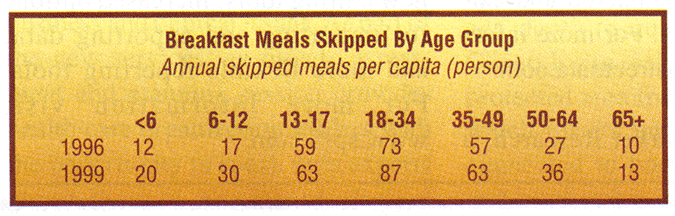
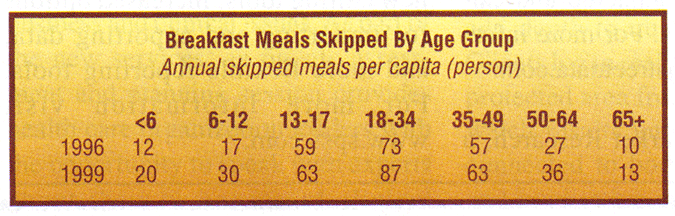
On-the-go and skipped meals accounted for 21 percent of all breakfasts last year, compared to 17 percent in the early ’90s. And an average of 73 breakfast meals per person were either eaten away from home or missed completely in 1999. Findings are reported in the firm’s latest Breakfast Book, which compares 1999 breakfast consumption patterns with the decade earlier. Information was collected from more than 2,000 nationally representative households. One of the key drivers for this trend is the increasing popularity of foods that are easy to eat and transport, such as yogurt, breakfast snack bars, and bagels. Fruit is the most popular carriedbreakfast food. However, breakfast snack bars have seen the largest increases among carried morning foods. They are now part of 6 percent of all carried breakfasts, twice as many as in 1990.
Top 10 Carried-Breakfast Foods
(Percentage of carried-breakfast meals including)
1) Fruit 24%
2) Breakfast/Snack Bars 6%
3) Cookies/Brownies 6%
4) Yogurt 5%
5) Bagels 4%
6) RTE Cereal 4%
7) Sandwiches 4%
8) Toaster Pastries 1%.
9) Donuts 1%
10) Muffins 1%
Not surprisingly, given the growing popularity of eating on the go, NPD reports that restaurants are preparing more of our breakfast meals for us. While the number of meals eaten at a restaurant remains constant, people are picking up more breakfast meals on the go and eating them elsewhere. The popular breakfast sandwich served at most fast-food restaurants reigns as America’s favorite gab-and-go morning food.
Top 10 Restaurant Breakfast Foods Eaten Off-Premises
1) Sandwiches
2) Donuts
3) Soft Drinks
4) Potatoes
5) Bagels
6) Eggs
7) Pancakes
8) Sausage
9) Biscuits
10) Cereal
Finally, while most people still eat breakfast, Americans are skipping breakfast more often. Skipped breakfast meals increased to 49 meals per person, up from 42 meals per person ha 1990. The average person skips approximately one breakfast meal a week. NPD found that people of all
ages are skipping breakfast more than they did years ago. Children 6-12 and young adults 18-34 lead this trend with the largest increases ha skipped meals within the past few years.
The NPD Group’s National Eating Trends panel is the primary source of data for this study. NET’s annual sample consists of 2,000 households containing approximately 5,200 individuals. The panel is demogaphically and geographically balanced to U.S. Census Bureau statistics each year.
Research finds the best brands in America
Total Research Corporation, Princeton, N.J., has announced the winners of its first syndicated online consumer survey, EquiTrend Online, naming the 19 world-class brands in the U.S. market.
Top honors go to Waterford Crystal. The 200-year-old Irish manufacturer of hand-crafted crystal was judged by American consumers as the brand was the highest quality.
“These are brands that are expensive and appeal to elegance, brands that are inexpensive and appeal to functional excellence, brands with a very simple product promise, and brands with much more complicated images,” says Doug Berdie, president of Total Research’s Strategic Brand Research Group. “Why are these 19 very electric brands on the same list? Because they share the same characteristic: They deliver what they promise. As a result, they score extremely high with all 40 consumer segments we measure. That’s what a 50-cent candy has in common with a $100,000 automobile. Quality counts.”
EquiTrend Online utilizes Internet technology to provide feedback from 30,000 Internet users on their perceptions of the quality of more than 1,300 brands in 35 industry categories.
The 19 Products with the Highest Quality (in descending order)
1) Waterford crystal
2) Rolls-Royce Bentley
3) Craftsman tools
4) Crayola crayons and markers
5) Bose stereo & speaker systems
6) Discovery Channel
7) M&M’s candies
8) WD-40 spray lubricant
9) Philadelphia brand cream cheese
10) Arm & Hammer baking soda
11) Reynolds Wrap aluminum foil
12) Harley-Davidson motorcycles
13) Kodak photographic film
14) Neosporin ointment
(15) Heinz ketchup
(16) National Geographic magazine
(17) Master Lock padlocks
(18) Clorox bleach
(19) Reese's peanut butter cup
Cable networks beat majors in connecting viewers with Web sites
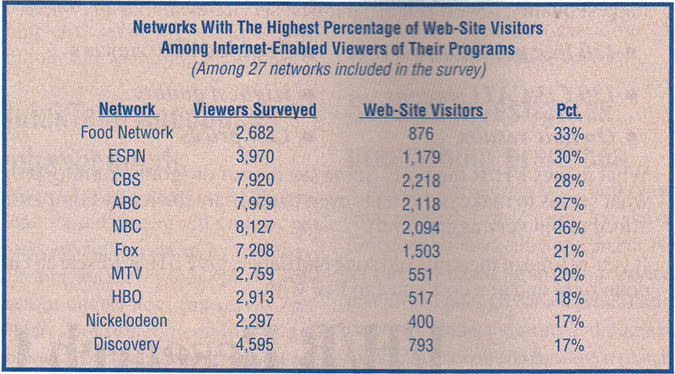
The Food Network and ESPN have emerged as leading television networks when it comes to connecting viewers to progam Web sites. The major broadcast networks (CBS, ABC, NBC, and Fox) have nogdone as well ha terms of getting Internet-enabled viewers to access their program sites, although they still do better than most cable networks.
These are some of the fmdings from a new study jointly conducted by Cincinnati-based Burke, Inc. and Greenwich, Conn.-based NFO Interactive. Findings from the study, "Connecting With Viewers: TV Progams and Their Web Sites," suggest that network Web sites can play a key role in creating loyal program viewers.
To discover more about the evolving relationship between television and the Intemet, 8,605 adult NFO Interactive panelists were surveyed via the Intemet from October 9 to October 25. Panelists were first asked which of 315 programs on 27 broadcast and cable TV programs they had personally watched in the three months prior to being surveyed. Viewers of progams were then asked if they had ever gone to the network Web site for that program and, if so, whether they had gone to the Web site for program information during or after their viewing. Viewers of each network were also asked if they had ever decided to watch a progam as a result of visiting that network’s Web site.
A total of 2,682 individuals, or 31 percent of those surveyed, indicated that they had watched at least one of 14 listed Food Network programs in the three months prior to the survey. Of these, 876, or 33 percent, had also been to the Web site devoted to at least one of the progams viewed. "Emeril Live" by itself attracted 714 of these viewers to the Web, although several less heavily watched Food Network progams ("Food Finds," "Good Eats," "Inside Scoop," "Calling All Cooks," and "FoodNation") also managed to inspire at least one-quarter of their viewers to journey to the program Web sites.
Five ESPN programs, including NFL football and Major League Baseball coverage, were included on the survey. A total of 3,970 individuals, or 46 percent of those surveyed, indicatedthat they had watched one of the listed programs. Of these, 1,179, or 30 percent, indicated that they had been to ESPN’s sports-oriented Web site,
The major broadcast networks were definitely the most viewed by survey respondents. More than 90 percent had seen at least one listed program on NBC, ABC, and CBS, and 84 percent had seen at least one of the Fox programs listed: Of these four networks, CBS did slightly better than the others in getting Web-enabled viewers to its program Web sites. Twenty-eight percent of surveyed CBS viewers indicated that they had been to the Web site of at least one CBS progrhrn they had seen, compared to 27 percent forABC, 26 percent for NBC, and 21 percent for Fox. (See table.)
CBS’s leading Web franchises ha the period covered by the survey included "Survivor" and "Big Brother." ABC’s numbers were especially sparked by "Who Wants to Be a Millionaire." NBC’s most-viewed Web site was for its Olympics coverage. For Fox, the leading producer of Web-site visitors was its NFL football coverage.
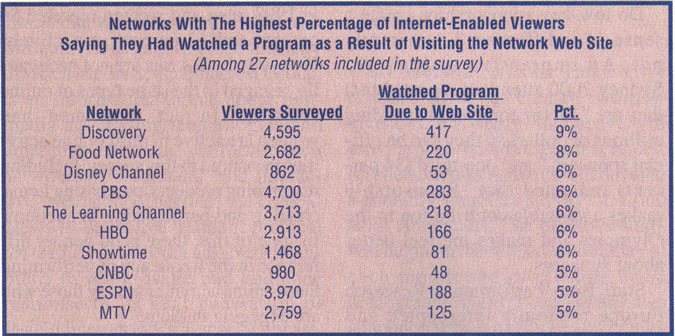
Even more cable networks beat the major broadcast networks in terms of program viewing. In this area, the Discovery Channel was the leader among networks included in the survey. A total of 417 surveyed individuals - 9 percent of all Discovery Channel viewers surveyed - indicated that they had decided to watch a progam on the Discovery Channel as a result of visiting its Web site. (See table.)
By contrast, only about 4 percent of Intemet-enabled viewers of each of the major broadcast networks (ABC, NBC, CBS, and Fox) indicated that they had watched one of that network’s shows because as a result of a Web-site visit.
Credit card companies worst junk mailers
PrimeResponse, an Orlando, Fla., relationship marketing firm, has released the first set of results from its research study "Junk Mail Offenders in the New Economy" showing that banking, credit card and insurance organizations as the worst purveyors of unsolicited junk mail.
These initial findings are from the first in a four-part global research study that gathered feedback from consumers in Australia, France, Germany, Netherlands, the U.K. and the U.S. To conduct this study, PrimeResponse commissioned the services of Ipsos-RSL Ltd. in September 2000. The survey was conducted using an omnibus methodology in Australia, France, Germany, the Netherlands, the U.K. and the U.S. In France and Germany, Ipsos-RSL used its CAPIBUS Europe omnibus methodology, a harmonized CAPI omnibus service. In the remaining four markets, Ipsos-RSL used preferred suppliers to collect the data.
The study revealed that the buying public believes financial services organizations (e.g., banks, credit card companies and insurance agencies), in an effort to gain more business and gow their bottom line, have forgotten how to treat consumers as individuals - and are jeopardizing customer relationships.
For the first findings, PrimeResponse focused on the sectors within the financial services industry that distributed the most unwanted direct mail as well as the channel most often used for contacting the consumer (direct mail, telemarketing and e-mail). The firm also analyzed the extent to which the public is prepared to reveal information about themselves to these organizations based on different scenarios, both with and without incentives.
In the U.S., respondents cited credit card companies as the worst junk mail offenders, pushing 64 percent of all unwanted direct mail. Similar results were also reported in the U.K., where people received most of their unwanted direct mail from credit card companies, who were responsible for more than 50 percent of all consumer junk mail. In France, Germany, the Netherlands and Australia, banks, building societies and credit card companies were all highlighted as the worst offenders for distributing unwanted direct mail to consumers.
Financial services companies account for the most junk mail sent to consumers, with the exception of Germany and the Netherlands. However, in both of these cases, banks still received the secondhighest score. Traditional channels, such as direct mall and telesales, are used equally for males and females. However, newer electronic channels are focused primarily toward males. This is especially true for e-mail, but also for text messaging and the Web.
The base sample for the study was 1,000 adults aged 15+ in all markets except Germany and Australia, where the population surveyed was age 14+, and in the United States, where the adults contacted were aged 18+. A summary of the study is available at www.primeresponse.comJnews/pressroom/nm_summary.html.
At the Olympics, less may be more
Critics have always charged that the Olympics are more about marketing and less about sport, but a survey of fans attending the Sydney 2000 Games has found that subdued commercialism does not necessarily mean diminished sponsorship results.
While previous Summer Olympic Games have been critiqued for over-the-top marketing and a carnival-like atmosphere, organizers of Sydney 2000 were determined that the Olympic stage should be more than just another advertising medium deluging Olympic fans. Their efforts appear to have been successful: A Performance Research study of visitors to the Sydney Olympics revealed that only 20 percent reported the Games to be over-commercialized - a steep drop from the 1996 Atlanta Games, where 40 percent of attendees cried "Over-commercialization!"
But does subdued commercialism mean weaker impact? The results may indicate the opposite. When looking at returning worldwide sponsors McDonald’s, Kodak, Nike, IBM, UPS, and Visa, each one recorded higher spontaneous recall figures in Sydney than they did in Atlanta. The most extreme lifts were noted for McDonald’s (35 percent spontaneous recall in Sydney; 9 percent in Atlanta), IBM (21 percent Sydney/9 percent Atlanta ), and Visa (16 percent in Sydney/8 percent in Atlanta). The only exception to this trend was Coca-Cola; however, considering its headquarters is in Atlanta, a drop in sponsorship awareness would be expected.
Do low-key sponsorships create a sense of indifference? Apparently not. An impressfve majority of Sydney 2000 attendees reported that they are "All for companies spending millions of dollars so they can be official sponsors," and one-third (34 percent) indicated that "Sponsorship makes a valuable contribution to the Olympics and makes me feel better about sponsors."
Staff from Performance Research Europe randomly intercepted and interviewed, in-person, 200 attendees during the 2000 Summer Games. The margin of error is +/-5 percent. Performance Research Europe is a division of Performance Research, Newport, R.I.
Electronics not just ’toys for boys’
When it comes to technology, women and men may well be more alike in their thoughts and perceptions than most people think. According to the results of a study by eBrain Market Research, although a technology gender gap does still exist, the types of consumer electronics products men and women have in their homes do not vary widely. Further, there are very few differences when it comes to the "regular" usage of these same products.
The study found that men are only somewhat more likely to have certain types of products in their homes than women (home stereos, hand-held music devices, computers, video game systems, camcorders and DVD players). The study also found that there is little difference between men and women in terms of actually using these same products. For example, when asked, "Which of the following do you personally use on a regular basis?" the biggest discrepancy was found in camcorders (men 44 percent, women 33 percent), whereas most categories were separated by less than 5 percent.
Also interesting is the apparent disappearance of the gender gap between the number of men and women online. Sixty-six percent of men report being online compared to 61 percent of women. In a similar survey conducted in 1998, men and women reported 56 percent and 42 percent respectively. However, both sexes are not necessarily engaged in the same types of online activities. In fact, more men than women are active in most online activities measured in this survey, including researching products, purchasing items, chatting and participating in auctions. In spite of this, there is no gender difference in the frequency of performing these online activities among those who are engaging in them.
"The concept of consumer electronics products being ’toys for boys’ is clearly outdated," says Todd Thibodeaux, chief operating officer of eBrain Market Research. "The utility of these products is universal, and consumers, both male and female, recognize the benefits to their lifestyles and workstyles."
The gender differences that were found dealt mainly with the research and installation aspects of consumer electronics purchases. When asked who initiates the purchase pro. cess, the survey found a clear bias towards men as the initiator - nearly 60 percent of men responded "myself," as opposed to less than 50 percent of women. In addition, men tend to utilize the media as a resource for information about technology more than women, while women tend to get their information from other people, such as their spouse, children, other relatives or friends.
The biggest difference was found in installation behavior once a product is purchased. Men are clearly more involved with the set-up and connection of new product purchases. When asked who is responsible for setting-up or connecting a new product, nearly 80 percent of men answered "myself," as opposed to only 40 percent of women.
The survey was designed and formulated by eBrain Market Research and fielded between October 6-9 to a representative sample of 1,000 random national households. The complete study is available free to Consumer Electronics Association member companies.