
Save some, spend some
Now that the gift-giving season has come to an end, American kids have a tremendous amount of money at their disposal. Will they be running out to buy the latest video game system, or will they be persuaded by their parents to put their money into college funds? According to a two-part study conducted by KidzEyes.com, an online research panel, the large majority of kids (71 percent) between the ages of 6-14 will save some of their money to buy something later. Nearly half (46 percent) of the kids reported they would spend their money right away; 28 percent said they would put it in the bank to save for the future; 14 percent said they would give money to a charity; and 6 percent said they would let their parents decide what to do with it. The KidzEyes.com survey of more than 1,700 kids nation-wide examined kids’ relationship with money as well as their shopping and spending habits.
Kids’ primary source of spending money is gifts. In fact, 80 percent of kids said they get their money from gifts. Other sources kids get money from include their parents, with 48 percent of parents giving their kids money when they need it, and working miscellaneous jobs including mowing lawns, shoveling, washing cars, and babysitting (34 percent). Fifty-eight percent of kids also get a weekly allowance which averages $6 nationwide.
Once kids decide it’s time to spend their money, it’s a safe bet that they will spend some, if not most, of their money on food. When asked to detail what their past three purchases were, 75 percent of kids mentioned some sort of food.
Candy was the most popular food selection, with 59 percent of kids reporting candy purchases. Candy was an especially popular choice among younger kids (ages 6-8), with 66 percent reporting buying it, as compared to older kids (ages 12-14), who reported buying candy 49 percent of the time. Older kids are significantly more likely to purchase beverages; 38 percent reported that they used their own money to buy beverages, whereas only 24 percent of younger kids reported buying beverages. After food, younger kids prioritize buying toys, whereas older kids choose to spend their money on clothes and music. In fact, 58 percent of younger kids said one of their past three purchases had been a toy, compared to only 18 percent of older kids. Likewise, . older kids reported purchasing clothes (37 percent) and music (21 percent) as compared to younger kids who purchase these items only 16 percent and 9 percent respectively.
On average, kids claim to spend between $8-9 per week. Boys and girls tend to spend the same amount of money per week, but older kids are spending about twice as much as younger kids. While these relatively small purchases might not seem to amount to much, in reality, kids are spending more than $16 billion of their own money per year.
And just how well do kids really understand the concept of money? They have a pretty good understanding that while money is not the key to happiness, it is extremely important. Only 15 percent of the kids thought that people with money are the happiest in life. However, kids do think that money has the potential to make them happier. Ninety-four percent of them thought they would definitely or possibly be happier if they woke up tomorrow with $10,000. Interestingly, more boys think that money will make them happier compared to girls. Seventy-five percent of the boys sampled emphatically agreed that acquiring more money would make them happier, as compared to 64 percent of girls.
When kids were asked in an openended format what they would buy if they won $10 in a lottery, a typical response was toys. When that figure was raised to $1,000, many kids said they would buy more toys. And if kids won $1 million in a lottery, most said they would want to buy even more toys and also buy some things for their parents.
In terms of being strategic or impulsive with their money, kids are pretty split down the middle. Boys are slightly more likely to act impulsively with their money: 60 percent of boys said they would rush right out to buy something when they wanted it, while 51 percent of girls said they would rather save their money until the time was right.
Consumers look to simplify meal prep
Nearly 80 percent of all suppers consumed in America take place at home, according to research from The NPD Group, Inc., Port Washington, N.Y. As a result, Americans are looking for ways to make meal preparation easier, according to NPD’s annual Report on Eating Patterns in American.
Although the number of suppers prepared by females has declined slightly from 78 percent in 1995 to 76 percent in 2000, the job of cooking still falls mainly on the shoulders of women. Therefore, according to Harry Balzer, vice-president of NPD and author of Eating Patterns in America, “Mom is looking for an easier way to prepare meals and has found three key ways to do just that.”
Eating Patterns in America found that the easiest way to make every meal less work is to cut back on the number of dishes served. In 2000, the average supper consisted of 3.6 dishes, the lowest number in the 16 years of the report and 8 percent smaller than 10 years ago. The side dish is one being dropped. In 1990, 65 percent of suppers had at least one side dish, but in 2000 that number was only 56 percent. The side dishes most often eliminated are vegetables, potatoes, salads, and bread.
The second way American cooks are making easier meals is by spending less time assembling the main dish. Although there is still a main dish at supper, it is more likely to be a frozen product. The percent of suppers served with a frozen main course reached an all-time high in 2000 of 11.5 percent, up 22 percent from just five years ago.
The third way Americans are making their lives easier is by inviting fewer people over to share a meal. In 2000, the average American household served 52 meals to guests (including breakfast, lunch, supper and snacks). That is down from 94 guest meals in 1985 and 72 in 1995. As Balzer puts it, “Having guests over is more than just a meal. You have to clean the house too!”
Although Americans are interested in making meal-time easier, they are not taking meals out from restaurants. For the first time in 12 years, the number of meals purchased at a restaurant by the average American to be eaten at home dropped from 141 in 1999 to 138 2000. The decrease is directly related to the number of new, ready-to-cook and ready-to-eat products offered at the supermarket.
The Report on Eating Patterns in America is based on the results of over 30 research studies conducted conducted by NPD, including the daily food and beverage consumption of 5000 Americans. The studies used for this analysis included proprietary daily food diaries, retail sales, kitchen audits, restaurant sales, food safety concerns, appliance and cookware sales, nutritional concerns and others.
Newspaper readership holding steady
Newspaper readership in the top 50 U.S. markets gained nearly a full percentage point in the Newspaper Association of America’s Fall 2001 Competitive Media Index (CMI), an NAA analysis of market data from Scarbi~rough Research for the period ending March 2001.
In the top 50 markets, 54.3 percent of all adults said they read a newspaper yesterday, a gain over the 53.5 percent reported in the spring CMI report. Sunday readership held steady at 63.7 percent, compared to 63.8 percent in the last CMI.
"The newspaper industry has put tremendous effort and resources into shoring up its readership base, and it’s encouraging to see a gain in our reach," says NAA President and CEO John F. Sturm. "Further, since the survey period for this report ended in March 2001, these numbers stand alone. They do not reflect the surge in readership we’ve heard about from folks picking up newspapers to help them comprehend the events of September 11 and their aftermath." When looking at a ful! week, the number of people who read a newspaper increases significantly. Over five weekdays, newspapers reach more than seven in 10 (72.9 percent) adults, and over four Sundays, newspapers reach more than three-quarters (77.4 percent) of adults in the top 50 markets.
Other media held steady or showed slight declines from the spring CMI to the fall. The average half-hour of prime-time TV held steady at 38.8 percent of adults, compared to 38.6 in the spring. The same block of cable prime-time reached 12.9 percent of adults, faring slightly better than the 12.2 last spring. The average quarter-hour of both morning and afternoon radio drive-time fell to 21.9 percent (from 22.9 percent) and 17.9 percent (from 18.5 percent), respectively.
In addition to reporting newspaper readership trends, NAA conducted an analysis of data in the Audit Bureau of Circulations’ (ABC) Fas-Fax report for the six-month period ending September 30. Based on ABC data, NAA concluded that for the 757 papers reporting for this period, total daily circulation Was 47,861,622; the 593 Sunday papers saw total net-paid circulation of 52,596,972. Several ABC role changes affecting how newspapers report paid circulation make it difficult to compare data from this Fas-Fax with that reported a year ago. Although this Fas-Fax reporting period includes the increases in newspaper sales since September 11, the data are averaged over a six-month period ending September 30.
"New definitions created by ABC for what constitutes paid circulation mean that comparing this report to the previous year’s numbers is unworkable," says Sturm. "NAA’s core focus is readership and we will continue to report readership analysis from the CMI twice a year," Sturm says. "This is the last time NAA will provide an analysis of aggregate ABC data. We are hopeful that in the future ABC will report aggregate Fas-Fax totals."
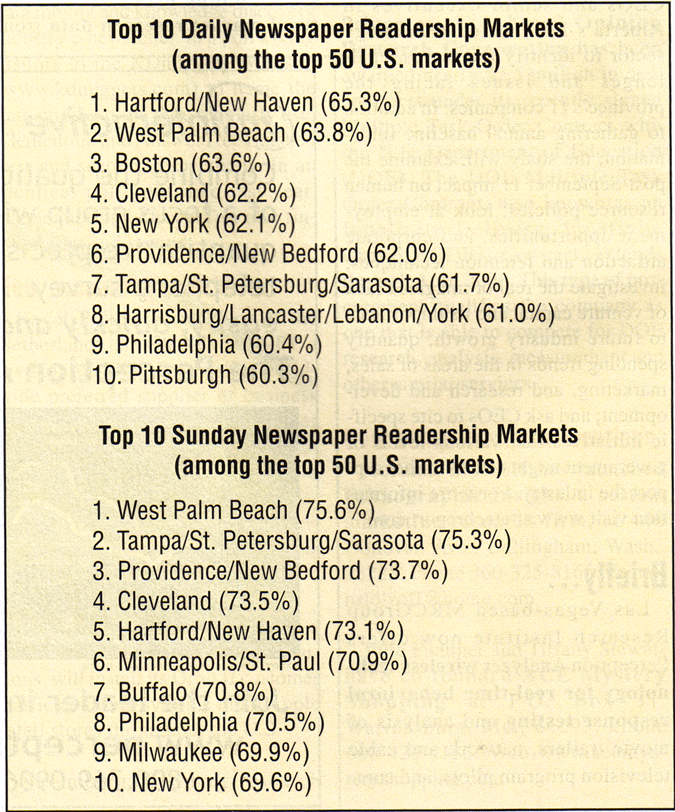
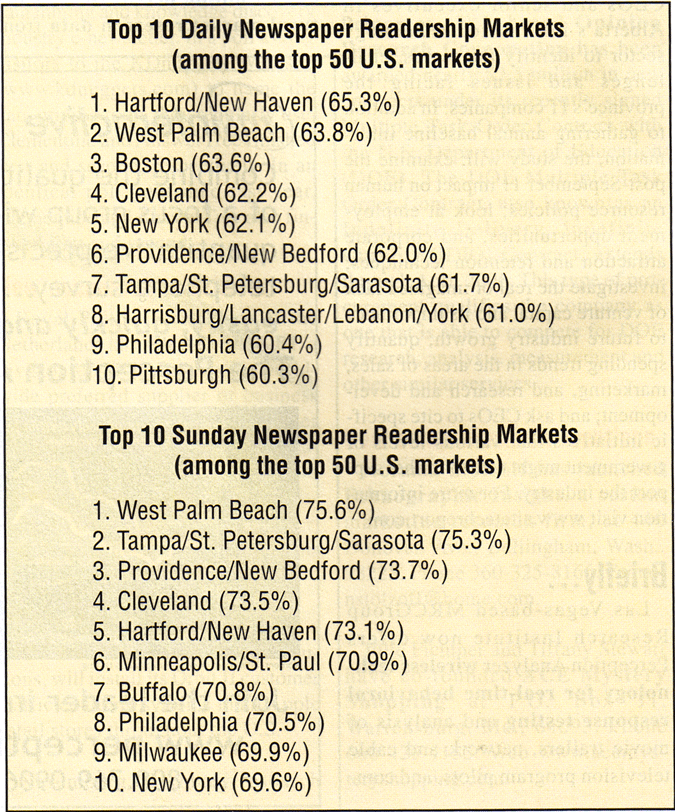
The chart shows a list of adult readership in the top-10 daily and Sunday newspaper markets, according to the Fall 2001 CMI.
The CMI is based on audience research data collected by Scarborough Research, New York, to which NAA subscribes. Scarborough measures 75 DMAs (including the top 50). It collects data via telephone interview and a mailed consumer survey booklet and seven-day TV diary. Scarborough collected fieldwork for Release One 2001 from February 2000 through March 2001.
Ranks of women-owned firms keep growing
The expansion in the number of women-owned businesses with 100 or more employees, as well as those with $1 million or more in revenues, is outpacing the growth rate of all businesses of the same size, according to a new study from Center for Women’s Business Research (founded as the National Foundation for Women Business Owners), which was underwritten by Wachovia Corporation and conducted in cooperation with Dun & Bradstreet. The study also documents that women-owned businesses are as financially robust and creditworthy as all businesses, regardless of size.
The study, "Removing the Boundaries: The Continued Progress and Achievement of Women-Owned Enterprises," takes an in-depth look at the characteristics of commercially active women-owned firms in the United States between December 1997 and December 2000, focusing on growth and financial strength. The study found that the number of women-owned firms with 100 or more employees increased by 43.9 percent, which was 68 percent faster than all businesses breaking the 100-employee mark during the 1997 to 2000 period. The ranks of women-owned firms with 500 or more employees are expanding even faster.
The number of these firms increased by 124.3 percent over the same period, nearly triple the growth rate among all firms of this size. Further, the number of women-owned firms with revenues of $10 million or more grew by 36.8 percent, more than three times the rate of comparably-sized firms.
The study also reaffirms that women-owned businesses are just as financially robust and creditworthy as the average U.S. firm.
"This new and compelling information demonstrates women-owned firms’ continuing vitality and growth," says John Guy, small-business segment executive for Wachovia. "There are no differences between the scores registered by women-owned firms and the scores of the average U.S. firm in three key measures - bill payment, financial stress and overall creditworthiness. On a five-point scale of financial stress, the vast majority of women-owned and all firms are at the low end of the scale, with 74.3 percent of women-owned and 70.6 percent of all firms under very low levels of financial stress. In addition, when assessing overall credit-worthiness, 65.7 percent of women-owned firms have a low to moderate credit risk rating, compared to 62.9 percent of all firms."
Contrary to common perception, women business owners are no more likely than men to have home-based businesses. Just over one-fourth (27.9 percent) of women-owned firms are home-based, as are 23.9 percent of all commercially active U.S. firms. The study also confirms that women own businesses in every industry and the rate of growth in the number of women-owned firms exceeds the industry average in nearly every major industry group. The growth in the number of women-owned businesses is highest in agriculture/ forestry/fishing (79.3 percent), engineering/ accounting fresearch services (30.4 percent), real estate (26.7 percent), durable manufacturing (26 percent) and other services (21.9 percent).
"Women-owned businesses also continue to start firms in every industry, with one-third [33.6 percent] of women-owned firms being less than four years old," says Ron Wesson, senior vice president for minority- and women-owned business solutions for D&B. "The industries with the greatest share of women-owned start-ups over the past three years are health services [45 percent], retail trade/general merchandise stores [44.4 percent], finance and insurance [37.5 percent], engineering/accounting/research services [36.4 percent] and business services [36.2 percent]."
Women-owned firms are as likely as all firms to remain in business. Two-thirds (65.5 percent) of the women-owned firms that were in business in December 1997 were still in business at the end of 2000, similar to 66.2 percent of all U.S. businesses.
The age profile of women-owned businesses is moving toward that of all firms, although women-owned firms are still somewhat younger than the average U.S. firm. There is significant growth in the number of early stage growth women-owned firms - more than one-third (37.7 percent) of women-owned firms are from three to 11 years old, compared to 29.6 percent of all U.S. firms.
Regional differences can be seen among women-owned firms in terms of growth, entry of new women-owned firms, and financial strength and creditworthiness. In every region of the country - with the exception of West North Central - the growth rate in the number of women-owned firms exceeds the regional growth rate among all firms.
The regions with the greatest share of new women-owned firms are the Mountain and West South Central states (49.9 percent in each region are less than six years old) and the South Atlantic region (47.3 percent).
Women-owned firms in the North and East exhibit the best overall financial strength and creditworthiness. On three measures - bill payment, financial stress and overall creditworthiness - women-owned firms in the Northeast and West North Central regions perform better than the national average.
On an industry basis, women-owned firms in mining and finance/insurance/real estate have better than average ratings on all three measures of financial strength and creditworthiness.
Not afraid to fly
A survey of 400 air travelers conducted in late October 2001 by Milwaukee-based Market Probe found that 39 percent exhibited a high level of comfort in planning their next airline trip. Thirty-two percent showed a moderate level of comfort and 29 showed low levels of comfort. New York and Washington, D.C. were two cities most travelers are not comfortable flying to, followed by Los Angeles and Chicago. Among people who had flown since September 11, comfort levels were slightly higher. Forty-eight percent of those flying after September 11 reported a high level of comfort in planning their next airline trip with another 32 percent showing moderate levels of comfort; 20 percent felt low levels of comfort.
Energy issues not top-of-mind
Americans appear to have turned their attention away from energy issues, based on the results of a survey conducted by International Communications Research, Inc., Media, Pa., for Deloitte & Touche LLP between October 3 and October 7. At the same time, the survey of more than 600 respondents indicates consumers have increased concern about fuel price, security and reliability, with fewer survey respondents in 2001 (39.7 percent) being aware of changes in the electric industry compared to 2000 (50.5 percent). This reverses a five-year trend of increasing consumer awareness of changes in the electric industry. An even greater majority of survey respondents in 2001 (56:2 percent) versus 2000 (52.7 percent) expect that electric rates will increase rather than decrease due to deregulation.
"Not only are consumers less informed, they appear to be more pessimistic about the benefits of electric deregulation," says Gregory Aliff, managing partner of Deloitte & Touche’s Energy Resources Group practice. "Our survey indicates that consumers continue to be concerned about prices, reliability and availability of electric services in the future. Less than half the states have taken any action on electric deregulation, so the survey reflects some backsliding from 2000."
Survey results for awareness varied widely in part because there is no national policy concerning consumer choice of electric supplier. The decision to introduce competition for electric supply to consumers is reserved for state-by-state determination. Currently about half the states have passed legislation or taken regulatory action.
"For the 2001 survey, we also added questions concerning nuclear power and increasing domestic oil and gas consumption," says Branko Terzic, director of the regulatory services at Deloitte & Touche. "Respondents were overwhelmingly for increasing domestic energy production [73 percent "yes"], but were almost evenly split [42.3 percent for, 47.6 percent against] on the issue of resuming nuclear power plant construction when considering the margin of error in the survey."