
Thumbs down on distracted drivers
A Maritz Poll from St. Louis-based Maritz Research reports that 90 percent of American drivers feel driver distraction (doing other things while driving) is a significant cause of accidents in the United States. Furthermore, almost one-third of the respondents (31 percent) reported they have gotten into or nearly gotten into an accident because they were distracted while driving. More men (34 percent) than women (29 percent) have gotten into or nearly gotten into an accident because they were distracted while driving.
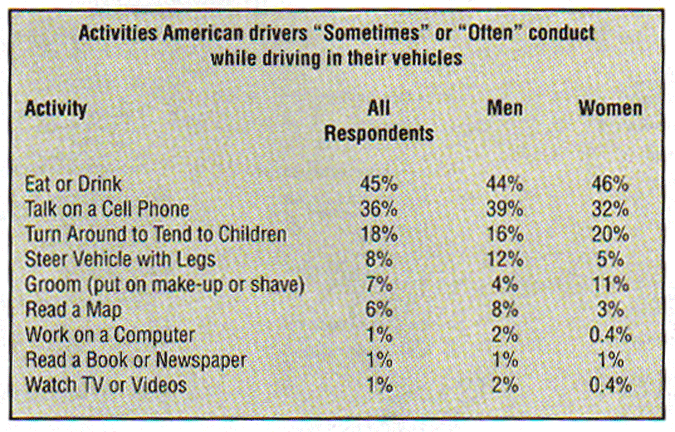
While 90 percent of respondents believe driver distraction causes accidents, a large percentage still engage in driver distraction activities. For the most part, more men than women engage in these risky behaviors. Americans were asked if they "Never," "Rarely," "Sometimes," or "Often" engage in a variety of activities while driving.
The findings are based on a random national telephone survey of 1,004 (501 male, 503 female) U.S. adult automobile owners.
According to the Maritz Poll, respondents who were previously in an accident or nearly in an accident because they were distracted while driving were still more likely to engage in driver distraction behaviors. These respondents were between 36 percent and 45 percent more likely to report that they "sometimes" or "often" engage in the following behaviors while driving: turning around to tend to children; talking on a cell phone; steering with legs; and, eating or drinking.
The findings further report that younger and middle-aged drivers engage in driver distraction behaviors more than older drivers. For the most frequent driver distraction behaviors, 18- to 44-year-olds engaged in the behaviors at fairly similar rates. However, those over age 44 reported engaging in those behaviors much less frequently.
Dollar stores garnering consumer attention
A study from Chicago-based Information Resources, Inc., "IRI Insights on Dollar Stores" shows that the $12.5 billion channel of trade has clearly arrived and shows no sign of slowing. Dollar store operators are aggressively working to broaden offerings, increase convenience relevancy, and match the deep-value premise consumers seek as economic uncertainty continues to loom. While dollar stores have often been characterized as the source for lower quality non-essentials, consumers prove otherwise, increasing their purchases of name brand food and health items in dollar stores. With one in five U.S. households now spending roughly the same amount on consumables in dollar stores as they do in club or drug stores, the competitive retail pool is deepening.
Key findings include:
- More shoppers and more frequent trips to the dollar store are driving the channel’s double-digit growth. Dollar stores added three million new household shoppers in the past year. Shoppers of other channels like food, drug, mass, supercenter, and convenience were not immune to catching the dollar store bug as more than half of the heaviest shoppers in these channels also shopped the dollar store.
- Dollar stores continue to effectively home in on an important retail void, combining convenience and low-priced shopping options. Dollar shoppers have strong shopping opinions and differ from some conventional wisdom. Dispelling the myth of the trapped urban shopper, over one-third of the most involved dollar store shoppers like to store hop - half wish stores were open longer so they could shop at anytime. While on tight budgets, they also think shopping is fun and regularly seek convenient altemafives for traditional grocery and drug purchases. Dollar store shoppers are very deal-aware, easily switching brands for savings.
- Heavy dollar store shoppers are an extremely involved shopping group and are driving over 80 percent of consumables sales in the channel. Far from being an obscure minority of shoppers, roughly one in five U.S. households qualifies as a heavy shopper of dollar stores.
- Dollar stores are seeing additional purchases of many traditional food items as manufacturers continue to develop products and packaging specifically for the dollar channel.
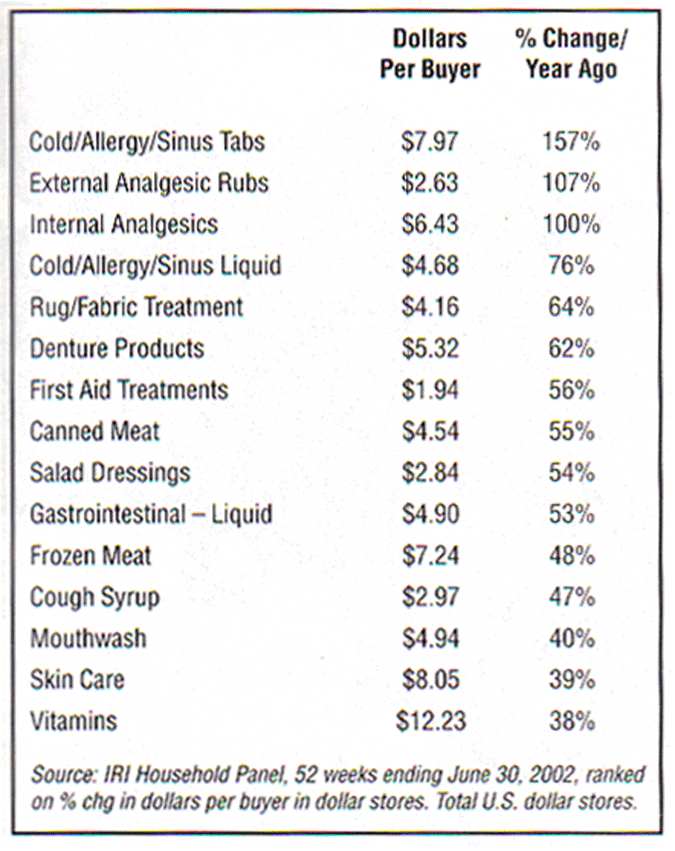
Shoppers are also adding more healthcare items to their baskets. Over the past year, shoppers of such items as cold care and analgesics have doubled their individual purchases of those items in dollar stores. Eleven of the top 25 growth categories in dollar stores are health or beauty care (see chart).
Percentage of adult women sports fans doubles
According to a national study from Scarborough Sports Marketing, New York, 50 million women avidly follow professional sports (this includes women who are very/somewhat interested in the NHL, NFL, NBA, WNBA, PGA, NASCAR, pro soccer, or MLB). Talk to any sports enthusiast and most will stereotype the sports fan to be male. Wouldn’t they be surprised to know that the female fan is giving their male counterparts a run for their money? The percentage of adult women 18+ who are loyal (very/somewhat avid) sports fans has doubled in the last four years, surging from 29 percent in 1998 to 58 percent in 2002.
The study revealed that Major League Baseball (MLB) was the biggest hit among women 18+ over the last four years, with the number of loyal female MLB fans jumping from 12 percent in 1998 to 28 percent in 2002. Women also tackled football in record numbers, with 31 percent reporting they are loyal NFL fans in 2002, compared with only 17 percent in 1998. Other professional sports organizations that demonstrated measurable growth among loyal female fans over the last four years included NASCAR (increasing from 5 to 13 percent); the PGA (swelling from 5 to 12 percent); the NBA (growing from 11 to 19 percent) and the NHL (increasing from 5 to 10 percent).
In addition to the growth trends among female sports fans, the study also offered insight into the demographic profile, socioeconomic characteristics and lifestyle activities of these enthusiasts. The study indicated that loyal female NHL fans are 34 percent more likely than the average woman to be age 18-34; they are 23 percent more likely to be single; and 70 percent of loyal female NHL fans have purchased sports apparel in the past 12 months. What do these fans do when they’re not following the NHL? They are more than twice as likely then the average woman to go in-line skating, 76 percent more likely to participate in team sports and 44 percent more likely to go camping.
Scoring points in more recent years is the WNBA. The loyal female WNBA fan’s median age is 42; they are 27 percent more likely to see a movie within the first two weeks of the opening; and 16 percent more likely to have children in the household. They also like to stay active when they’re not following the WNBA. Loyal fans are 26 percent more likely than average to go bowling; 46 percent more likely to stay in shape by jogging/running; and 11 percent more likely to enjoy photography in their spare time.
The study indicated that female sports fans are active consumers of, and participants in, a variety of sports and entertainment activities. For example, the study revealed.that female NFL fans like to rev things up off the field, attending NASCAR events (48 percent more likely), R&B/rap/hip-hop concerts (35 percent more likely) and comedy clubs (28 percent more likely) at rates well above the norm. Similarly, avid female MLB fans are 25 percent more likely to attend country music concerts, 24 percent more likely to attend rock concerts and 12 percent more likely to buy/lease a new SUV in the next 12 months.
How do female loyal sports fans vary across the U.S.? The markets that post the largest percent of loyal fans are Denver and Minneapolis (both 69 percent). Other high-ranking markets included Buffalo, N.Y. and Cleveland (both 66 percent)and Jacksonville, Fla., St. Louis and Atlanta (all 65 percent). Meanwhile, female residents of Fresno, Calif., E1 Paso, Texas, Los Angeles, and Wichita, Kan., were the least likely to get in the game, with half of women in those markets avidly following professional sports.
Business confidence remains strong despite gloomy global outlook
Senior executives in North America are considerably more optimistic than their counterparts in Europe and Asia Pacific that global economic conditions during the coming year will improve, according to research by Taylor Nelson Sofres (TNS) in consultation with Deloitte Consulting.
The proportion of senior executives in North America who believe that "global economic conditions will improve" over the next 12 months has increased by 10 percent between Q2 and Q3 of 2002. This contrasts with a decrease of 15 percent in the expectations of executives in Europe over the same period of time and a drop of more than half (51 percent) among executives in Asia Pacific.
The study surveyed more than 600 CEOs, CFOs, COOs, CIOs, heads of strategy and tax directors each quarter from companies in Asia Pacific, Europe and North America. The study found that just 5 percent of senior executives in North America surveyed in Q3 believe "that global economic conditions will get worse over the next 12 months" compared with 10 percent who felt this in Q2.
In contrast, almost one in five (19 percent) senior executives in Europe currently believe that global economic conditions will deteriorate compared with just 11 percent in Q2. In Asia Pacific, almost half (45 percent) of those senior executives questioned in Q3 said they thought that tile global
economic situation would worsen over the next 12 months compared with just 2 percent in Q2.
Globally, respondents from companies with revenues of less than $1 billion were almost twice as likely to think that global economic conditions will get worse in the next 12 months compared with those from companies with revenues of $3 billion or more. In addition, confidence among those from companies with sales below $1 billion showed the most dramatic decline between Q2 and Q3 with an increase of 19 percentage points in the proportion of businesses predicting that global economic conditions will get worse.
The most pessimistic business sector globally was heavy industry, with more than a third (37 percent) of respondents in Q3 saying there would be a decline in the global economic climate over the next 12 months. None agreed with this statement in Q1 and Q2. In contrast just 12 percent of respondents from the financial services sector felt that economic conditions would worsen.
CEOs and tax directors demonstrated the most significant decline in confidence since Q1 at the global level, with heads of strategy and CIOs emerging as the most optimistic over the past three quarters that global economic conditions will improve during the next 12 months.
Internet penetration at 66 percent of adults nationwide
The nation’s online population remains stable, showing only a slight apparent increase after a pause which coincided with the bursting of the dotcorn bubble. According to data from The Harris Poll, fully two-thirds (66 percent) of all adults are now online. This includes more than half (55 percent) of all adults who access the Interact from home, almost a third (30 percent) who access it from work, and almost one in five adults who go online from a school, library, cyber cafe or other location. Of course, some people are online from two or more places.
These numbers show rates of Internet penetration have remained fairly stable, with a non-significant apparent increase from 64 percent to 66 percent in Internet penetration (for those online at any location) since fall 2001. Those online from home are up from 52 percent to 55 percent; those online at work are up from 28 percent to 30 percent, and those online at another location are unchanged at 19 percent. Additional waves of data collection will help to determine whether this increase is, in fact, significant.
The profile of Internet users still has a bias towards the more affluent, better educated consumers, but the profile by age is looking more like a cross-section of all adults - up to, but not including, those over 65, who comprise 16 percent of all adults but only 5 percent of those online.
One other interesting finding in this research is that there has been little change in the amount of time Internet users spend online. On every occasion Harris has measured it, respondents have been spending seven or eight hours online each week. A reasonable assumption however is that as technology and Internet skills have improved, people can get more done now in the seven or eight hours they spend online than they could have a few years ago.