
Grocery stores losing share of shopping trips
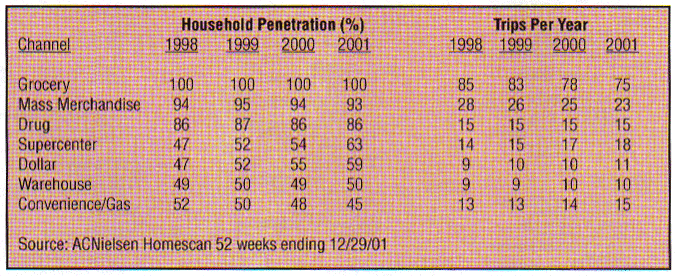
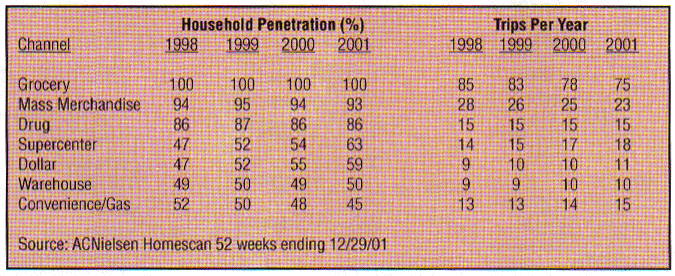
Consumers are shopping less frequently in traditional grocery stores, while they are increasing their trips to supercenters like Wal-Mart and dollar stores, according to the latest "channel blurring" study from Chicago-based ACNielsen U.S. According to the study, supercenters and dollar stores are showing gains both in the percentage of households who shop in those channels and in the number of trips consumers take to them each year. The findings were based on an analysis of ACNielsen Homescan consumer panel data.
According to Todd Hale, senior vice president, consumer insights, ACNielsen U.S., "More than ever, grocery retailers have to create a unique reason for shoppers to choose them. The consumer has to associate the name on the store with something very positive and very different from the competition, whether it’s the freshest produce, ,the best selection of seafood, or the most interesting and convenient-to-purchase prepared meals. Retailers could be doing much more with their frequent shopper databases to segment their customers and to develop strategies around each segment to grow their overall busirless."
As the chart shows, all U.S. households still shop in traditional grocery stores, but the annual number of trips households make to such stores is continuing to decline. At the same time, both supercenters and dollar stores have shown strong gains in household penetration and smaller gains in annual trips.
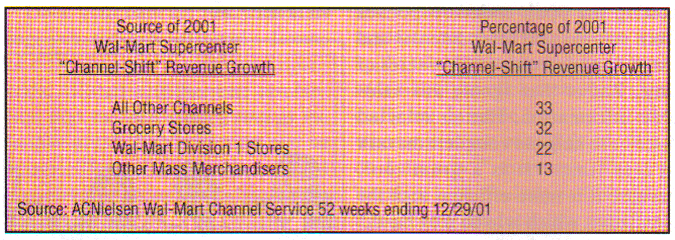
Among supercenters, Wal-Mart has been especially successful at converting grocery-store customers to Wal-Mart customers. An analysis of ACNielsen Wal-Mart Channel Service data shows much of the retailer’s supercenter sales growth coming from traditional grocery-store shoppers. While 7 percent of 2001 Wal-Mart Supercenter sales growth came from new shoppers and 21 percent came from existing shoppers who increased their Wal-Mart Supercenter spending, the majority - 72 percent - came from a direct shift of dollars that had previously gone to other channels. As the chart shows, almost one-third of that "channel-shift" revenue growth came from the grocery channel.
Hale says it is important to note that the degree to which Wal-Mart is gaining at the expense of the grocery channel is actually somewhat less than would be expected. "When you exclude the supercenter channel, grocery stores generated 40 percent of all-outlet revenue in 2001. Therefore, of the channel-shift revenue growth experienced by supercenters, we would expect 40 percent to come from the grocery channel. The fact that it was 32 percent means grocers are having at least some measure of success defending their turf."
The Truth about Marriage
Have you ever hidden a price tag from your spouse? Suppressed a secret desire or just wished you weren’t married anymore? With 40 percent of British marriages now heading for divorce, U.K. research firm MORI conducted a Reader’s Digest Poll of married people, looking at their attitudes towards marriage, their experiences, and how honest and open they are with each other. MORI interviewed 971 married adults aged 16 years and over throughout Great Britain.
Some of the poll’s greatest surprises arose from conversations married people wish they could have but don’t especially younger men: 44 percent of men under 45 wish they could talk to their partner about having more fun; 40 percent of men under 45 wish they could talk to their partner about spending more time together; 29 percent of men under 45 wish they could talk to their partner about spending more time together; 29 percent of men under 45 wish they could talk about their sex lives, compared with 17 percent of women; 22 percent of men under 45 wish they could ask their partner to be more affectionate.
The seven-year itch is fact not fiction: 30 percent of people married between six and nine years confess that they’ve wished they could wake up one morning and not be married anymore; 30 percent of men married for nine years or less wish they could talk about their sex lives—compared with 12 percent of women.
What are our most-kept secrets? Money is a major taboo area—one in five of those who have been married for 20-29 years have no idea how much their spouse has saved or invested or even how much their partner earns; 44 percent of women and 39 percent of men confess they have kept something secret from their partners.
Over a quarter (27 percent) of married people say that given their experience, they would not get married again. Nearly one in five (18 percent) admit they have at some point had dreams or aspirations they do not talk about with their spouse.
Internet penetration increases
According to data from Harris Interactive, Rochester, N.Y., fully two-thirds (66 percent) of all adults are now online. This includes more than half (55 percent) of all adults who access the Internet from home, almost a third (30 percent) who access it from work, and almost one in five adults who go online from a school, library, cyber cafe or other location. Of course, some people are online from two or more places.
These numbers show a modest increase in Internet penetration since last fall. Those online from any location are up from 64 percent to 66 percent; those online from home are up from 52 percent to 55 percent; those online at work are up from 28 percent to 30 percent, and those online at another location are unchanged at 19 percent.
These are the results of a nationwide Harris Interactive survey conducted by telephone with a sample of 2,038 adults in February and March. between February 13 and 19, 2002 among a nationwide cross-section of 1,021 adults and a similar survey of 1,017 adults interviewed between March 13 and 19, 2002. Figures for age, sex, race, education, number of adults, and number of voice/telephone lines in the household were weighted where necessary to align them with their actual proportions in the population. The 66 percent of adults now online comprise 137 million, up from 127 million last fall.
This new growth in the Internet population comes after a six-month period, from spring 2001 until fall 2001, when there was no growth. Presumably this pause in online growth was the result of a slowing economy and the loss of some of the magic of the Internet following the collapse of the dot-com investment bubble.
The profile of Internet users still has a bias towards the more affluent, better-educated consumers, but the profile by age is looking more like a cross-section of all adults - up to, but not including, those over 65, who comprise 16 percent of all adults but only 5 percent of those online.
One other interesting finding in this research is that there has been little change in the amount of time Intemet users spend online. On every occasion Harris has measured it, respondents have been spending seven or eight hours online each week. A reasonable assumption however is that as technology and Internet skills have improved, people can get more done now in the seven or eight hours they spend online than they could have a few years ago.
The Harris Poll was conducted by telephone within the United States between February 13 and 19, 2002 among a nationwide cross-section of 1,021 adults and a similar survey of 1,017 adults interviewed between March 13 and 19, 2002. Figures for age, sex, race, education, number of adults, and number of voice/telephone lines in the household were weighted where necessary to align them with their actual proportions in the population.
Seven in 10 mothers use PCs
Just over 70 percent of the nation’s mothers age 21 and over use computers in 2002, up significantly from 57 percent in 2000 and 35 percent in 1994, according to preliminary results from the 2002 Technology User Profile report released by MetaFacts, an Encinitas, Calif., research firm.
Access to the Intemet is one reason for the big increase in computer use by mothers, as nearly eight in 10 American mothers with PCs access the lnternet. "Gaining access to the Internet and e-mail has played a major role in convincing mothers to buy and use home PCs," says Dan Ness, MetaFacts principal analyst. "Although many different types of Intemet appliances have been available for years, these haven’t been as widely adopted as personal computers."
The personal computer is a focal point for other technology products in the household. Nearly one-third (31 percent) of PC-using morns have a digital camera and 18 percent have aPDA. "The age of children in the household was not a factor in whether moms were more or less likely to have a PC," says Ness. "Households with toddlers have the same PC penetration rate as those with pre-teens and teens." Cellular phones are another technology product favored by moms. More than eight in 10 (82 percent) of moms with PCs have a cellular phone, compared with only half of moms without PCs.
Of the mothers who do not own a computer at home, the main stated roadblocks to purchasing one were a lack of experience in buying consumer electronics, perceived high risk in buying electronic products, not feeling they can keep up with current events, and financial concerns. "Waiting for prices to come down and concerns about Internet security and privacy received similar importance ratings from PC-using morns and morns that don’t use PCs," says Ness.
Socioeconomic factors are some of the most distinguishing characteristics separating PC-using moms from those that don’t use PCs. Morns with PCs are educated (at least some college), work outside the home, and work in a professional, managerial, technical or administrative occupation. Also, their spouses have a similar educational and occupational profile. Household incomes are also a defining factor, with incomes$35,000 and over being above average in their PC use by moms.
Other findings from the report include:
- A greater percentage of moms in suburban areas use PCs than in central cities.
- The three states with the highest percentage of morns using PCs are Vermont (94 percent), South Dakota (89 percent), and New Hampshire (85 percent).
The data mentioned above are from preliminary results from the 2002 Annual Edition, as well as the published 2000 Annual and 1995 Annual editions of the Technology User Profile. The 2002 Annual Edition preliminary results are based on responses from 28,357 households drawn to be representative of all American households, of which 8,647 had a mother age 21 or older with children 18 and under in the home. Statistics from sample surveys are subject to sampling and nonsampling error.
Sales of digital cameras, camcorders heat up
With graduations, weddings and the summer holiday approaching, digital cameras and digital camcorders experienced a boost in sales in the first three months of 2002, according to NPDTechworld. In the channels that NPDTechwofld tracks, combined unit sales of both categories experienced a 24.5 percent increase during the first three months of 2002 when compared with the first three months of 2001.
For the first three months of 2002, 1.229 million digital cameras were sold, compared with 958,000 during the same period in 2001 and 578,000 in 2000. For the same period, digital camcorders sold 215,000 units in 2002, 202,000 units in 2001 and 129,000 units in 2000.
"Digital cameras and digital camcorders are selling because they represent high quality in an easy-to-use product," says Tom Edwards, senior analyst, NPDTechworld. "Sales are up because the price points have come down considerably and many consumers are finding the technology too hard to pass up. Ten million digital cameras and camcorders will be sold this year, a 20 percent increase over the prior year."
The average selling price for digital camcorders decreased from $803 in March 2001 to $710 in March of 2002. The average selling price for digital cameras decreased from $425 in March 2001 to $385 in March of 2002.
In addition to sales price, another factor causing a boost in sales is the ease in which these digital products tie in with other products in the home including televisions and PCs.
Sales of digital media that allow consumers to tie their picture-taking together with their other electronic devices are also skyrocketing. In the first quarter of 2002 NPDTechworld tracked the sales of almost 1.5 million memory cards, an increase of more than 150 percent over the first quarter in 2001.
Simultaneous TV/Net use on the rise
New findings from MultiMedia Mentor, a media planning service from Knowledge Networks/SRI, suggest that television/Internet convergence is gaining acceptance among average Web users. During early weekday evenings, for example, simultaneous TV/Intemet use among consumers age 35 to 49 has nearly doubled over the past six months.
As part of MultiMedia Mentor, Knowledge Networks/SRI conducts year-round studies of consumers’ use of five major media - TV, radio, the Internet, magazines, and newspapers. The latest KN/SRI research shows that, compared to six months earlier, convergent TV/Internet use between 6 p.m. and 9 p.m. on weekdays nearly doubled among adults 35 to 49, with 11 percent reporting simultaneous use yesterday - a figure that had held at 6 percent for the previous two surveys.
Similarly, among men 18 to 34, simultaneous TV/Web use during the same hours rose 3 percentage points, to 13 percent, after remaining at 10 percent for the past two studies. For women of the same age group, the figure is 8 percent - unchanged for the past year.
Among teens (ages 12 to 17), TV/Internet convergence also grew, but more slowly than in the past; 13 percent reported simultaneous use from 6 p.m. and 9 p.m. during the work week, versus 11 percent six months earlier and 6 percent one year earlier.
MultiMedia Mentor data are based on in-depth interviews with about 5,000 consumers annually, with interviewing conducted 48 weeks per year.