
The affluent seek value the same as the rest
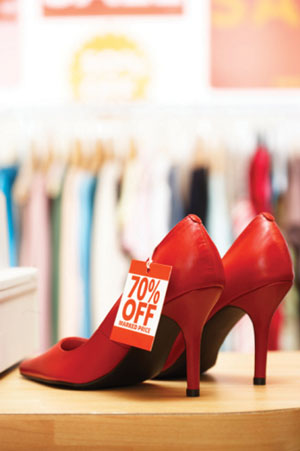
For several years, luxury retail and marketing consultants have fed the media with anecdotal research about the sales of $700 Manolo Blahnik shoes, $1,000 Prada handbags, and $250 True Religion jeans as though such sales are commonplace. But the affluent women in a survey of the wealthiest 10 percent of U.S. households by The American Affluence Research Center (AARC), Alpharetta, Ga., report they are more likely to spend less than $120 for nice shoes, less than $100 for a purse for every day and less than $75 for a pair of women’s jeans.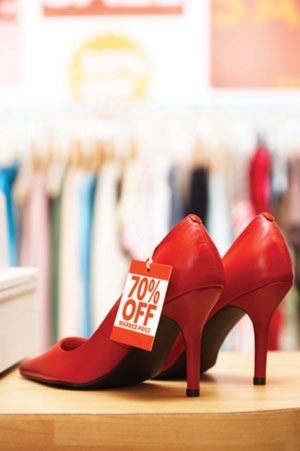
Survey respondents were asked to specify the most they could imagine spending for 37 different products and services. They were also asked to name the brand they would most likely purchase for each of the items. Both men and women were asked about the same 15 products and services. The wealthy women were asked about an additional 11 gender-oriented products and the affluent men about an additional 11 products.
Both men and women were asked to provide a price (the median value of the price reported by men/women is shown in parentheses) and a brand for a new auto ($40,000/$35,000) for personal use, a room in the winter in a Caribbean resort ($300/$250 per night), a European cruise ($300/$300 per person per night), a hotel room in New York ($300/$300 per night) for a vacation, a refrigerator ($1,500/$1,500), an original painting ($3,000/$3,000), a washer/dryer set ($1,500/$1,500), a king-size mattress ($1,000/$1,500), a set of linens for a king-size bed ($200/$150), wall-to-wall carpet ($20/$20 per square foot), a watch for dressy occasions ($1,000/$500), a watch for every day ($130/$150), a bottle of wine ($40/$30) for a special dinner at home, frames for sunglasses ($125/$150), and a large 24-inch wheeled garment bag ($200/$150).
Women were asked to provide a price and a brand for a dressy suit ($250), shoes ($120) to go with the dressy suit, a cocktail dress ($200), shoes ($100) to go with the cocktail dress, a pair of jeans ($75), a pair of diamond stud earrings ($1,000), a purse ($100) for every day, skin rejuvenation cream ($50 for 1.7 ounces), liquid makeup/foundation ($25 for one ounce), a bottle of perfume ($60 for 1.7 ounces), and lipstick or gloss ($15).
Men were asked to provide a price and a brand for a business suit ($500), shoes ($200) to go with the business suit, dress shirt ($75) to go with the business suit, a tie ($50) to go with the suit, a tuxedo ($500), shoes ($125) to go with the tuxedo, shirt ($75) to go with the tuxedo, a sport coat ($250), slacks ($100) to go with the sport coat, a dressy long-sleeve sport shirt ($75), and dressy short-sleeve sport shirt ($50).
Contrary to assertions by some luxury market consultants that the current economic problems are creating longer-term changes in their lifestyles and reductions in spending on luxury and conspicuous consumption by America’s wealthy, most of the affluent are behaving like their normal, rational and frugal selves. Their careful spending is not a new trend.
While the concepts of “stealth wealth” and “luxury shame” are now being advanced by the retail and luxury consultants and futurists through anecdotal research about cutbacks in the spending on ostentatious luxury, Kurtz says “the sale of luxury goods and services, as defined by the majority of America’s affluent, is not subject to much change in 2009, just as it has not shown much change over the past 30 years.” For more information visit www.affluenceresearch.org.
Loyalty industry fights middle-age bloat
Membership in travel and hospitality industry loyalty reward programs has climbed to 556 million in 2009. Airline frequent flyer programs reached 277.4 million, up 9 percent (since 2007); hotel reward programs reached 161.9 million, up 26 percent; and gaming reward programs reached 106.0 million, up 37 percent, according to the 2009 Colloquy Loyalty Census, a study conducted by Cincinnati research company Colloquy that measures the scope of U.S. loyalty marketing.
But don’t read too much into the growing numbers. Of the overall 1.8 billion loyalty rewards program memberships, Colloquy pegs the number of active memberships in U.S. loyalty programs at 792.8 million - a number that the study’s authors characterize as “one of the worst-kept dirty secrets of the industry.”
Definitions of active memberships vary from company to company; but a typical example is a member who has at least one instance of activity, such as earning points on a purchase or redeeming for a reward, within a 12-month period. The 792.8 million number means the rate of active membership is relatively flat at 43.8 percent, compared to 39.5 percent in 2007.
“With roughly one billion inactive memberships, essentially names in databases, it’s fair to say the U.S. loyalty industry has reached the middle-age bloat stage,” says Colloquy partner Kelly Hlavinka.
“Given the bursting of the credit bubble, the recession and pressure to control program costs, loyalty marketers must turn to growing program value, not the size of their membership base,” says Colloquy editorial director Rick Ferguson. “Conditions are ripe for marketers to use loyalty data across the enterprise, enhance value propositions and adopt innovative loyalty models such as coalitions, as they seek to revive lapsed members and turn engaged members into profitable, loyal customers.” For more information visit www.colloquy.com.
Satisfaction with online retailers dropping
Customer satisfaction with many of the largest online retailers has taken a dive, and the decline threatens to smother an online retail recovery. The annual Top 100 Online Retail Satisfaction Index from ForeSee Results, an Ann Arbor, Mich., research company, and FGI Research, Chapel Hill, N.C., fell 3 percent since last year to an aggregate score of 73 on a 100-point scale.
Online retail stalwarts Netflix (85) and Amazon (84) led all e-retailers for a fifth year in a row, showing that it is possible to succeed despite tough times. The largest improvements went to the sites of Kohl’s (+6 percent year-over-year to 76), Costco (+3 percent since last year, and +6 percent since 2005), and eight other companies that improved 3 percent.
Only 16 of the top 100 e-retailers improved while over half declined. Even Apple.com got knocked from its throne, sliding nearly 6 percent to 75 and now trailing Dell.com and HPShopping.com. Apple’s expansion into cell phones has been a boon for the company, but it may be having trouble serving a different customer base on its Web site. Other notable declines include CVS.com (-8 percent to 71, trailing Walgreens.com and Drugstore.com); NeimanMarcus.com (-7 percent to 70) and Willams-Sonoma.com (-6.4 percent to 73).
An analysis of the factors that impact customer satisfaction shows that consumers are more price-sensitive than in previous years. Preceding reports of the Top 100 Online Retail Satisfaction Index have shown that despite being a perpetually low-scoring element, price has had a relatively low impact on overall satisfaction. However, the 2009 study reveals that although shoppers aren’t more dissatisfied than in previous years, price now matters more.
Satisfied shoppers are 71 percent more likely to purchase online than dissatisfied shoppers and are 72 percent more likely to recommend the Web site. But satisfaction with the Web site has an impact with a shopper’s brand experience and translates into a greater likelihood (44 percent more likely) to make a purchase offline. For more information visit www.foreseeresults.com.
AM/FM losing out to mobile devices
Twenty-one percent of radio listeners say AM/FM radio has a big impact on their lives, ranking second to cell phones (47 percent) - and the Apple iPhone in particular (23 percent) - as the audio platform/device that has a big impact on people’s lives, according to The Infinite Dial 2009: Radio’s Digital Platforms, a study conducted by Columbia, Md., research company Arbitron Inc. and Edison Research, Somerville, N.J. Overall, the study shows continued growth in usage and ownership of various forms of digital audio platforms, including online radio, iPod/MP3 players and podcasting. But even with the weekly online radio audience increasing over the past year, AM/FM radio may have a difficult time keeping up with iPods and portable MP3 players.
Forty-two percent of persons age 12+ own an iPod or other brand of portable MP3 player, and 64 percent of 18-to-24-year-olds own a digital audio player. And these devices prove to detract from over-the-air radio: 32 percent of teens age 12-17 and persons 18-24 are spending less time with over-the-air radio specifically due to time spent with an iPod or other portable MP3 player.
The weekly online radio audience increased in the past year to 17 percent of the U.S. population age 12 and older; up from 13 percent in 2008. On a weekly basis, online radio reaches 20 percent of 25-to-54-year-olds; up from 15 percent in 2008. However, the numbers are not keeping up with those of iPod/portable MP3 player ownership. For more information visit www.arbitron.com.
Consumers shop for value over brand
Consumers around the world are more wary of trying new consumer goods products when they sense the economy is slowing down. In fact, more than half of global consumers shy away from new grocery, personal and household products during an economic downturn, according to a study conducted by Ipsos Marketing, a New York division of Paris research company Ipsos. The study gathered global consumer attitudes and behavior and surveyed 18 countries.
Not surprisingly, new beauty products are especially vulnerable during an economic downturn, with 70 percent of global consumers saying they are not likely to try a new beauty product. Not only are new products at risk of low trial, but established brands are in danger of low repeat. In the study, 80 percent of global consumers say they are very or somewhat likely to switch from their usual brands to lower-priced brands or brands that are on sale during trying financial times. Moreover, 72 percent of consumers say they would switch to store or generic brands.
One area on which marketers can (and must) focus is value. Value is typically a higher priority for consumers during an economic downturn. While pricing does not necessarily need to change, consumer perceptions about cost versus benefits should be explored to make sure consumers think there is a fair trade-off. Consumer behavior resulting from an economic downturn should also be investigated to uncover new product and positioning opportunities.
“Consumers may dine out less often, visit beauty salons less often and forego outside entertainment such as movie-going,” says Sunando Das, vice president of Ipsos Marketing’s global consumer goods business, “but these possible changes present marketers with opportunities to offer consumers products that will enable them to replicate these experiences at home for less money.”
For example, marketers could offer gourmet-style food that can be prepared in the kitchen, spa products that can give a luxury experience at home and snack products that can be used to recreate the movie theater experience. For more information visit www.ipsosmarketing.com.
Recession morphs dollar-store shopper profile
The recession has been a boon to dollar stores, which attracted increased consumer spending in 2008, including spending among high- and middle-income shoppers. Consumers at all income levels are shopping more at dollar stores, with high-income shoppers spending 18 percent more at dollar stores in the second half of 2008 compared to the prior year, according to New York researcher The Nielsen Company. Dollar stores are outpacing major consumer packaged goods channels among both low- and high-income shoppers.
Despite the increase in spending among high- and middle-income shoppers, low-income shoppers are still the primary dollar-store customer. Forty-five percent of dollar-store sales are from low annual household incomes (below $30,000), 47 percent from middle incomes (between $30,000 and just under $100,000), and 8 percent from high incomes (greater than $100,000).
The most loyal dollar-store customers tend to have low incomes and live in small towns and rural areas or in urban centers. Senior couples, senior singles (particularly widows) and younger families with children are more likely to shop in dollar stores only occasionally, relying on other retail channels to meet the rest of their household needs.
Among those who regularly shop at dollar stores, the most commonly-purchased household items include paper goods, such as napkins and paper towels, detergent, trash bags and cleaning and laundry items. For more information visit www.nielsen.com.