
••• leisure research
Ranks of avid campers still growing
 Increasing popularity among African-Americans
More than 6 million new North American households have adopted the camping lifestyle since 2014, with the number of campers who camp three times or more each year – the most avid group of campers – having increased by 64 percent. This growth, according to the results of the 2018 North American Camping Report, an annual independent study supported by Kampgrounds of America Inc. (KOA), is an indicator that camping is fast becoming a lifestyle attribute among U.S. and Canadian households – and there is no indication this trend is slowing down.
In the U.S. there was an increase of 2.6 million new camper households in 2017. Further, representation among all ethnicities is beginning to appear more like the overall population. Building on 2017 report findings, campers at all experience levels and among all ethnicities continue to express the desire to camp more and are equally likely to say they intend to increase their camping trips in 2018: 45 percent of all campers indicated they will increase camping trips in 2018, an increase of 3 percent from last year’s report, while 39 percent of new campers in 2017 will increase camping trips in 2018.
Increases in camping – both in reach and frequency – can be tied to increased accessibility of camping due to the removal of previously held beliefs and barriers. While previous research demonstrated bugs, safety/security and/or campers not knowing anyone who camped as primary barriers to camping, those barriers are waning with technology and social media serving as access portals to helpful information both prior to and during the camping experience. Further, according to campers who say access to cell or Wi-Fi service has a great deal of impact on the length of their trips, they are able to take almost a full week extra of time camping.
“Camping is a highly social activity, and with that, we are seeing campers turning to their social circles or other camping influencers for information and resources, including borrowing or renting RVs and gear. It’s this social nature – both on and off the campground – that continues to reduce barriers and fuel the growth of annual camping in North America,” says Toby O’Rourke, president of KOA. “With reduced barriers and the desire of campers to connect with nature and each other, it is no surprise that camping is fast becoming a fundamental component of an outdoor lifestyle.”
The 2018 North American Camping Report shows campers viewing camping as a time to relax, escape stress and clear their minds. Even with an influx of new campers (both younger and more ethnically diverse), differences in opinion about the reasons for camping are beginning to lessen, with close to half of all campers suggesting that camping has “a great deal of impact” on reducing stress and allowing them to spend more time with their families. There is also increased recognition that camping contributes to emotional and physical health.
Camping continues to grow in the U.S. and the future of camping is strong. Overall camping incidence remains stable with 61 percent of U.S. households (77 million) having someone who camps at least occasionally, a minor increase over last year. Forty-five percent of all campers indicated they will increase camping trips in 2018, while 39 percent of new campers in 2017 will increase camping trips in 2018.
As first noted last year, teen campers continue to be highly engaged in camping and demonstrate a great deal of enthusiasm toward camping and the outdoors. Teen campers express higher levels of enthusiasm toward camping than what adults predict; 94 percent of teens state they are enthusiastic about camping, compared to 77 percent of adults who say that teens are enthusiastic. Nearly all of the teen campers surveyed claim they intend to camp as adults and if they have children, they intend to bring them camping. In fact, most teen campers identify a benefit of camping as relaxing the adults in their lives (as well as themselves).
Further, new campers in 2017 are more diverse than the overall population with a nearly even split between white and non-white campers. The representation of Hispanic and African-American/black new campers is in line with U.S. Census figures, while new Asian-American campers are represented at three times that of U.S. Census figures (new Asian-American campers represented 17 percent of new campers in 2017, against 5 percent from Census data). African-American/black campers are most likely to report an increase in camping, while Asian-Americans are most likely to say that their camping will remain consistent year over year.
Those who serve the outdoor hospitality sector should plan on higher levels of camping across the board but primarily among younger campers, who may drive the camping economy as they experiment with different types of accommodations and camping.
Six out of every 10 Millennial households tried some type of camping or lodging in 2017 but the experimenting is being driven by Hispanics (71 percent) and African-Americans (78 percent) trying out new ways of camping.
Nearly all Millennials (93 percent) and Gen Xers (93 percent) would like to try some type of new camping in 2018. Millennials are the most likely to want to experience backcountry camping and/or glamping, while Gen Xers seek unique accommodations.
Both Millennials (66 percent) and Gen Xers (58 percent) are changing their camping habits and included both more weekends and weekdays in their trips this past year.
Access to technology while camping is helping to eliminate barriers to getting outdoors. A past determinant of camping has been not having access to information about some of the issues that may have hindered camping in the past, such as safety and security. These issues can now be addressed with social media networks and searching the Internet, putting information at the prospective camper’s fingertips. Nearly all campers (97 percent) state that they bring some type of technology with them while camping. In a continued upward trend since 2014, campers are significantly more likely to go online while camping. Yet, in a departure from the results observed last year, campers are significantly more likely to say that the use of technology detracts from the overall enjoyment of their camping experiences (38 percent in 2016, 49 percent in 2017).
What’s more, the idea of unplugging while camping is in fact unlikely to mean a complete disconnect from technology. About a third of all campers say they have their smartphone with them but they don’t turn it on (used for safety only). The use of social media to share photos and videos while camping continues to grow, with 27 percent of Millennials and 25 percent of Gen X campers surveyed saying that sharing camping experiences through social media is important (compared to 24 percent of all campers). Millennial families are more likely than other Millennials to post a status update via social media (40 percent), check-in (40 percent) and share photos or videos (68 percent) while camping.
Tent usage remains consistent and the highest camping accommodation with 61 percent of campers identifying tents as their primary way of camping; about one-fourth (24 percent) of all campers use an RV as their primary way of camping. Among campers who claim an RV as their primary way of camping, 44 percent do not own the RV they use most. A full one-fourth of this subset of campers say they borrow the RV, and one-in-five say they rent from a company or peer-to-peer rental service. Borrowing an RV is most common among Gen Xers. Among Millennials, those with families are most likely to consider renting an RV from a peer-to-peer service (followed by Millennial couples). The largest growth in RV usage is among African-American campers, with 27 percent stating that an RV is their primary way of camping, which is up from 19 percent last year. Forty-one percent of African-American campers state they tried an RV for the first time in 2017.
U.S. and Canadian household results: This survey was conducted in January 2018 by Cairn Consulting Group. The sampling methodology targeted a randomly selected sample of U.S. and Canadian households. Sampling was designed to obtain n=2,903 completed survey among representative U.S. households and representative Canadian households. A sample of n=2,402 U.S. households is associated with a margin of error of +/- 1.99 percent. Among Canadian households, a sample of n=501 is associated with a margin of error of +/- 4.37 percent.
Teen survey results: The results are based on a total of 403 surveys completed among a random sample of U.S. households with children between the ages of 13 and 17. Each survey was completed with a teen respondent whose parents gave prior permission. A sample of n=403 teen campers is associated with a margin of error of +/- 4.9 percent.
All surveys were completed online via an outbound solicitation sent to a randomly selected cross-section of U.S. and Canadian households. The sample of households from which the surveys were completed was statistically balanced to ensure that the results are in line with overall population figures for age, gender and ethnicity.
••• brand research
Consumers wary of influencer marketing
Got to be real
Brands spent an estimated $2 billion on influencer marketing in 2017 but nearly one-quarter of influencer marketing dollars are being wasted on inauthentic content that today’s savvy consumers don’t trust, according to new research by Minneapolis ad agency Carmichael Lynch.
According to the study, The Truth About Influencer Marketing, more than a third of women (35 percent) think influencers are dishonest when content is sponsored. However, many influencers surveyed are unaware of this consumer skepticism. More than four in five influencers said their audience considers brand-sponsored content “about the same” as their regular content, and only 1 percent of influencers said their audience responds negatively toward brand-sponsored content.

“Consumers look to influencers for honest opinions and it’s this trusted relationship that sets influencers apart from ads – it’s word-of-mouth at scale. But trust in the industry has eroded through some high-profile missteps,” says Emily Buchanan, executive vice president, Carmichael Lynch Relate. “Influencer marketing is in a position to thrive but the industry must drive meaningful change and regain consumer trust.”
2018 influencer partnerships survey methodology: In October 2017, Carmichael Lynch Inc., via Toluna, conducted an online survey of 121 influencers (bloggers, vloggers and content creators) who regularly partner with brands, in order to determine their perceptions toward sponsored content.
2018 sponsored content survey methodology: In December 2017, Carmichael Lynch Inc., via Toluna QuickSurveys, conducted an online survey of 1,058 consumers to determine who consumes influencer content (which includes things such as a blog post, video, podcast and social media post), to understand their perceptions of sponsored content and to compare their attitudes against the influencer survey. Of the adults who participated in the survey, 561 reported that they consume influencer content. Data is reported at a statistical significance of 95 percent and above.
••• shopper insights
In-store shoppers happy to go it alone
Self-service over associates
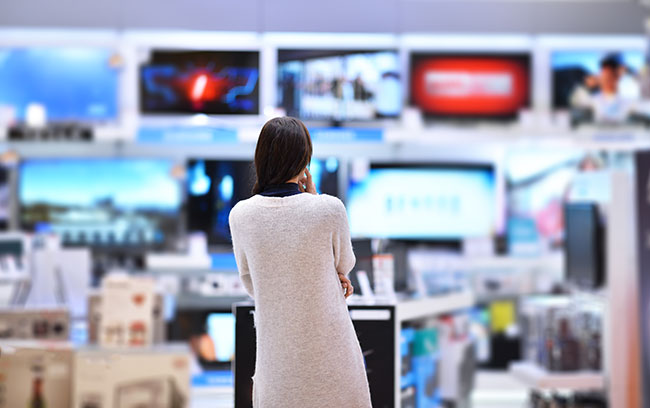
To better understand what drives shoppers into stores, and what they like to see when they get there, HRC polled 2,900 North American consumers about their shopping habits and preferences, revealing that a majority of shoppers are looking to in-store technology for customer service.
In fact, approximately 85 percent of consumers surveyed want to be able to check prices at price scanners throughout a store rather than having to ask a sales associate for pricing information. Further, 69 percent of shoppers said that being able to order a technology product online and then pick it up in store is important (likely where they can see it and test it before buying), with a similar 65 percent saying it is important for apparel.
Conversely, while the need for store associates is diminishing overall, nearly 52 percent of all respondents said that an in-store personal shopper who helps them choose products is important when shopping for technology items. However, most respondents still preferred technology over personal service, as a much higher 76 percent of overall respondents rated an in-store app that will provide personal recommendations as important.
Consumers surveyed showed less enthusiasm about several of the popular technology innovations and in-store experiences that many retailers are offering. Technology in apparel-store dressing rooms that assists with shopping was deemed important by only 17 percent of those surveyed. And only 6 percent of respondents ranked customized lighting in dressing rooms as important when shopping for apparel and shoes. Mobile payments ranked only slightly higher, with about 8 percent of those polled saying that having the option to pay via a mobile app was important to them. Only 19 percent of respondents overall said that retailers’ special events designed to create communities were an important part of a store’s offering, particularly when shopping for apparel and beauty products. Events may grow in importance in years to come, however, as a slightly higher 24 percent of Generation Z listed them as an important store feature.
Across all consumers surveyed, in-store environment ranked as the most important factor while shopping (53 percent). The survey identified additional key environmental factors that shoppers also value in-store:
Mobile promotions and sales. Nearly 34 percent of all respondents ranked receiving promotional and sales information sent directly to their smartphone upon entering the store as important.
Mobile point-of-sale. Nearly 30 percent of respondents said that being able to pay a sales associate from anywhere in the store was important, an indication that digital scanning technologies will play a growing role in retail.
Social media. Nearly 70 percent of Generation Z and 63 percent of Millennial respondents are turning to social media to share pictures and gather opinions from their friends and family before they buy, particularly in apparel.
Wi-Fi. Free in-store Wi-Fi was ranked as important by 30 percent of respondents overall and the rate was higher among younger generations, who tend to seek opinions from their social networks and share photos via social media when they shop.
In-store apps. About 29 percent of overall respondents ranked in-store apps that would provide personal recommendations as an important store feature, versus only 17 percent who ranked sales associates that would help you choose as important.
Reserve online, pick up in-store. Being able to reserve apparel online and try it on in-store before purchasing was ranked as important for 42 percent of Millennials and 38 percent for Generation Z.
HRC Retail Advisory’s survey was conducted online February 20-March 7, 2018. The total sample size was 2,903 U.S. and Canadian consumers ages 10-73 (with those ages 10-17 recruited to participate through their parents).
••• travel/b2b research
Room for some change
Exec travel programs outsourcing hotel procurement
A study, A New Horizon in Hotel Sourcing, found that change is in the air for travel executives: More than half (51 percent) of corporate travel programs have made some change in their approach to hotel sourcing in the past three years – with the vast majority saying they have derived savings from a new direction.
The study, conducted by Alexandria, Va.-based ACTE Global (Association for Corporate Travel Executives) and underwritten by travel agency HRS, focused on how corporate hotel procurement practices are evolving.
Driven by multiple pressure points, including rising hotel rates, a fragmented hotel marketplace and the amount of time that traditional hotel sourcing takes, 48 percent of travel managers who made a change decided to outsource some or all of their hotel procurement to either a global hotel services provider or a third-party specialist.
One of the primary barriers to continuous sourcing adoption is education: 42 percent of travel executives who have not implemented continuous sourcing are not familiar with it. About one-third (31 percent) cite lack of time or resources.
One-fifth of travel executives report that they do not stay abreast of business changes that could impact their hotel programs, such as an emerging need in a new geographical market, unless it’s RFP season. This suggests that, for the remaining executives who do monitor throughout the year, continuous sourcing may help them act on business shifts more quickly.
ACTE members around the world (Americas, 38 percent; EMEA, 38 percent; APAC, 24 percent) were polled electronically from February 20 to March 5, 2018, about strategies and challenges in the hotel sourcing process. A total of 226 executives responded to the survey, which was conducted by research firm Rockbridge Associates.