
Use of frequent-shopper programs keeps growing
A study conducted by ACNielsen U.S., a Schaumburg, Ill., operating unit of ACNielsen Corporation, found that participation in grocery store frequent-shopper programs has grown to 66 percent of U.S households - up from 55 percent in 1997 and 35 percent in 1996. For the most part, the dramatic increase can be attributed to the growing number of retailers who are introducing such programs.
The fact that more retailers are offering such programs is no surprise, says Robert Tomei, ACNielsen senior vice president of marketing. "There is a significant incentive for retailers to offer frequent-shopper programs because program members tend to spend significantly more per shopping trip than non-members," he says.
The amount program members spend per shopping trip compared with non-members varies by retailer. However, program members have been found to spend as much as two to three times more per shopping trip than non-members.
A geographic analysis of household participation shows significant differences across the country. The top five markets are Chicago, where 97 percent of households participate in at least one frequent-shopper program, Phoenix (95 percent), Los Angeles (93 percent), Denver (92 percent) and Charlotte (91 percent). The bottom five markets are Houston (52 percent), San Antonio (18 percent), Columbus (17 percent), Miami (10 percent) and St. Louis (10 percent).
The study also looked at the role that frequent-shopper programs have on consumers' decisions about where to shop. While the convenience of a store's location and store deals were ranked first and second, the fact that their store of choice offers a frequent-shopper program ranked third. Next came assortment of merchandise, everyday low prices, quality of merchandise and customer service. It is noteworthy that respondents placed the frequent-shopper program above everyday low prices, Tomei says.
"Apparently, people prefer to do something proactive to save money. Handing the cashier a frequent- shopper card feels more tangible than the promise of everyday low pricing," he says.
Participating households use their frequent-shopper cards often. In fact, 82 percent said they use a frequent-shopper card every time they buy groceries. Another 12 percent said they use their card most of the time. From a retailer's standpoint, the primary goal of a frequent-shopper program is to increase consumer loyalty. However, as more retailers roll out such programs, consumers are spreading their loyalty among several stores. Of households that participate in at least one frequent-shopper program, 57 percent participate in two or more. Seven percent of households participate in four or more programs.
"The savviest retailers will evolve their frequent-shopper programs to the next level of category management which will be a more proactive, more personal 'direct-to-consumer' marketing approach designed to build the strongest possible relationship with their best customers," Tomei says.
ACNielsen's third annual frequent-shopper study included responses from nearly 41,000 households on the company's Homescan Consumer Panel.
Name that sponsor
During the month of March, the Fox Sports/R.O.I Poll asked 1,205 U.S. respondents to name the sponsors of the NCAA Basketball Tournament. Of the more than 80 companies mentioned, Nike, which was not a sponsor, was most often named, at 13.7 percent. Rounding out the top three were such non-sponsors as Coca-Cola (6 percent) and McDonald's (4.9 percent). In fact, of the top 10 companies named, only Pepsi, at 4.5 percent, was an actual tournament sponsor. College basketball fans (defined as having an interest level of three or more on a five-point scale), as expected, are slight]y more in tune with the sponsors. While the list of top 10 companies mentioned did not vary much from the overall list, there were a few notables. For example, roughly 90 percent of the respondents who correctly named American Express and Taco Bell as sponsors were categorized as fans. And while the gap between Coke and Pepsi stood at 1.5 percent among the general population, it was less than half of that when looking at just fans. The poll was conducted by R.O.I Research, New York.
1998 a solid year for new products
The stock market may have had its ups and downs in 1998, but things were solid on the new product front. For the second year in a row, packaged goods firms pumped out more than 25,000 new food, beverage, health & beauty aids, household and pet products, according to Naples. N.Y.-based Marketing Intelligence Service, Ltd., a new product reporting firm. While 1998's count didn't eclipse 1997's record, there was no shortage of new products to choose from on store shelves.
Truly innovative new products, however, continued to be rare. Just 5.9 percent of the entries reported by Marketing Intelligence Service in 1998 earned an Innovation Rating. A qualitative measure of new product introductions, the firm's Innovation Ratings measure the number of new products with breakthrough features or benefits in any one of the following six areas: formulation, positioning, packaging, technology, creating a new market, and merchandising. While 1998's overall Innovation Rating edged up slightly from 1997’s 5.8 percent figure, innovation has been trending down since 1986, when the peak Innovation Rating of 18.6 percent was achieved.
-
While the percentage of innovations may have been small in 1998, a number of entries offered outstanding new features and benefits. The following top 10 new product innovations were chosen by Marketing Intelligence Service. Ltd. from the more than 25,000 new product introductions reported in 1998 in the firm's Product Alert publication.
-
With more of us eating on-the-run, yogurt would seem to be left out in the cold. Don't tell that to Minneapolis-based General Mills, which found a way to make yogurt portable with Yoplait Go-Gurt Yogurt. This kid-friendly yogurt is packed in a tube that eliminates the need for spoons. Just rip open the tube, put the open end in the mouth and squeeze. And since the tubes can be frozen and thawed for consumption later in the day. Go-Gun is great for lunch boxes and bags.
-
Sound Bites Lollipops may be the year's strangest and most fun innovation; just insert a lollipop into the battery-operated Sound Bites handle, bite down on the sucker and hear music playing inside your head. Sound Bites works by conducting sound vibrations through the lollipop into your teeth and inner ear for an experience like no other. Priced at around $10 for the handle, batteries and two lollipops, it's new from Campbell, Calif.-based Odd/On/Sound Bites.
-
Why should Haagen-Dazs and Ben & Jerry's have all the fun? Now you can make your own ice cream at home, faster and easier than ever before without any special equipment with Geno's Instant Ice Cream Mix. Packed in a 32 fl. oz. drink box, this liquid mix is refrigerated prior to use and then shaken and poured into a bowl together with whatever flavorings you choose - fruits, nuts, cookies, chocolate chips, candies, etc. The mix is then poured into a covered container and frozen until firm. It's new from Southington, Conn.-based GMV Desserts, Inc.
-
Is the pickle your favorite part of a hamburger? If so, you're in luck. With new Vlasic Hamburger Stackers Pickles you get a pickle in every bite of your burger. That's because these pickles measure a whopping three inches in diameter, yet are packed with taste and crunch. A horticultural triumph, Hamburger Stackers are made from specially-bred cucumbers that grow 10 times larger than standard pickling cucumbers. They're new from Vlasic Foods International. Inc. of Cherry Hill, N.J.
-
It's hard to find a section of the supermarket that's not drowning in funky flavor blends right now. But what makes Kellogg's Nutri-Grain Twists Cereal Bars special is not the blended flavors, but how the flavors are blended. Kellogg takes two flavors (strawberry and blueberry. for example) and puts each in its own separate soft baked crust "tube" that is twisted over and under a "tube" which holds the other flavor. The two are combined when you eat the bar for a unique flavor twist. Battle Creek, Mich.-based Kellogg USA is the manufacturer.
-
If two blades are good, then three must be nirvana. And so it goes for the Gillette Mach3 Triple Blade Shaving System. Said to offer the closest shave ever in fewer strokes, all with less irritation, Mach3 is replete with bells and whistles. The shaver is the first with three progressively aligned blades, the first with a lubricating strip that fades to signal that it's time to replace the razor and the first with mistake-proof cartridge loading. Boston, Mass.-based Gillette Company is the manufacturer.
-
Drano Foamer Clog Remover attacks gunk where liquids can't reach. Unlike liquid drain cleaners which run along the bottom of the pipe section, where most clogs occur. Drano Foamer fills and clears the entire pipe section to keep drains clear longer. Boxes containing two packets of this concentrated powder treatment are new from Racine. Wis.-based S.C. Johnson & Son, Inc.
-
Pink underwear syndrome may go the way of the dodo bird if Carbona Dye Magnet has anything to do with it. Just drop this sheet on top of the laundry and add detergent. Dye Magnet's "magnetic" properties absorb excess dye and grunge, preventing colors from bleeding onto one another while actually washing clothing in cleaner water. Use Dye Magnet and you won't have to worry about separating the whites from the colored clothes. Better yet, Dye Magnet can be used over and over again. If ever a product were tailor-made for college campuses, this would be it. Thank Fairfield. N.J.-based Delta Carbona for this one.
-
A record number of products debuted in 1998 boasting antibacterial properties. One of the most clever was Cut & Toss Disposable Cutting Boards. As the manufacturer, St. Albans, Vt.-based Fonda notes, the most sanitary cutting board you can use is the one you don't re-use. More sanitary than wood or plastic cutting boards, Cut & Toss is flexible with fold-up sides which make usage and cleanup a snap.
What is going to be hot in 1999? How about allergy control. With the average person spending up to 90 percent of their time indoors, allergies caused by indoor pollutants arc on the rise. S.C. Johnson & Son's innovative new AllerCare line was designed for allergy sufferers and includes Dust Mite Carpet Powder and Dust Mite Spray Carpet & Upholstery Allergen Treatment spray. Both claim to reduce dust mite allergens for up to four weeks, keeping dust and dust mite allergens from becoming airborne.
The U.S. doesn't have a patent on innovation, as these top five international innovations chosen from the new product innovations featured in International Product Alert show.
-
Allergy sufferers can find relief with a new gum now available in the Japanese market. Lotte Tencha Mint Gum not only delivers cool and refreshing taste, it's also claimed to help combat allergies.
-
Multix Antibacterial Cling Wrap does more than just cover food, it protects it from bacteria. New in Australia, this cling wrap is treated with Microban.
-
Glow in the dark drinks are now a reality thanks to new Phota Lite Glow in the Dark Powder. Debuting in Japan, the powder contains the enzyme responsible for light generated by fireflies and is marketed as a fun drink additive.
-
No time to blow dry your hair in the morning? Use new Lazartigue Rapid Drying Shampoo and you'll have nothing to worry about. That's because this U.K. entry reduces drying time by as much as 30 percent.
-
Keep ant infestation in check and clean your floor at the same time with S.C. Johnson's new One Stop Protective Floor Polish. Available in South Africa, it keeps floors shiny-clean and repels ants for days with its natural ant repellent.
For more information call Tom Vierhile at 800-836-5710, ext. 28, or visit the company's Web site at www.productscan.com.
Jewish American travelers enjoy visits to Israel
A majority of Jewish Americans who have been to Israel are likely to return in the future, according to research from Princeton, N.J.-based Response Analysis Corp. The firm conducted 1,206 telephone interviews among a representative sample of Jewish Americans who have taken a vacation in the past two years or who plan a vacation in the next 12 months. It is estimated that three out of four Jewish adults (3.4 million) meet this vacation criterion. There are 4.5 million Jewish adults, age 18 and over, in the United States.
The survey was conducted for the Government of Israel to better understand how Jewish American travelers feel about Israel as a travel destination. Arie Sommer, Israel Tourism commissioner for North America, says, "Our repeat travel market to Israel is very large. Jews like what they experience. They have good feelings about Israel's hotels, its weather, and the wide range of things to do in Israel. Half of our visitors want to spend more time in Israel on their next trip."
Approximately one million Jewish American travelers are interested in returning to Israel (698,000) or visiting Israel for the first time (324,000). Six out of 10 Jewish Americans, including those who have been to Israel and those who have not, said they were very or somewhat interested in visiting Israel to celebrate the 50th anniversary of Israel being declared an independent state.
Jewish Americans perceive Israel's greatest strengths as a place to visit to be: sightseeing opportunities, historical significance, cultural activities, and religious significance. However, they give Israel mixed reviews on some of the more traditional travel criteria: fairly strong ratings for "good weather" and "good hotels", low to moderate ratings for "nice place to relax," "good value for the money," and "good restaurants." Israel's lowest rating is on "a safe place to go."
Among the additional findings are:
-
51 percent of Jewish Americans I who have visited Israel have been there multiple times.
-
62 percent of Jewish Americans who have visited Israel traveled independently (i.e., not as part of a tour group);
-
Jewish Americans also like to travel overseas to France (17 percent), Britain (17 percent), and Italy (13 percent).
For more information call 609-921-3333 or visit the company's Web site at www.response-analysis.com.
College students respect authority, creditors
With graduation just around the corner, today's 18-24-year-old college students may be ready to live up to their reputation as a new crop of consumers, respecting creditors and authority figures and caring for the environment as well, according to a recent Pulsefinder On-Campus Market Study.
The study points to a shift in college students' attitudes toward environmentalism, joining the workforce, and assuming responsibility for their own finances. Fifty-four percent claim to be "environmental activists," while 45 percent of today's college seniors believe they will have "no problem finding a job" after receiving a diploma and one out of five believes it's "in" to be "working hard at school." Over 70 percent agree with the statement "I respect authority" while more than half say it is "out" to be interested in fraternities and sororities. More than half say they arc paying all their credit card bills themselves.
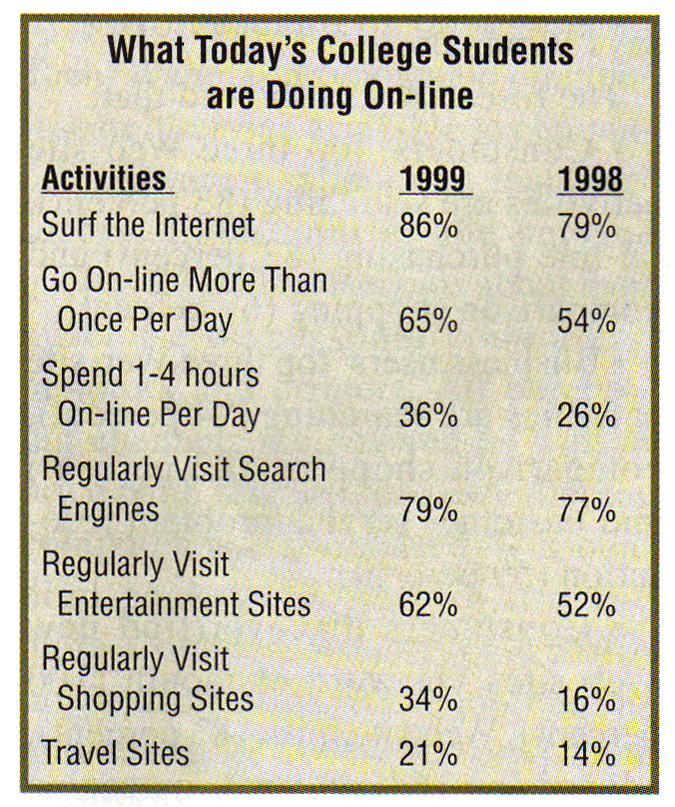
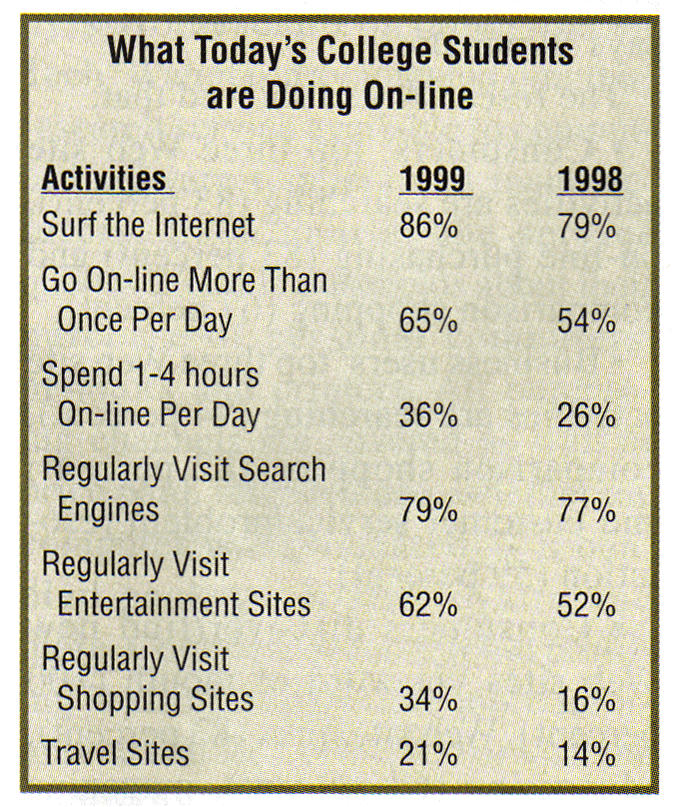
In addition to surveying college students' attitudes toward these and other subjects, the study also covered college students' activities on the Web. The number of college students making purchases on-line has jumped from 43 percent to 61 percent in the past year. On-line consumer activity among this segment has increased overall since 1998, with more frequent visits to search engines, as well as travel, entertainment and shopping sites. The study also found increases in the number of hours spent on-line and in the number of daily log-ins.
The Pulsefinder study, which was conducted by Greenfield Online, Inc., Westport, Conn., and Network Event Theater, Inc. (NET), surveyed 1,400 four-year college students drawn from an on-line research panel of 30,000 students ages 18-24. To qualify for the study, all participants had to have Internet access. The sample then was balanced to represent the national four-year college population in terms of gender and region. For more information call Gail Janensch at 203-429-0111 or visit the company's Web site at www.greenfieldcentral.com.
Web users look for a little control
Cognitiative. Inc., a San Francisco consulting firm, has released findings from recent Pulse of the Customer focus group research. The findings uncover Web users' attitudes and feelings on personalization, privacy and targeted marketing on the Web. as well as highlighting Web usage and awareness trends.
Topline findings include:
-
Of Web customers. 32 percent dislike sales-oriented e-mail so much they actually avoid doing business with the sender.
-
Ninety percent of Web customers prefer broad choice over vendor-controlled personalization.
-
Few vendors are doing a good enough job with on-line customer service, even though more than 59 percent of business customers consider receiving on-line customer service their most important Web activity, and prefer it to telephone support.
According to the research, personalization works best when customers feel they are the ones controlling it and making the decisions about how it is used. Examples of personalization that customers like include being able to: design their own pages: control what information is presented to them; request information based on their specifications: and link to other sites that interest them.
Web personalization backfires when customers perceive that their personal information is being misused. Customers say that personalization can feel intrusive, invade privacy, limit their options and too often forces them down the wrong path.
"It's all an issue of control," says Laurie Windham, founder and chief executive officer of Cognitiative. "On-line users feel very strongly about intrusive marketing practices, and are choosing via their keyboards with whom they do business."
For example, one-third of customers dislike sales-oriented e-mail so much that they avoid vendors who send them. In fact, only telemarketing rated as more intrusive than unsolicited e-mail. On the positive side, respondents noted that they feel empowered by trusted vendors with whom they have a relationship, and that Web personalization and appropriate communications help them save time and broaden their exposure.
In related findings, on-line customer service efforts are falling short of customer expectations. Customers prefer responses to their questions within a few hours, but response times of one day are acceptable. Few vendors are doing a good enough job with on-line customer service at this time. The study also found that exceeding customers' expectations can result in extreme brand loyalty. "To date, on-line customer service has been so dismal for many customers that when vendors are actually responsive, the customer is surprised, delighted and loyal for life," says Windham.
The research also showed that:
-
Consumers' top three Web site activities are searching (83 percent), on-line purchasing (83 percent) and comparison shopping (67 percent).
-
Business users' top three Web site activities are searching (94 percent), comparison shopping (82 percent) and customer service/problem resolution (59 percent).
-
Consumers discover/find new Web sites via word of mouth (71 percent). Web site links (83 percent, advertising (67 percent), magazine articles (61 percent), newspaper articles (50 percent) and conferences (17 percent).
-
Business users discover/find new Web sites via magazine articles (94 percent), Web site links (88 percent), advertising (76 percent), word of mouth (71 percent), newspaper articles (53 percent) and conferences (47 percent).
Topline findings are available online at www.cognitiative.com.