
Interest high in managing medical benefits on-line
A majority (78 percent) of Internet users covered by health insurance say they are interested in managing their benefits through an insurance carrier’s Web site, according to research from New York-based Cyber Dialogue. This makes online benefits management among the most-desired activities for on-line health users, ahead of applications like on-line drug stores and personal medical records.
The impact on health insurance carriers’ revenues could be substantial. In fact, 90 percent of Internet users have health insurance, and among the 10.3 million Internet users who anticipate changing insurance carriers over the next 12 months, 37 percent report that they would be very or somewhat likely to switch carriers in order to manage their benefits on-line.
"This high level of interest reflects deep levels of consumer frustration with health care red tape and bureaucracy," says Scott Reents, manager of health care strategies at Cyber Dialogue. "It also presents an enormous opportunity - on-line benefits management is a strong candidate to become the ’killer app’ for Internet health."
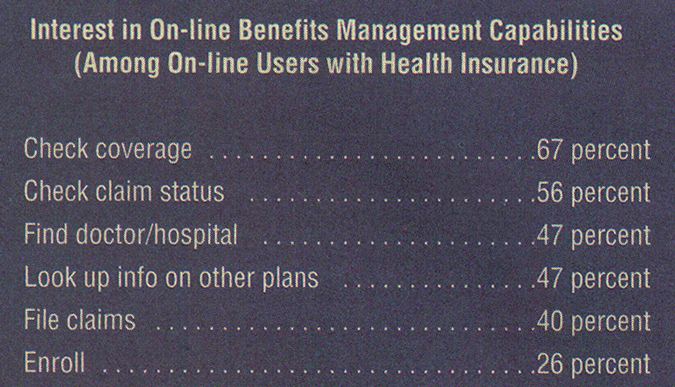
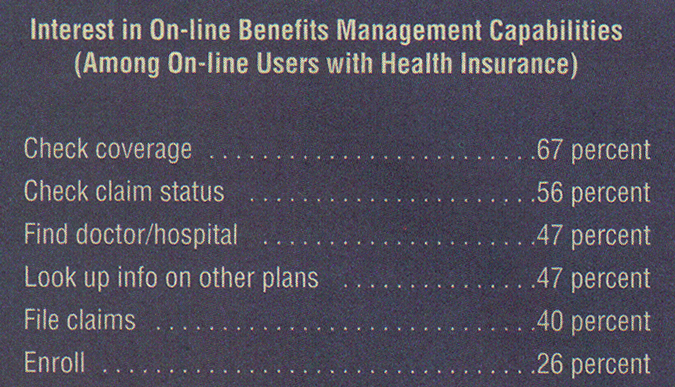
In particular, on-line users are interested in having the ability to check the extent of their coverage for various procedures and physician office visits, with 67 percent of on-line users with insurance saying that they were very or somewhat interested in this feature. Other features showing high user interest include checking status of filed claims, finding in-network doctors and hospitals, and looking up information on alternative or supplemental health plans.
At this time, one major barrier to online benefits management appears to be the insurance industry. Despite the high levels of consumer interest, only 8 percent of insured Internet users are actually using their Reents. "This looks like a case where insurer’s Web site, and 68 percent aren’t even aware that their insurer has a Web site.
"Consumers want this convenience, but insurers either aren’t offering the functionality consumers desire, or they aren’t effectively marketing it," says Reents. "This looks like a case where insurers will be forced to choose either to invest in the Internet or to lose business to competitors who do."
Findings from Cybercitizen Health are based on in-depth interviews with more than 2,700 U.S. adults. The study was fielded in July 1999 and is accurate within +/-1.9 percent at the 95-percent confidence interval.
Moving carries a host of expenses
A survey by Boston-based movecentral.com finds that homeowners who move spend $9,400 on purchases during the three-month relocation period, while renters spend $3,700. Conducted by movecentral.com and Bostno-based Atlantic Marketing Research, the survey polled 22,000 relocated Americans and yielded an average response rate of 4.1 percent.
During 1998 and 1999, 42 million Americans moved, spending $102 billion on move-related goods. Homeowners spent an average of $9,400 on purchase; renters spent $3,700. Fifteen percent of homeowners and 12 percent of renters stated that they bought a computer within the eight weeks surrounding their move; homeowners spent an average of $2,160, and renters spent $1,340. Twelve percent of all moving homeowners bought a car; 66 percent of these car buyers made the purchase within four weeks after moving. Over half (57 percent) of owners and 37 percent of renters bought furniture within the 12 weeks surrounding their move; homeowners spent an average of $3,500 and renters spent $1,220. Thirty-five percent of owners and 40 percent of renters bought bedding; of these individuals, 72 percent did so within three weeks after their move. Owners spent an average of $420 and renters $240. Fifty-five percent of moving homeowners purchase at least one appliance when they move, and 57 percent of homeowners buy furniture. Twelve percent of all respondents with Internet access research moving companies on the Web; 8 percent reached real estate sites, 7 percent researched appliances/furnishings and 2 percent research electronics, computers and banking services. Six percent of movers using the Internet for research actually made on-line purchases; those buying goods andservices spent an average of $600.
Use of frequent shopper programs on the rise
The number of U.S. households participating in frequent shopper programs (FSPs) increased for the fourth consecutive year, reaching 70 percent in 1999 - double the number of households that participated in 1996, according to the fourth annual Frequent Shopper Survey, conducted by ACNielsen U.S., an operating unit of ACNielsen Corporation.
As the number of retailers offering FSPs continues to grow, so does the number of households participating in more than one program. "Fifty-nine percent of households that belong to a frequent shopper program now belong to two or more - up from 57 percent in 1998," says Jane Perrin, managing director, ACNielsen global services. "This is putting pressure on retailers to further differentiate themselves from their competition. The retailers who are doing the best job with their frequent shopper information are those that are using it to proactively foster loyalty among their best customers."
The market with the highest percentage of households belonging to an FSP is Chicago, with 97 percent enrolled. Other top markets include Phoenix (96 percent), Los Angeles (92 percent), Charlotte (92 percent) and Denver (91 percent). Buffalo/Rochester, N.Y. - where Tops introduced a new program - experienced the highest growth rate in 1999 (+16 percentage points to 89 percent). The nation’s largest city, New York, has a participation rate of 73 percent - the same rate that it had in 1998. Even with 70 percent of all households enrolled in frequent shopper programs, the study indicates that there is still room for growth in certain markets. One-third of all respondents stated that there is a grocery store they would shop at more often if it offered a FSR and the most common reason for not belonging to a program is that the store where non-members shop does not offer one. Markets with the lowest FSP enrollment rates include Miami (6 percent), Columbus (14 percent), St. Louis (17 percent), San Antonio (20 percent) and Houston (51 percent).
Among other key findings:
- Saving money is the number one reason why people join and participate in an FSR
- Eighty-three percent of FSP members use their card every time they shop.
- Demographically, FSP member households tend to be slightly larger than non-member households, more affluent, better educated and employed in professional/ white collar professions.
Nearly 38,000 households in the ACNielsen Homescan consumer panel participated in the study, which was conducted in October and November 1999.
Doctors going on-line
Research by Princeton, N.J.-based Total Research Corporation has found that the majority - 74 percent - of primary care physicians (PCPs) in the U.S. have Internet access. As an increasing number of their patients are going on-line to research diseases, drugs and medical conditions, most PCPs are reportedly doing the same thing - accessing the Web from their homes in the evening. PCPs are spending an average of seven hours per week on-line. The main reasons they are reportedly using the Internet are for medical purposes, e-mail, news and shopping.
Of those PCPs who do not have online access, 31 percent expect to be online in the year 2000, while another 35 percent say they never intend to be hooked up to the Intemet. It was found that among those PCPs who do not have on-line access, 29 percent are over 60 years of age.
The results are based on a survey of 217 primary care physicians, of whom 154 were interviewed on-line and the remaining were interviewed over the phone between November 11 and December 31, 1999.
Total Research also found in the phone-Internet study that 37 percent of primary care physicians believe that the health care reform measures currently being debated in Congress will have a positive impact on their practice. When asked what kind of positive impact health care reform would have on their practice, 70 percent of these physicians said that health care reform would improve the quality of patient care. Another 37 percent of PCPs indicated that health care reform would have no impact on their practice, and 11 percent speculated that health care reform would have a negative impact on their practice, while 15 percent had no opinion.
The right to sue an HMO received overwhelming endorsement from these doctors. The survey found that 89 percent of PCPs strongly believe that patients should have the right to sue their HMO for denying care, while 6 percent said patients should not have that right, and 16 percent had no answer.
The physicians who said they believe patients should be able to sue their HMOs gave multiple reasons:
- 35 percent said HMOs need to be held responsible;
- 21 percent said patients have a right to medical care;
- 17 percent said no one should be without legal recourse;
- 14 percent said doctors should be malting decisions, not HMOs;
- 13 percent said denying medical care based on cost is unacceptable.
Most of the respondents learned about health care reform issues from newspapers, TV and medical joumals. About a quarter of respondents reportedly learned about health care reform issues from the Intemet, by talking to colleagues and listening to the radio. The study found that significantly more PCPs wit health care reform will have no impact on their practice than respondents with Internet access.
Depression is top gay health concern
Depression tops the list of health concerns for lesbians and gay men, according to a gay health survey released by GayHealth.com. The site, created and operated by lesbian and gay medical professionals, is a source of health and wellness information for the gay community.
The survey ranked depression as the top health concern, even surpassing HIV, for both lesbians (35 percent of those surveyed) and gay men (32 percent of those surveyed). This figure is even more striking when compared with a similar survey of heterosexuals also conducted for GayHealth.com. Results showed that gay men and lesbians are approximately two times more likely than their heterosexual counterparts to be concerned about depression.
According to the survey, prostate and testicular problems, HIV, sexually transmitted disease (STDs) and hepatitis followed depression respectively as the top five health concerns of gay men. For lesbians, breast cancer, cervical cancer, menstrual pain and estrogen replacement followed depression as major health concerns.
What about re-gifters?
In the past year, 96 percent of American consumers purchased at least one item defined as a gift, according to a market research report published by Unity Marketing, Stevens, Pa., entitled "Gift Consumer Market: Drives, Motivations, Purchasing Patterns and Trends."
Despite its name, the gift market is largely made up of consumers buying items for their personal use. "Our latest survey reveals that the gift market is misnamed. While some product categories that are included in gifts, such as greeting cards and stationery, are pri marily purchased to give to others, the majority of products encompassing gifts are self-purchased," says Pam Danziger, president of Unity Marketing.
Fifteen product categories comprise the gift market, including aromatherapy and potpourri, art/prints, candles, Christmas decorations, dolls, figurines and sculpture, garden/outdoor items, gift baskets, greeting cards and stationery, lamps and lighting accessories, linens/pillows/throws/ rugs, personal care, picture frames, plush/stuffed and bean bag toys, wall decor.
"The most-purchased category in gifts is personal care, including special soaps, lotions and skin care products," Danziger says. "This category is booming now because it taps into the consumer trend toward buying personal indulgence products that mal¢e the consumer feel special."
Candles, Christmas decorations, linens/pillows/throws/rugs, and picture frames round out the top five product categories in terms of consumer purchases.
Among the top sources for gifts, according to the 1,017 American adults surveyed by telephone in February 2000, are department stores and mass merchants, used by 87 percent of the consumers as a source for gift products. The survey also reveals that specialty retailers are losing market share in gifts to competing retailers.
"One of the most significant findings from the survey in terms of its impact on the health of the gift industry is the shift of consumer sales out of specialty retailers and into other channels," Danziger says. "Just two years ago, some 62 percent of gift consumers made purchases at specialty retail stores, but this year only 46 percent of consumers purchased gifts through specialty retailers. While specialty retailers are losing market share, catalogs and mall order are being used more frequently by consumers, from 15 percent in 1998 to 34 percent in 2000, and the Intemet is now used by 14 percent of the consumers to purchase gifts."
Included in the new report are profiles of five segments of the gift market that are characterized by different attitudes and motivations behind gift giving, gift shopping and home decorating.
For example, the Decorators segment primarily purchase gift products to decorate their homes, while the Obligated Gifters purchase gifts out of duty and a feeling of obligation. The Extravagant Gifters buy gifts both for themselves and as gifts and are the highest-spending segment on gifts. Both the Disenfranchised and Just Looking gift segments are turned off to the gift shopping experience, but the Just Looking gifters are also interested in decorating their homes.
The report examines the giftware consumer market and is based upon a telephone survey to a representative sample of American consumers. It examines gift-consumer demographics and their buying behavior, including shopping, purchasing and spending levels, where purchases are made and what items are bought.