
’Cyberchondriacs’ number 110 million nationwide
E-health (the use of the Intemet related to health and health care) continues to grow, and a recent national survey finds that 110 million adults sometimes go online to look for health care information. Rochester, N.Y., research firm Harris Interactive calls them "cyberchondriacs." On average, they search the Web for this type of information three times a month, searching mainly through portals or search engines rather than by going directly to particular sites.
These are the results of The Harris Poll, a nationwide survey of 707 adults (18+) who are online from home, office, school, library, or some other location. Surveys were administered by telephone between March 13 and 19, 2002.
Other findings of this survey include:
- 80 percent of all adults who are online (i.e., 53 percent of all adults) sometimes use the Internet to look for health care information. However, only 18 percent say they do this "often," while most do so "sometimes" (35 percent), or "hardly ever" (27 percent).
- This 80 percent of all those online amounts to 110 million cYberchondriacs nationwide. This compares with 54 million in 1998, 69 million in 1999 and 97 million last year.
- On average those who ever look for health care information online do so three times every month.
- A slender 53 percent majority of those who look for health care information do so using a portal or search engine which allows them to search for the health information they want across many different Web sites. About a quarter (26 percent) go directly to a site that focuses only on health-related topics and one in eight (12 percent) goes first to a general site that focuses on many topics that may have a section on health issues.
Those who go online for health information tend to be younger (which fits the profile of frequent Internet users), and they are better educated and more affluent than the general population. These cyberchondriacs include 82 percent of people aged 18 to 29, 84 percent of those with postgraduate education and 77 percent of people with household incomes of over $75,000.
The data shows that the Intemet continues to be used by huge, and growing, numbers of the public interested in getting information about particular diseases or treatments or about staying healthy. The results also demonstrate the critical importance for health care Web sites to be quickly and easily accessible through search engines and portals.
Data from other Harris Interactive research show that, increasingly, cyberchondriacs are using the sites of established organizations - academic, governmental, pharmaceutical, etc. - rather than using "pure e-health" sites.
Online Magazines gather dust, not readers
Fast and free online magazines are not enough for Americans to sacrifice the convenience associated with traditional paper magazines. According to a survey by InsightExpress, a Stamford, Conn., market research firm, Americans still demand that they be able to take their magazines to bed, into the bathroom, or on their commute. Publishers waiting for readers to change and opt for online over traditional paper magazines may be wasting their time.
Today, less than one in three individuals (32 percent) read any magazines online. Readers cite inconvenience (54 percent); dislike of online banner ads, pop-ups, and general distractions (47 percent); prices of online magazines (43 percent); and eye strain (23 percent) as the main reasons for staying away from online magazines.
Readers so prefer traditional to online that, of those people who regularly read online magazines, only 22 percent actually prefer reading magazines online – while 73 percent expressed that they would not forgo their paper magazine for an online alternative – even for half the price. In fact, while a majority of respondents (63 percent) currently pay for a traditional magazine subscription, nearly 80 percent expect online magazines to be free.
“Given that resources remain scarce, publishers would be better served to cut their losses when it comes to online and focus on their reader’s overwhelming preference: high-quality paper magazines,” says Lee Smith, COO of InsightExpress.
It was not all bad news for online publications – readers do believe that online provides more timely content (59 percent) – however, only 22 percent perceive that online magazines provide higher quality content than their print versions.
“Though online magazines have an advantage in that they can deliver real-time news and information, they don’t stand a chance when competing for a reader’s undivided attention,” says Smith. “Online is not the magic bullet publishers were hoping for to retain readership.”
Some African-Americans misinformed about hypertension
Many low- to middle-income African-Americans may be misinformed as to the causes, symptoms, and treatment of high blood pressure, recent study findings show. Proportionally, three times as many blacks die due to hypertension as whites and the condition is a "major reason why life expectancy is years less for African-Americans," according to a report in the January issue of the American Journal of Medicine. Dr. Ruth R. Wilson of San Jose State University in California and her colleagues conducted street surveys of 60 people aged 18 to 67 and interviewed another 107 people divided into 12 focus groups. Ten of the 60 individuals interviewed on the street had a history of high blood pressure.
Slightly more than one third of respondents (35 percent) believed that high blood pressure resulted when individuals ate pork "or other foods causing blood to travel too fast to the head," hence the term "high blood," according to a report. Only 15 percent of the survey participants correctly associated high blood pressure with elevated pressure in blood vessels.
Ten of the 12 focus groups correctly identified heredity as a factor related to high blood pressure, and eight groups identified salt, excess alcohol and excess weight, or lack of exercise as contributing factors. On the other hand, eight groups considered pork or other "wrong foods" to be a major cause of high blood pressure and five groups cited evil spirits or sin. All 12 groups thought psychological stress was a major cause of high blood pressure.
"Emotional stress is not thought to be a major cause of chronic hypertension, and there is little evidence that stress reduction techniques (relaxation, mediation, biofeedback) are effective treatments for hypertension," the authors wrote.
Individuals from all 12 groups thought headaches, dizziness, weakness or fatigue, and ears that hurt or pop were symptoms of high blood pressure; only four groups knew that high blood pressure often has no symptoms.
Eleven of the 12 groups incorrectly believed that high blood pressure could be treated with garlic, or herbs or vitamins, the report indicates. Nine groups cited vinegar as a treatment; six groups cited Epsom salts or salt and two groups believed that prayer was an effective treatment for the condition.
What’s more, although high blood pressure is known to be a leading cause of death among African-Americans, none of the 18- to 29-year-old focus group participants identified it as such. Two of the four groups of 30- to 49- year-old participants and three of the four groups of 50- to 74-year-old participants identified high blood pressure as a leading cause of death. In contrast, every group identified AIDS and crime as leading causes of death among African-Americans, and most groups also cited cancer as a leading cause of death.
"Public health efforts need to target young adults, in part, because the African-American disadvantage in death and disability caused by hypertension is greatest among persons younger than 45 years old," the researchers wrote. ’Malternatives’ fastestgrowing alcoholic beverage group As demonstrated by the success of "maltematives" - innovative, flavored malt-based beverages - new products are one key to reaching twentysomething consumers of legal drinking age in the highly competitive beer, wine and spirits industry, according to a new survey released by Chicago-based Information Resources Inc. entitled "IRI Insights on the Beer, Wine, Spirits Consumer Decision-Making Process."
IRI found that "malternatives" were making inroads into the $125 billion beer, wine, and spirits industry, and have been particularly successful in penetrating the young adult (aged 21-29) segment, which is entering a significant growth period as Echo Boomers mature.
"Beer, wine, and spirits manufacturers have a major opportunity to establish a relationship with the most sought-after consumers. IRI’s research shows that young adults are more interested than other groups in trying new alcoholic beverage products," says Ed Kuehnle, president of IRI North America, "But to reach these consumers, it is critical to take their unique purchase patterns into account. For example, versus the over 30 crowd, they are more likely to purchase alcoholic beverages for immediate consumption and are significantly more likely to be driven by mood."
According to IRI data for supermarkets and drugstores, volume sales of new "malternative" beverages like Smirnoff Ice and Mike’s Hard Lemonade grew 81 percent during the 24 weeks ending January 13, 2002 versus the same period last year. This sharp increase compares to 1 percent growth for the alcoholic beverage category as a whole.
Key findings from the IRI study:
- Consumers are far more open to different types of alcoholic beverages when in a restaurant (49 percent) or bar (37 percent) than in a store (14 percent).
- Three quarters of consumers do not make a brand choice before they enter a restaurant.
- Young adults (aged 21-29) are more likely than those over 30 to purchase for immediate consumption (40 percent versus 21 percent).
- Young adult purchase decisions are more likely to be driven by mood than those over 30 (57 percent versus 44 percent).
- Young adults are more open to trying new products (56 percent versus 40 percent).
"New types of alcoholic beverages should be aggressively promoted onpremise in bars and restaurants. In off-premise locations, including liquor and convenience stores, new products targeted to the young adult market should have single-serve distribution and adequate shelf space to avoid out-of-stocks on six- and 12-packs," Kuehnle says.
Americans turning up the heat on frozen food
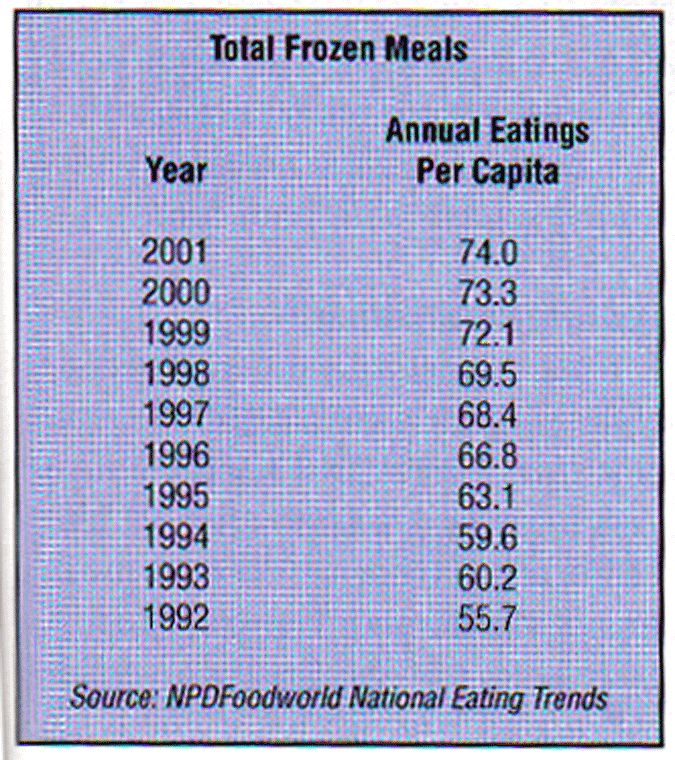
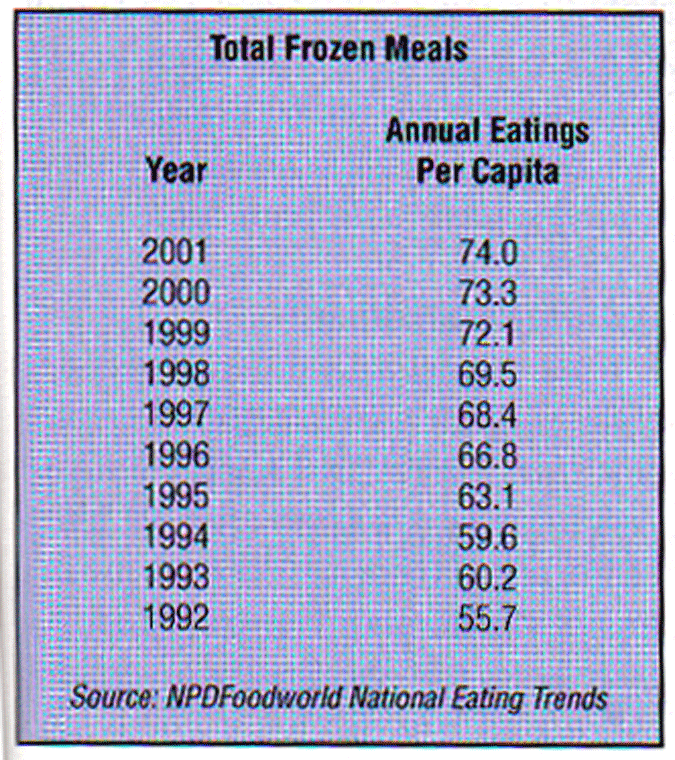
Port Washington, N.Y.-based NPDFoodworld’s National Eating Trends "Turning up the Heat on Frozen Meal Options" report shows that although restaurant take-out meals per capita fell in 2001 for the first time since the early 1980s, the frozen meal category has continued its steady growth over the past 10 years. The average American ate a frozen meal option about six times each month or 74 times during the period of March 2000 through February 2001, a 33 percent increase since 1992.
The report shows that this category has established a sizeable presence not just at dinner, but at breakfast, lunch, and snack time as well. "With supermarket sales of frozen meal options increasing, it is important that manufacturers understand what is driving growth in order to develop successful market strategies," says Arnie Schwartz, vice president, NPDFoodworld. "With 80 percent of meals eaten at home, but Americans spending less time in the kitchen, frozen food manufacturers appear to have hit their stride and are giving restaurant take-out some competition."
Study identifies marketing outsourcing trends
Superior, Colo., marketing firm Maccel Group has released results from its online survey, "Marketing Outsourcing Trends." The purpose of the survey was to identify trends and plans for companies seeking to outsource marketing activities. The survey results identify the marketing activities that are most often outsourced and how outsourced firms are typically selected.
The results indicate that 45 percent of companies surveyed believe that selecting a marketing services firm with a "proven methodology or process" is extremely important. This requirement is even more important to large companies (2,000 employees and greater), with more than 67 percent requiring a proven methodology. In addition to selecting firms with a proven methodology, companies choose firms based on their expertise in the customer’s industry.
The marketing activities outsourced by at least 40 percent of survey respondents include marketing collateral development, Web site development, advertising creative, and direct mail campaigns. Large companies are more likely than smaller companies to outsource additional activities such as telemarketing, product launches, brand development, and product or service message development.
Additional findings indicate that one third of the companies saw their marketing budget decrease in 2002, with nearly a quarter of respondents indicating their budgets were cut by more than 10 percent over the last year. Companies are focusing their marketing efforts on lead generation programs and are allocating the largest amount - one-third plan to spend more than 20 percent - of their budgets to such programs.