
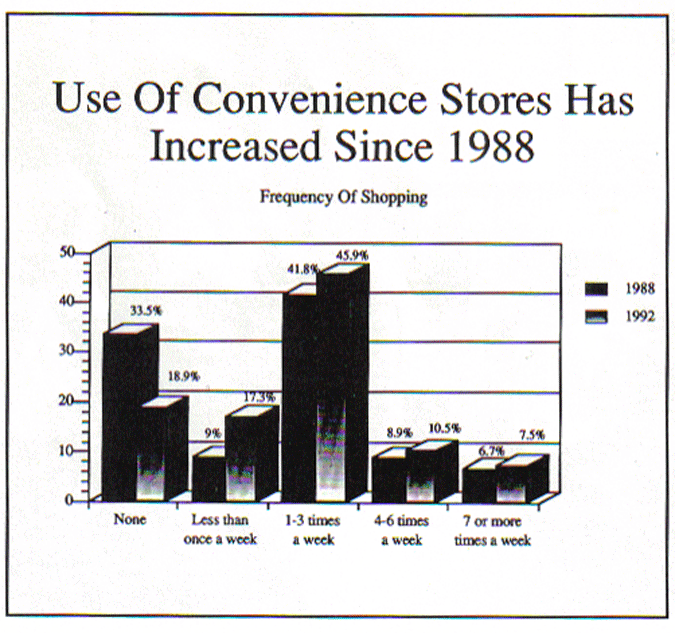
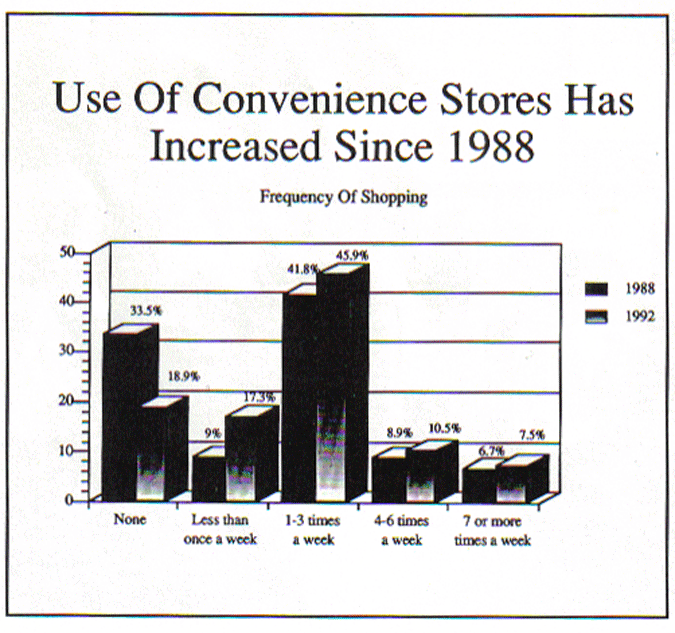
Convenience store usage is up, survey finds
The popularity of convenience stores has increased significantly in the past four years, according to a recent Maritz Ameripoll. Eighty-one percent of Americans now shop at "C-stores" - a gain of fifteen percentage points since 1988. The Ameripoll is a national consumer opinion poll conducted regularly by Maritz Marketing Research Inc. The telephone sample of 1,000 is evenly split between females and males.
"Four years ago one-third of Americans (33%) said they never shopped at convenience stores," says Beth Nieman, research manager, Maritz Marketing Research. "That number has now fallen to 19%."
According to the new study, 64% of consumers use convenience stores at least once each week. Of those, 15% shop one time per week, 31% shop 2-3 times per week, 10% shop 4-6 times per week, and 8% use C-stores on a daily basis.
Young adults are the most likely users of convenience stores. Eighty-one percent of 18-24 year olds shop at least once per week - 17 percentage points greater than the national average. But usage of convenience stores drops steadily with age - only 45% of people age 65 and older shop C-stores at least once per week.
Men and those with incomes between $25,000 and $44,000 are also likely to shop regularly at C-stores. Seventy-one percent of men, compared to 56% of women, shop at least weekly. Eleven percent of men shop daily. Overall, 72% of consumers with incomes of $25,000-$44,000 shop at least weekly, more than those with higher or lower incomes.
Convenient location is the primary reason shoppers use convenience stores. A close second is selection of items (25%) followed by quick check out (23%). About 10% of shoppers use convenience stores because they sell gasoline.
Forty-one percent of convenience store shoppers say staples like bread, milk, and eggs are the items they purchase most frequently. Women in particular are more likely than men to purchase such items.
Packaged beverages, including soft drinks, juices, and bottled water are popular with 13% of shoppers. Others frequently purchase tobacco products (9%), automotive products (9%), fountain drinks (6%), and snacks (6%).
Americans are more likely to visit convenience stores in the evening than any other time. Half (50%) of shoppers go during the evening hours. Morning (24%) is also popular, followed by afternoon (21%).
Reliability is tops to new car buyers
When it comes to buying an automobile, Americans are most concerned with its durability and reliability, according to a national study conducted by Consumer Attitude Research (C.A.R.), a subsidiary of Research Data Analysis, Inc., Bloomfield Hills, Mich.
According to the study, the top five reasons why Americans choose one car over another when they purchase a new car are:
- Durability and reliability
- That it's well-made
- Ease of handling
- Safety features
- Manufacturer's reputation
The study also showed that the least important reasons why Americans choose one vehicle over another are:
- Advice of relatives and friends
- Interest rates/credit terms
- Television/newspaper/magazinereviews
"These results reflect a trend toward the expectation of trouble free and safe vehicles," says Mark Konkel, president of C.A.R. "Customers value quality more than a manufacturer's reputation. This fact combined with the ever decreasing 'quality gap' between imported and domestic vehicles would seem to point to increased sales for the Big Three."
The results were compiled by C. A.R. from a national survey of over 18,000 Americans who bought new 1992 model year cars.
Workers pessimistic in study of four U.S. metro areas
Although one of five U.S. workers says it is somewhat or highly likely that he or she will lose his or her job sometime during the next six months, a major new survey finds that 44% of households in the Boston, Chicago, Dallas/Fort Worth, and Los Angeles metropolitan areas expect their individual financial situations to stay the same in 1992, and 31% see their situations improving.
The above findings are based on 4,104 detailed telephone interviews conducted during February by Original Research II, Boston. The survey will be ongoing this year with comparative results reported periodically to reflect changes in attitudes over time.
To help jump start the economy, capital gains tax cuts are supported by 52% of the survey respondents - with surprisingly strong support from middle-and lower-income individuals. Middle-income tax cuts, another proposed solution to the economy's present slump, are supported by 64% of respondents. Meanwhile, the survey finds the most favored policy is reductions in defense spending and use of the "peace dividend" for domestic purposes, as identified by 70% of respondents.
The four major metropolitan areas surveyed were selected because of their political, cultural and economic diversity, as well as the differential impact of the national recession on each. Some findings on a region-by-region basis include:
Boston
- 81% of respondents in the Boston area anticipate their household incomes will increase or remain the same during the next six months - an indication that the worst may be over for these New Englanders, perhaps hardest hit by the recession.
- However, one of four residents in the Boston metropolitan area say they plan to move within the next year. Of those, 27% say they will move out of Massachusetts altogether.
- More than three of four respondents from the Boston area support reductions in defense spending, the greatest number in favor of any metropolitan area surveyed.
Chicago
- Here, more than in any other area surveyed, 12% of employed respondents say they are highly likely to lose their jobs within the next six months.
- Respondents in the Chicago metropolitan area are less likely to move within the next year than those in any other surveyed. Still, one of four say they plan to move, and, of those, 20% plan to leave Illinois.
- Even though a capital gains tax cut is least favored among those surveyed in the Chicago metropolitan area, nearly half support the proposed plan.
Dallas/Fort Worth - The individuals surveyed in Dallas/ Fort Worth are most optimistic about their personal financial situations improving, with 33% of respondents expecting to earn more this year.
- On the nation's overall economic health, however, fully one of three expect the condition to worsen.
- While more respondents here than in any other region, 70%, are in favor of middle-income tax cuts, fewer, 59%, support reductions in defense spending.
Los Angeles
- Signaling continued concern engendered by the recession, 11% of Los Angeles area respondents say personal unemployment is highly likely.
- Of four survey areas, Los Angeles was most in favor of upper-income tax cuts, supported by 26% of respondents.
- 28% of residents in the Los Angeles metropolitan area say they plan to move within the next year. Of those, 22% say they will move out of California altogether.
Poor, senior citizens most likely to call themselves lonely
The loneliest people in America are senior citizens, Baby Busters, the poor, the unmarried, and people in the Pacific region (Oregon, Washington, and California). These are the results of a new survey of Americans conducted by Barna Research Group Ltd. of Glendale, Calif. The survey, conducted among a nationally-representative sample of 1,052 adults, focused on people's attitudes regarding friendship and loneliness.
While only 13% of all American adults called themselves "lonely," this percentage was considerably higher among some groups than in others. People with a gross annual household income of less than $20,000 were two or three times as likely as other income groups to term themselves as lonely. Twenty-two percent of the lower-income respondents said they are lonely, compared to only 11% of the people earning $20,000 to under $40,000, and 7% of the respondents with a higher income.
The age groups most likely to be lonely were senior citizens (21%) and people between the ages of 18 and 26 - a group commonly known as the Baby Busters (19%). Only 11% of the Baby Boomers, and 7% of the respondents between the ages of 46 and 64, described themselves as lonely.
Marital status also had a significant bearing on the answers people gave. While only 6% of the people who were currently married said they are lonely, these figures shot up to 20% among singles, 22% among separated and divorced people, and 23% among widows and widowers.
Regionally, there were not huge differences, but people in the Pacific region (17%) were somewhat more likely to describe themselves as lonely than were those in the Midwest (13%), the South (12%), Mountain states (11%), or the Northeast (10%).
Twelve percent of all survey respondents also felt that in times of trouble, they don't have anyone they can turn to for real comfort of support. Again, this feeling was particularly high among lower-income people (21%), seniors (17%), people who had less than a high school education (22%), blacks (20%), Hispanics (31 %), and people in the Pacific states (21%).
Even though most people did not go so far as to call themselves lonely, more than two out of five people (44%) did say they wish they had more close friends. Additionally, 63% said they personally know someone they would describe as truly lonely.
Although people age 65 or older were the age group most likely to be lonely, they were also the age group most likely to say they do not know anyone who is lonely. This suggests that seniors are more likely than other age groups to be polarized into two types of people. One group is those who have few relationships and are lonely. The second group is those who not only have enough relationships and friendships to satisfy themselves, but whose friends also tend to have sufficient relationships. In many cases, it appears that seniors are lonely because other senior citizens do not reach out to them to form relationships (or because the lonely ones do not reach out to join the circle of seniors who have built and maintained good friendships).
Seven out of ten Americans (71%) said it is easy for them to make deep, lasting friendships. Interestingly, there was no statistically significant difference according to income level, education level, marital status, region of the country, or ethnicity. Men, however, were less likely to say they could easily make deep friendships than were women (67% to 75%). In addition, seniors were more comfortable with their ability to make friends than were people under theage of 65 (81% to 70%). People who were involved religiously (e.g. read the Bible, attend church, attend Sunday school) were also more comfortable with their ability to make friends than were people who were less active or inactive in religion.
Where would people go to make new friends? The main places, listed by nearly half of all adults, were church (49%) and work (46%). Other sources, each mentioned by about one-fifth of the respondents, were social or exercise clubs (20%), community activities or organizations (18%), and school (18%). Among seniors, however, only 16% said they could rely on work for this purpose, and 8% said school. This left 73% depending on church, 25% on community activities or organizations, and 18% each on the neighborhood or social/ exercise clubs.
Younger people took a different approach. Most of the Baby Busters would look for friends at school (42%) or work (41%), along with social or exercise organizations (23%). Compared to other age groups, church (29%) and community activities or organizations (10%) were rarely a factor.
Poll shows widespread awareness of alcohol abuse warnings
The public has virtually universal awareness of the statements in proposed warnings in alcohol beverage advertising, according to a recent national Roper Organization opinion survey of adults and young people. Anheuser-Busch Companies, Inc. commissioned the poll to test public knowledge of the proposed warnings and public opinion as to their effectiveness.
Of five warnings proposed in legislation pending before the U.S. Senate, 99% of Americans of all age groups said they already knew of the risks described in two of the warnings. The statements in two other warnings were known to 98% of the public, while the fifth warning was common knowledge to 97%, according to the poll. These levels of knowledge were very similar among adults and youths aged 14-20.
"The poll shows extremely high awareness of the information in the proposed warnings, among adults and young people alike," says Harry O'Neill, vice chairman of The Roper Organization. "Such high levels of awareness are very rarely found."
The survey also found that seven in ten of the total sample (73%) and of 14 to 20 year-olds (69%) believe that the warnings would not be effective in preventing alcohol abuse. In addition, of those Americans who drink, some 95% said that advertising did not influence their own decision to start drinking and does not affect how often or how much they drink.
"We are against alcohol abuse and illegal underage drinking - period," says Stephen K. Lambright, vice president and group executive of Anheuser-Busch Companies, Inc. "However, we are concerned about the application of measures supposed to combat abuse that are of no benefit. As this Roper survey shows, the proposed warnings would not tell people anything they don't already know - and the vast majority believe that ad warnings would not prevent abuse. The ad warnings approach should be rejected in favor of education, awareness, and law enforcement, which are already reducing abuse."
In its survey, Roper interviewed 1,202 people 14 years of age and older by telephone in late November 1991. Additional interviews were also conducted among 602 respondents aged 14-20, using the same questionnaire to allow for a larger sampling. A total of 738 interviews were conducted among the 14 to 20 year-old age group.
Following are the five statements included in the proposed ad warnings and the percent of all Americans, the percent of those 14-20 years of age, and the percent of those 21 and older who said they already knew of these risks associated with the abuse of alcohol:
- "Alcohol impairs your ability to drive or operate machinery" - known by 99% of all three groups.
- "Drinking during pregnancy may cause birth defects. Women should avoid alcohol during pregnancy" - known by 98% of all those polled, by 99% of 14-20 year-olds,and by 99% of 14-20 year-olds, and by 98% of those 21 and older.
- "Alcohol may be hazardous if you are using certain kinds of over-the-counter prescriptions, or illegal drugs" - known by 97% of all persons sampled, 94% of those 14-20 years of age, and 98% of all adults.
- "Drinking alcohol may become ad-dictive" - known by 98% of those polled in each group.
- "It is against the law to purchase alcohol for persons under age 21 known by 99% of all those sampled, 98% of the adults and 100% of those under 21.
The survey also asked members of the public about the effectiveness of the proposed warnings in alcohol advertising. Again, the results were consistent across age categories, with seven in ten finding them ineffective in reducing abuse. Breaking the categories down, 73% of the total sample, 69% of 14 to 20 year-olds, and 73% of those 21 and older said the warnings would not reduce abuse.
One of the key reasons that people don't believe warning labels will work to reduce alcohol abuse may be that more than three-fourths (77% of all those sampled and 79% of those aged 14 to 20) feel that if someone is already aware of the possible dangers of using a product, then those people "aren't likely to pay attention" to warnings.
Also released were statistics regarding the effect of advertising on Americans' alcohol consumption practices. Only 4% of all those who drink said that advertising influenced their original decision to start drinking, while just 3% said that advertising influences how often they drink or how much they drink.