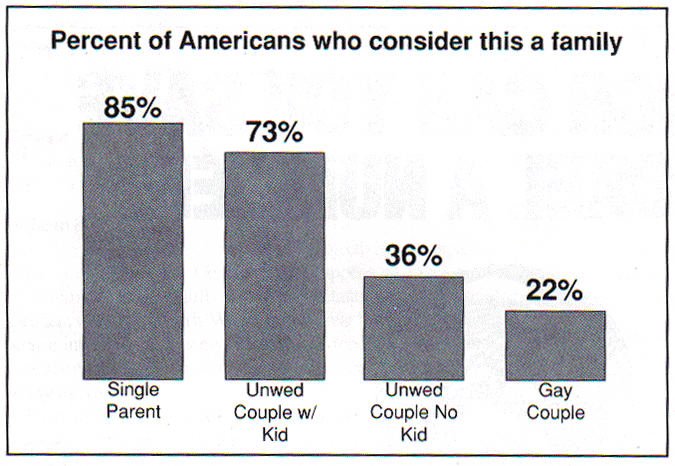
Americans' definition of family is changing
Most Americans agree that a single parent raising a child constitutes a family. An unwed heterosexual couple with a child also qualifies. But remove children from the arrangement and the definition narrows: Childless couples - heterosexual or homosexual - do not fit Americans' definition of a family unit.
These were among the findings of a new nationwide study conducted by the Barna Research Group Ltd. of Glendale, Calif. The questions were asked of a random sample of 1,009 adults, with a margin of error of plus or minus 4% at the 95% confidence level.
Eighty-eight percent of respondents said they consider a single parent with child a family; 10% disagree, while 2% are unsure. By and large, this opinion cuts across racial, religious, gender, educational and geographic lines. The one visible difference was among adults aged 28 to 36, who were even more likely (96%) to view this type of household as a family. Even among older adults, however, a clear majority (82%) considered this group to be a family.
When it came to cohabiting heterosexual couples without children, however, only 36% granted this group family status; 62% said they are not a family, while 2% were undecided. Here considerable variance existed between different age groups. Baby Boomers and Busters - adults under 47 - were more likely (42%) to consider this arrangement a family than were older adults (28%).
Opinions also varied geographically and according to marital status. Half the respondents in the Pacific region considered an unwed couple a family, compared with 29% in the South. About a third of married couples considered childless unwed couples a family, compared with 42% of never-married respondents and 43% of divorced, single adults. Predictably religion played a significant role on this question. The findings, however, may surprise some. Catholics were more likely (39%) to call an unwed couple a family than were Protestants (30%), with an even smaller percentage (24%) of evangelical Christians defining this arrangement a family. Regular practitioners (churchgoers and Bible readers) were also less likely to legitimize the single-parent grouping (about 30% in each group) than non-churchgoers or readers (40%).
Children seem to be a crucial factor in Americans' definition of a family. An unwed couple who have had a child together is a family, according to nearly three-quarters of the respondents. The age breakdown for this category compared to that of the single parent with child category, with younger (under 47) respondents more likely to agree than older.
Homosexual couples, defined in the survey as "two people of the same sex who are living together and have a sexual relationship with each other," received family status from only 23% of the respondents. Acceptance of gay couples was highest among Boomers and Busters; it was slightly higher in the Northeast (25%), significantly higher in the Pacific states (40%) and higher among single adults (30% compared with 20% of married respondents). Catholics (24%) again proved more open to non-traditional arrangements than Protestants (18%), regular churchgoers and Bible readers (16% and 14%, respectively) and evangelical Christians (10%). George Barna, president of the Barna group, noted that within non-evangelical Christian denominations, these findings seem to indicate that church leaders tend to be more open to non-traditional family units than are their lay followers. He added, however, that attitudes are changing, as acceptance of gay couples as families continues to grow. Barna issued a cautious prediction that a majority of adults could define a cohabiting gay couple as a family by the year 2000.
U.S. products rate high among Mexican consumers
Mexican consumers rated most U.S.-made products high for prestige and quality, according to a recent study. The poll, conducted in Mexico City, Guadalajara and Monterrey, asked 750 Mexican adults about their perceptions on quality and price for a variety of products made in the United States, Mexico, Japan and Europe. The products were major appliances, cars, casual clothing, cereal, TVs and VCRs, beer, wine and cigarettes. American goods were ranked best or nearly the best in five of the eight categories.
The poll was conducted in January 1993 by San Diego-based Market Development Inc., (MDI) which specializes in research among Hispanics in the United States and Mexico. This is the first MDI Mexico Poll.
U.S.-made major appliances fared best among the respondents, with high quality and low price. Japanese cars edged out U.S. cars in quality, but were considered more expensive than U.S. cars. Casual clothing from the United States, including jeans and athletic shoes, were highly rated on both counts, as were cereals; Mexican items in these categories also enjoyed a perception of high quality, but the U.S. goods were lower priced. Mexican and U.S. cigarettes were thought to be about the same in quality, with the Mexican brands slightly less costly. Mexican beer clearly won out among the respondents on both fronts, although U.S. brands were considered favorably. Wine was one of the few categories where European goods were strongly favored. Though somewhat expensive, it was judged the best quality. Japan led the approval ratings in both categories for TVs and VCRs, with U.S.-made units running second.
Public wants national health insurance, supports deficit program
Three-quarters of respondents in a recent survey favor a government-sponsored universal health care package. A healthy majority also support President Clinton's deficit-reduction proposals.
These and other findings were the result of a telephone survey of a random national sample of 502 adults conducted in April by Chilton Research Services, Radnor, Pa. Besides health care, the survey questioned respondents on the national deficit, automotive issues and violence in society. The results have a margin of error of plus or minus 5%.
Those who made less than $25,000 a year were especially enthusiastic about some form of national health care, with 86% weighing in for the program. Within the general 75% majority, however, there was considerable variance on how to pay for such a program. A clear majority (70%) favored "sin taxes" on alcohol and tobacco. Three other possibilities fell far short of this option: 44% favored a 2% increase on
income tax, 41% favored a gas tax hike of 10 cents per gallon, and 37% thought a 3% national sales tax was a good idea.
Respondents blamed the high cost of health care on several factors. Foremost were doctors (33%) and insurance companies (19%). Older Americans (61+) particularly held doctors responsible. Only 10% thought lawyers drove up health care costs, and just slightly more (14%) attributed high costs to politicians or the government.
On another issue, well over half the respondents (63%) supported Clinton's efforts to reduce the federal budget deficit. But a majority (52%) is still worried that the government will remain saddled with debt. Older Americans (61+) are more concerned about government spending than are adults under 30 (61% compared with 42%).
Dads give themselves a pat on the back
American fathers think they're doing a great job as parents. Redbook magazine surveyed 420 husbands on this and other aspects of fatherhood in January. The husbands were drawn from Redbook's previous "Mommy Track" national survey of 1,000 mothers 18 to 54 years old, with children under 18 living at home. EDK Associates collaborated on the study.
Nearly half the fathers thought they could raise their children as well as their wives and 42% think they are better parents than their fathers. A whopping 89% saw fatherhood as a desirable and appreciated role. However, the survey also revealed that women still take on the lion's share of parental duties such as dressing, feeding and preparing the kids for school in the morning, and checking on a crying child at night.
The survey looked at respondents' level of engagement in childrearing as well as their self-assessment as fathers. A deciding factor seems to be how comfortable men are with working wives. The survey placed fathers in one of three categories: non-traditional fathers, who are happy to have a working wife; "mixed-role" fathers, who would prefer their wives stay home, but need the second income source; and traditional dads, where the wife doesn't work. Mixed-role fathers were both less involved with their children and less confident (36%); traditional fathers were least involved, but most comfortable with their parenting skills (36%); and non-traditional dads were most involved with their kids and fairly confident in themselves as fathers (28%).
Nearly all respondents (92%) said they would use paternity leave if it were available, but seem pessimistic that companies would encourage or support this behavior. Most thought paternity leave would jeopardize their jobs and believe that society has not caught up with their changing parental roles.
U.S. consumers ready to buy American cars
After years where foreign cars ruled the market, Americans apparently want to drive a domestic car again, according to two separate studies. More than two-thirds of Americans planning to buy a new car in the next year plan to "Buy American," according to a recently survey by Chilton Research Services of Radnor, Pa. Of the roughly 15% of Americans who say they'll buy a new car, 69% intend to choose a domestic auto, compared with 22% who say it doesn't make much difference. Only 9% plan to buy a foreign car.
Research Data Analysis (RDA), of Bloomfield Hills, MI, uncovered similar results in its national tracking study. The percentage of new car buyers (January through March) who agree with the statement "The Japanese and Germans makes much higher-quality vehicles than we make in the United States" dropped from 58% in 1992 to 55% in 1992. The recent upswing in domestic auto sales would seem to corroborate this finding. RDA's subsidiary Consumer Attitude Research surveys approximately 40,000 new car buyers every year; the survey has a margin of error of plus-minus 1%.
The Chilton study also found that the public rated American cars high on perceived quality, with 52% of the public saying that generally, domestic cars are about as good as imports. A similar proportion (51%) of car owners or leasers (88% of the population) thought they were truly equal. Those who didn't own cars were even more enthusiastic (55%) about American cars' quality. More men (62%) than women (42%) thought American and imported cars were comparable.
And 70% of the population felt that the government should raise import tariffs on foreign cars, as President Clinton has suggested. On the other hand, only 30% supported Clinton's proposed gas tax, while 55% disapprove. Respondents making less than $25,000 ayear, or without a high school diploma, were particularly unsupportive (18% and 24%, respectively).
The poll was conducted by telephone April 15-19 among a random national sample of 502 adults. The survey covered health care, the deficit and social concerns as well as automotive issues. Results have a margin of error of plus or minus 5%.