
Survey finds TV best vehicle for new product introduction
According to a majority of adults, corporate advertising managers should put their money into television when introducing new products. R.H. Bruskin Associates recently presented a hypothetical situation to the American public concerning the possible advertising of a new product. The respondents were asked how they would react to the following scenario:
"A company is bringing out a new product and is interested in describing it as completely as possible to consumers. Their intent is to impress people and, above all, make them interested enough so that they will want to buy the product.
The company has a choice of advertising the product in many different ways; they can use newspapers, magazines, radio, TV, direct mail, billboards, or any other type of advertising.
"In thinking about what might have the greatest influence on you, what type of advertising do you feel they should use, and why do you feel that way?"
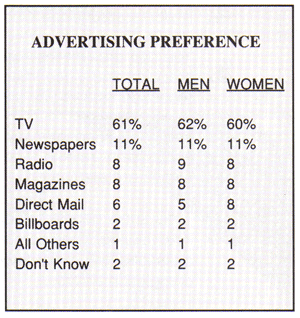
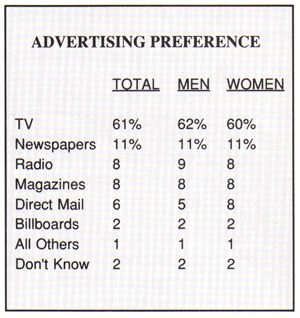
The results, based on a national telephone study of 1,002 interviews among men (502) and women (500), indicate a strong preference for television. This is true among both men and women, people in all age groups, all income groups, and all sections of the country. Here's how the overall results look among men and women:
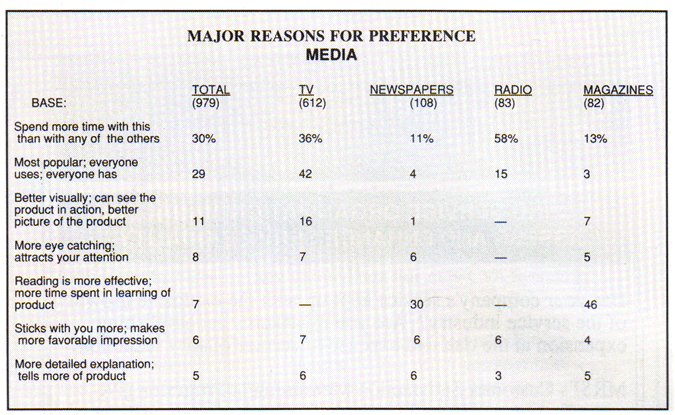
The major reasons for choice are shown below, but only for the four types of advertising which yielded a large enough base for analysis - TV, newspapers, radio, and magazines.
The consumer public has a strong perception that TV is where advertisers should put their money when introducing a new product. Their feelings are based initially on their own habits - time spent with TV, a feeling that TV is the most popular medium, and that showing the product in action provides an advertiser with greater advantages and the public with a better overall picture of the product.
Visits to sit-down restaurants decreased last year
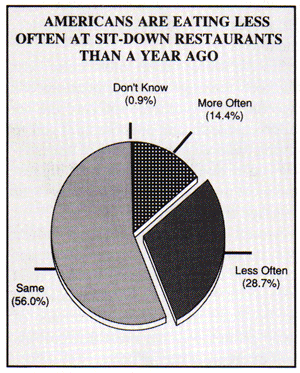
A recent Maritz AmeriPoll found that while eating out continues to be a popular American pastime, the number of trips to sit-down restaurants decreased last year. (Sit-down restaurants exclude fast food chains).
Twenty-nine percent of respondents said they are eating at sit-down restaurants less often than a year ago. That figure was offset somewhat by the 14% who are visiting such restaurants more often - but still indicates a net drop of 15 percentage points. The majority (56%) of those interviewed said they are eating at sit-down restaurants with the same frequency as they were a year ago.
The survey also discovered that Americans have an increasing preference for variety in the sit-down restaurants they frequent. Twenty-eight percent of those surveyed said the number of different restaurants they visit increased last year. Seventeen percent of respondents cut the number of restaurants they use, while 52% said the variety of restaurants they visit is unchanged from a year ago.
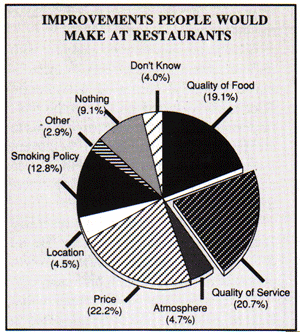
When asked about items they would like to see improved in the restaurants they visit most often, 22% of the respondents cited price, followed closely by quality of service (21%). Nineteen percent mentioned quality of food. Other items on the list of improvements are smoking policy (13%), atmosphere (5%), and location (5%). Nine percent of people are completely happy with the restaurants they visit most often and would change nothing.
According to AmeriPoll, most visits to restaurants were apparently unplanned. Nearly 2/3 of respondents said they are "very likely" or "likely" to make the decision to eat out at the last minute. Conversely, 1/3 said they are either unlikely or very unlikely to make a spur-of-the-moment decision. Thirty-four percent of women said their decisions are very likely last minute, compared to 29% of men. Twenty-one percent of men, on the other hand, claimed they are unlikely to make their decisions at the last minute, contrasted to 16% of women.
Super Bowl interest increases
Although San Francisco's thrashing of Denver in January may change some people's minds about future SuperBowls, a pre-Bowl survey by R.H. Bruskin Associates found that 44% of all adults had "much more" or "somewhat more" interest in the Super Bowl than in years past. Thirty-three percent said they were "much less" or "somewhat less" interested in the game. About 19% reported no change in interest, and 4% had no opinion. Among men the differences were even more dramatic; 49% expressed greater interest, compared with only 30% who indicated less interest (19% same, 2% no opinion).
Fans of professional football (43% of the total sample) reported a significant increase in interest; 66% are now more interested, compared with only 20% who said their interest has declined. The balance, 14%, indicated that their interest has remained about the same.
Of those more interested, 18% attributed it to greater parity of teams, more competitiveness, and the game being more interesting and more exciting. An additional 14% said their increased interest was based on a better understanding of football (17% of women said this). Other important factors resulting in increased interest include: 23% identified the Super Bowl as a family affair, and 18% said that they enjoy the sport of football more now than in the past.
Among those who reported decreased interest, the reasons centered around little or no interest in football (22%), a general decrease in interest in the sport (18%), and a feeling that football has become too commercialized, with the players only concerned about money (17%).