
Ad survey finds repetition a problem
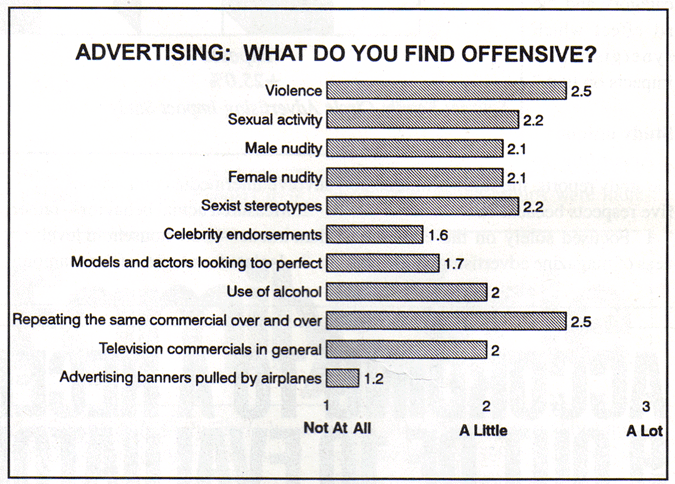
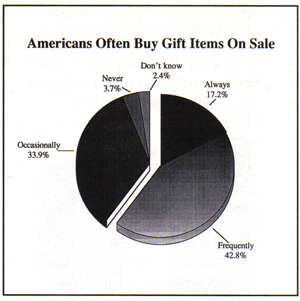
Sixty-five percent of respondents to a Telenation survey on advertising said that repetition of commercials bothers them a lot. Telenation is a national telephone survey conducted by Arlington Heights, Ill.-based Market Facts, Inc. In the survey, respondents were asked to indicate if they were bothered a lot, a little, or not at all by the items shown.
In general, violence scored highly, as did repetition. For the most part, men and women were in agreement, but there were some notable differences. While both men and women were bothered a lot by repeating commercials (men, 65 % and women, 66%), when it came to violence a much greater number of women were bothered a lot (76%) than were men (54%).
The sexes also disagreed considerably when it came to sexuality in advertising. More women were bothered a lot by sexual activity (63%) than were men (34%). When it came to nudity, women again were more inclined to be bothered. With regard to male nudity, 53% of women surveyed were bothered a lot compared to 36% of the men. Predictably, the women's reaction to female nudity was even higher. Of the female sample, 58% were bothered a lot by female nudity versus 27% of the male sample.
It seems that TV commercials are an accepted fact of life. Only 26% of the sample said they are bothered a lot by them, 45% felt bothered a little, while the remaining 29% were not bothered at all.
What did people think was the least offensive advertising? People were least offended (82%) by airplanes pulling advertising banners!
Men prefer department stores for holiday shopping
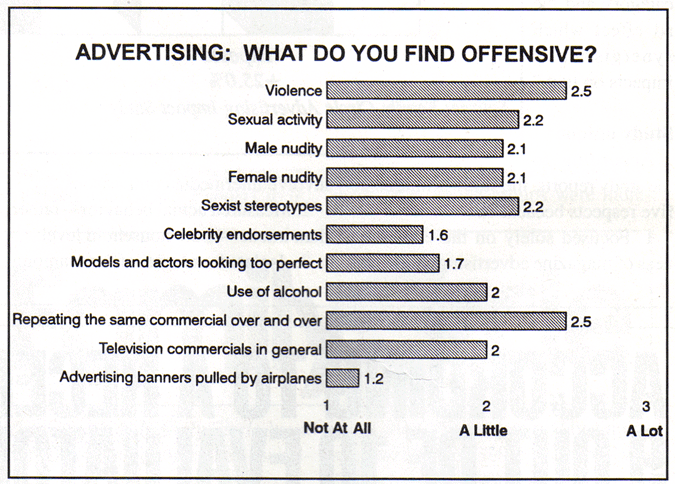
When asked which stores they would shop most often for holiday gifts, a Maritz Marketing Research study reveals that department stores are favored more by men, while women prefer discount stores. Forty-two percent of males use department stores more often. In contrast, 47% of women choose discount stores over department stores. Men rank discount stores second. For study purposes, department stores are defined as retailers like Sears, JC Penney, May Company, and Nordstrom. Wal-Mart, K-Mart, and Target are considered discount stores. The study also shows the higher your income, the more likely you are to shop at department stores for holiday gifts. Over half (51%) of those with incomes of $45,000 or more planned to shop most often at department stores, compared to 34% of those with incomes under $45,000. Nearly half (48%) of the last group would shop most often at discount stores.
As a whole, the portion of shoppers who use department stores and discount stores is about equal. The stores consumers say they shop most often for holiday gifts are:
- Discount stores (41%)
- Department stores (38%)
- Specialty stores such as clothing, hardware, or toy stores (11%)
- Mail order catalogs (4%)
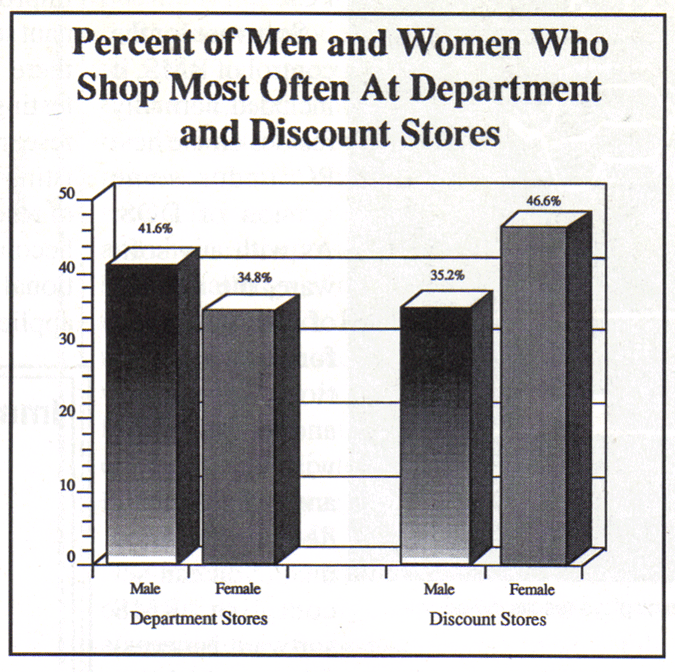
When purchasing gifts for the holiday season, most shoppers regularly choose items that are on sale. Six of ten either always or frequently buy sale items, while 34% occasionally buy them. Only 4% of shoppers never purchase items on sale.
The number of people always shopping sales declines steadily with increased income. For example, 23% of those with incomes under $25,000 always shop sales. That number decreases to 9% of those with incomes of $55,000 or more. The study also suggests women are more likely to buy sale items than men. Twenty-two percent of females always purchase gift items on sale; only 12% of men do so.
Most Americans believe ads contain subliminal messages
Although controversy surrounding the use of subliminal advertising has waned since the 1970s, a majority of Americans still believe that subliminal messages are being placed in advertisements. A national consumer opinion poll conducted in 1991 by Response Analysis Corporation, Princeton, New Jersey, on behalf of Seagram's Extra Dry Gin, found that six out of ten people believe that subliminal advertising is inserted into or is being used in advertisements.
Arizona Hispanics say they rely on Spanish media
The 1990 U.S. census estimates that nearly 700,000 Hispanics reside in Arizona. This makes the state seventh in the nation in terms of Hispanic population and fourth in concentration, with roughly one of every five residents of Hispanic origin or descent. Additionally, the Phoenix/Tucson consolidated metro area ranks third among western states in Hispanic population.
Hispanics participate as major players in Arizona's population growth and are increasing their numbers at a rate of 56 percent since 1980. And as this population grows, so does its interest in and reliance on Spanish language media, particularly the electronic media.
According to findings from two waves of Hispanic-TRACK Arizona, a study conducted by the Behavior Research Center, Phoenix, 88 percent of the Arizona Hispanic population relies on Spanish language television and 71 percent on Spanish language radio to meet all or part of their entertainment, music, news, or community affairs informational needs. Collectively, 93 percentuse Spanish language radio and television to meet these needs. Only seven percent rely on English language media exclusively.
Even in bilingual households, only 13 percent rely exclusively on English language media for their news and entertainment. And despite some suggestions that younger Hispanics are turning to English language electronic media, this study shows little evidence to support such a contention - only nine percent of 18 to 34 year old Hispanics said they rely exclusively on English language media.
Report outlines influence of advertising on kids
According to a new report by Find/SVP, New York City, advertising has a major impact on youths' purchases when it comes to breakfast cereals, fast foods, soft drinks, clothes, and salted snacks. However, advertising has its greatest influence on youths' selection of sneakers. When a study asked children to name their favorite car, 26% of them said Lamborghini, which retails in the neighborhood of a quarter of a million dollars. Today's children are becoming brand conscious at a very early age. There are several distinct reasons for this.
First, today's children shop more, and at an earlier age, than kids did in the past. They see something on TV, then they see it in the store and it just makes sense to them to buy it, or try to influence their parents into buying it.
Second, the increasing affluence of maturing baby boomerparents promotes brand awareness and consumer consciousness among their children. Also key is the grandparent factor. The average household income of the 55 to 64 year old group exceeds $35,000, and grandparents are gift givers.
Finally, dual income households have become prevalent. While both parents are away at work, teens and preteens are being given the responsibility of doing the shopping. While they may be told what product to buy, once loose in the store, they decide which brand of that product to buy.
The report also shows that 37% of 9-11 year olds, 49% of 12-13 year olds, and 54% of 14-15 year old children have their own television set. And anywhere from 33% to 40% of them are connected to cable. It is estimated that companies targeting children spent $680 million on television advertising in 1991. Children's television advertising is being revamped and most of it now features lots of action, loud rock music, and famous rock stars and athletes - all of which have great appeal to kids.
There are also now more magazines targeted to children. In 1990 there were 160 magazines for children 8 to 14 years old, up from 85 such magazines in 1986. Ad spending on all children's print media was $20 million in 1990, according to the Find/SVP report.