
Migraines demand multiple therapies
Migraine sufferers often rely on a complex regimen of various prescription and OTC medicines, as well as alternative therapies to prevent or relieve pain, according to a survey from DrugVoice, a Hoboken, N.J., health care market research company.
Despite the medical advances of recent years, patients often remain unsatisfied with migraine treatment. Less than half of migraine patients were satisfied with their medical care, with those seeing neurologists or headache specialists noticeably more satisfied. "Even the most innovative products are not thoroughly meeting patient expectations particularly along the dimensions of recurrence of headaches and prevention. Clearly, significant unmet need continues to exist in this market and products with meaningful advantages have a good chance of success," says Melissa Krauth, DrugVoice president.
Many migraine patients face economic barriers in accessing drugs to relieve their headache pain. A significant number of patients report that health insurers’ limits on the number of doses in a given month forces them to ration medicines carefully or pay for expensive medicines out-of-pocket. "Many patients have specific roles about what to take when, often reserving their most effective medicine for the absolute worst headaches. This not only reduces patient satisfaction, but must also be negatively impacting productivity in the workplace," says Krauth.
"Placing limits on abortive, preventive, or other migaine treatments can actually cost managed care more money by forcing severe migaineurs to go to the ER for treatment," says Michael John Coleman, executive director of MAGNUM, a migraine patient advocacy organization, and a director of the World Headache Alliance.
DrugVoice research reveals that patients are active participants in the migraine care process, and often do not view their physicians as fully understanding their needs. Switching among products is extremely common, as patients look for options that consistently and completely alleviate migraine pain. "Many patients are in the driver’s seat when it comes to selecting a migalne therapy. Over 50 percent of product switches are initiated by the patient, mostly due to side effects or efficacy that falls short of expectations," Krauth says.
An opportunity exists for pharmaceutical and health care companies to tap into this vein of consumer activism and more thoroughly undertand the patient's perspective. Those who fail to do so risk being left behind by consumers who have moved on to a product and treatment option that better meets their needs. "This is not just about direct-to-consumer advertising. It’s about understanding how the consumer will respond to all elements of your marketing mix - product characteristics, packaging, value-added services and, or course, advertising - and designing the best overall mix," says Krauth.
Leave me alone; get me a Kleenex!
When it comes to being sick, solitude can be infectious. According to a national survey, 73 percent of Americans who have had a respiratory tract infection said they prefer to be left alone, while 25 percent said they like to be pampered. Adults aged 55 and over were more likely than younger people to report that they like to be left alone, the survey found.
Women are more likely than men to feel guilty that they are not able to fulfill responsibilities, while men were more likely to feel bored when ill. Only 6 percent of people said they enjoyed the time away from responsibilities, findings reveal.
And men were more likely to report that a spouse or partner cares for them when they are ill, while most women say they take care of themselves.
The survey also found that 51 percent of people with respiratory tract infections such as bronchitis, sinus infections, ear infections and pneumonia spend their time sleeping. About 20 percent watch television, 13 percent read and 3 percent spend time on the Internet.
Ten percent of Americans say they are not paid when they are sick and 8 percent report that their employer gets angry. Women were more likely to report that their bosses are understanding when they call in sick.
The survey of 2,022 Americans aged 18 and older was conducted by Princeton, N.J.-based Opinion Research Cooperation International for Bayer Corporation.
Internet users interested in smart cards
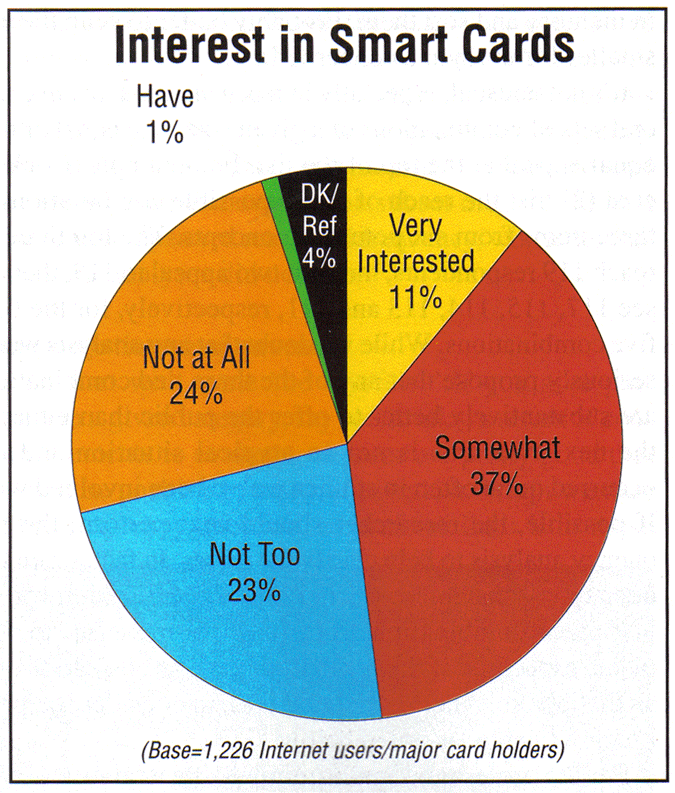
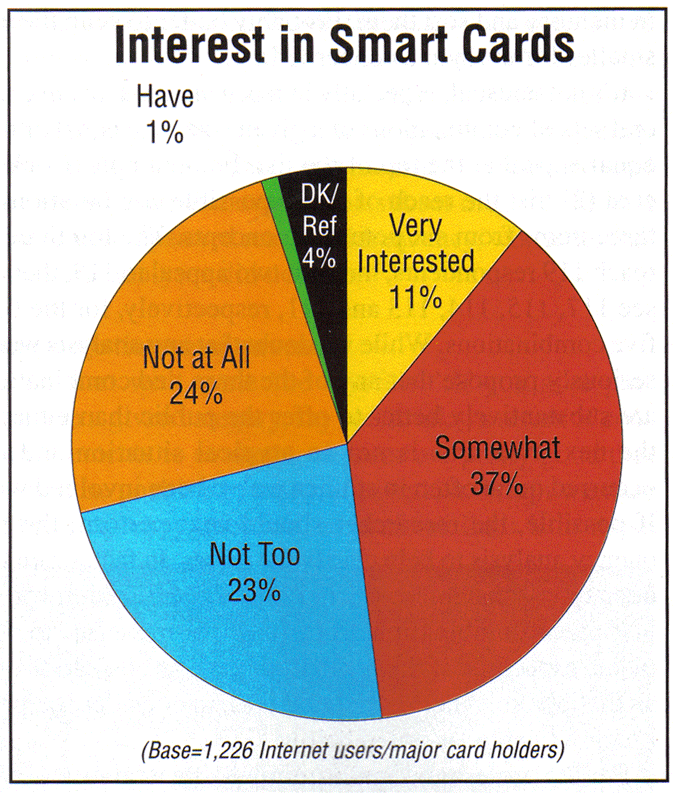
A significant number of Internet users express interest in smart cards, according to a recent research study by Atlanta-based Synergistics Research Corp. entitled, "Credit Cards: Online Opportunities." Close to half of the Internet users in the study say they are very or somewhat interested in obtaining a smart card. Interest tends to be more widespread among younger respondents and credit card revolvers. Only 1 percent of the respondents indicate they currently have a smart card. Large numbers of those who express interest in smart cards identify useful applications for this type of card. Nine in 10 smart card prospects say that a smart card would be useful for making purchases on the Internet. More than eight in 10 prospects indicate that it would be useful for keeping records of purchases in order to receive discounts, for storing personal financial information such as account numbers and balances, and for loading cash value onto the card from a checking account.
Hispanics favor Spanish-language ads
Critical segments within the Hispanic population are more receptive to Spanish-language advertising, according to Simmons’ 2000 Hispanic Study. The study found that:
- 50 percent of Hispanics say they remember more about an advertisement if it is in Spanish.
- Hispanics living in Houston and Miami are 24 percent and 20 percent respectively, more likely to agree to having greater retention when it comes to Spanish-language advertising.
- One in three Hispanics believe that Spanish-language advertising provides the best source of information for making purchasing decisions (42 percent of Cuban Hispanics support this concept).
- Almost half (47 percent) of all Hispanics say they are loyal to companies who advertise in Spanish.
- More than half of all Hispanics (57 percent) say they rely on TV to keep informed. Over 40 percent rely on radio.
- Puerto Ricans favor magazines as their main information source; Cubans favor TV.
Consumers view most product and service brands as commodities
Despite billions spent on marketing and branding every year, most companies have commoditized their products and services, according to a new study, "The Commoditization of Brands and Its Implications for Marketers," by Copernicus, a Newton, Mass., research firm, and Chicago-based Market Facts.
None of the 51 product and service categories studied are becoming more differentiated over time and 90 percent are declining in differentiation, with banks, bookstores, bottled water, credit cards, discount stores, and fastfood restaurants leading the pack in becoming much more similar and having the least brand differentiation. By "commoditized," Copernicus and Market Facts mean a company’s products and services are amazingly similar to competitor products and services in features, advertising, and price.
The study also found that consumers view low price as more important than brand name in 28 out of 37 product categories, particularly when selecting bookstores, bottled water, gas stations, office supply stores, pet supply stores, and rental cars.
"It’s astounding to see the huge range of products and services that are becoming commoditized," says Kevin J. Clancy, chairman and CEO of Copernicus. "Consumers can’t see differences between major brands in most categories, and as a result, many are buying based on price. If companies want to increase their margins - maybe even survive - they must learn how to develop value-add brands that set them apart from the competition in their customers’ minds."
Market Facts asked consumers to rate the leading brands in each of 48 product and service categories in terms of whether they are becoming more similar or different over time. Copernicus translated the measures of brand differentiation into a scale that ranged from +100 (much more similar) to -100 (much more different). More positive scores indicated increasing similarity between brands and a move towards commoditization.
The leading brands that received the highest similarity scores:
- 45: for Visa and MasterCard; 40: Staples and Office Depot; 38: Pets.Com (now defunct) and PetsMart.com; 37: L’Oreal and Clairol. The study also asked consumers to evaluate the brands in general in 51 product and service categories.
The categories receiving the highest similarity scores include:
- 37 for credit cards; 36: office supply stores; 35: bottled water; 34: bookstores. The categories perceived as least similar - or most differentiated - include:
- -2: political parties; 2: jewelry; 7: liquor.
Conducted among a nationally-representative sample of 615 men and women, age 18 or older, from Market Facts’ Consumer Mail Panel, the study investigated the performance of 51 different product and service categories (both old and new economy businesses) in terms of whether they are becoming more homogenous (i.e., the brands are becoming more similar or commodity-like) or heterogeneous (i.e., differentiated) over time.
The questionnaire used three differentmeasures: the first asked respondents to evaluate whether the two leading brands in a category were becoming more similar or different; the second queried respondents about the category as a whole; while the third focused on whether a low price vs. brand features or benefits were becoming increasingly more important to respondents.
E-shoppers overestimate past purchases
As e-commerce companies continue to struggle to build profitable consumer franchises in the digital economy, a new study by comScore Networks, a Reston, Va., firm that monitors online purchasing, shows that the use of consumer surveys to measure online buying behavior may have contributed to the demise of many companies by producing inaccurate estimates of market size.
In the offline world, it has long been known that consumers are apt to forget the details of their purchasing of many products and that they tend to overestimate how much they may have spent when asked to do so in consumer surveys.
To better understand the differences between survey recall data and actual observation, comScore conducted a study by administering an online consumer recall survey to a random sub-sample of the members of its opt-in electronic purchase monitoring service. In the study, consumers were asked to recall how much they had spent online at a variety of specific e-commerce sites. Their recalled statistics were then compared to what they had actually spent was measured through comScore’s electronic monitoring technology, which captures every purchase at every site.
The study identified a substantial gap between shoppers’ recollection and theiractual online purchases and site visits. Overall, consumers overestimated their past online purchasing by 55 percent. For example, those consumers who shopped at Amazon.com claimed they spent an average amount of $85 per month on that site, while their actual purchases amounted to a lower $67 on average per month. Bamesandnoble.com customers recalled spending $60 per month on average, with an actual purchase amount of $46 per month. The degree of overstatement varied considerably by site.
Video game sales declined last year
U.S. video games hardware, software and accessory sales declined 5 percent in 2000 compared to 1999, according to The NPD Group, Inc., a Port Washington, N.Y., research firm. Video game sales totaled $6.5 billion in 2000 vs. $6.9 billion in 1999.
While dollar sales were down, unit sales were up slightly. According to NPD, unit sales rose 1 percent to 191.4 million in 2000, compared to 188.6 million in 1999.
Video game console hardware and software dollar sales were down 20 percent and 4 percent respectively. However, the portable category showed significant growth in 2000. Portable software sales rose 26 percent in dollar terms and 28 percent in unit terms. Another strong performer was the portable accessories category. This category was up 56 percent in dollars and 76 percent in units compared to last year. The continued growth of the portable category was driven in part by the popularity of the Pokemon games. Pokemon’s impact is illustrated by the fact that four out of the 10 top-selling video game titles for the year were Pokemon Game Boy and Game Boy Color titles.
Video game software accounted for more than 63 percent of the industry’s units and dollars in 2000. The decline in software sales contributed to the year’s moderate decline. At the same time, quality licenses and strong gaming content fueled extraordinary sales for products that featured Pokemon, Tony Hawk, WWF, Zelda, Grand Turismo and NFL properties.
"The video game industry experienced a decline in overall dollar sales of five percent," says Richard Ow, NPD interactive entertainment account manager. "But this was to be expected, as the video game industry was going through a transitional period. The bear stock market and low consumer confidence also contributed to a slow year in overall retail sales. The Sony PlayStation and Nintendo 64 systems are entering their sixth and fifth years, respectively, in the U.S. market. While both systems may have already reached their peak in hardware sales, their software continues to sell.
"Lower price points for these systems across all categories affected the overall dollar growth. Sega’s" Dreamcast and Sony’s new PlayStation 2 represent the beginning of a new generation of console systems that will continue to build their market share in 2001. Microsoft’s X-Box, Nintendo’s Game Cube, and new portable Game Boy Advance will all be making a debut this year. With each system sporting its own uniquely powerful gaming and entertainment qualities, the transition from the 32164-bit generation into the next generation of gaming will mark the beginning of an exciting new video game cycle."
Sales of the total U.S. interactive entertainment market, which includes PC entertainment and video game software, were flat at $5.7 billion for both 2000 and 1999. Interactive entertainment software unit sales were up 5 percent for the year, totaling 200.5 million units vs. 191.8 million units for the prior year. PC entertainment software performed well in 2000, with an 8 percent unit growth over 1999.
Plastic surgery more accepted
Cosmetic surgery ma) not become as popular as coloring your hair, but a survey in ModetTz Maturity and My Generation magazines shows that more and more Americans are getting a little nip here and a little tuckthere. The survey, conducted by Roper Starch Worldwide Inc., Harrison, N.Y., found that:
- 55 to 64 is the "age of cosmetic surgery." Nearly one in 10 women in this age group - more than twice the rate of other groups - has had some cosmetic surgery and almost 16 percent expect to have it in the future. By comparison, only four percent of Boomers age 45 to 54 have had some form of cosmetic surgery, with about nine percent who say the will have some form of cosmetic surgery in the future.
- Cosmetic surgery is no longer a widespread taboo. Three out of five Americans believe in principle that if someone is not happy with how they look, there’s nothing wrong with their getting elective cosmetic surgery.
- Sixty percent of women and 35 percent of men would take advantage of the "cosmetic surgery deal of a lifetime" - surgery that was free, safe, and done so well that no one would know.
- Nearly half of all Americans know someone who has had cosmetic surgery. No longer just for aging movie stars and the very wealthy, cosmetic surgery has entered the American dream.
The survey also overturns a few myths about appearance and aging.
Myth: Americans are dissatisfied with how they look. The survey found that an overwhelming majority - 92 percent of women and 94 percent of men - are "completely" or "somewhat" satisfied with how they look for their age.
Myth: After 30, it’s all downhill. Wrong. The survey found that people think the average peak of attractiveness is 38 - not 18 or even 20.
Myth: Men look more distinguished as they age; women just look older. In fact, 65 percent of men and 60 percent of women believe that men and women are equally likely to "grow distinguished-looking" as they age.
Myth: It’s better to be pretty on the outside than pretty on the inside. Morn was right. Three out of five surveyed say that inner beauty counts more than looks "in the real world."
Myth: Appearance is extremely important to most women. In fact, the survey found that spending time with family, having a fulfilling relationship with a spouse or significant other and "feeling good about myself" were much higher priorities than appearance.
Roper Starch also conducted a separate online survey with 500 respondents who’ve had cosmetic surgery and found that, for the most part, they have bought into the myths. They believe that good looks count more than a great personality; they are far more likely to have gone on diets to lose weight, color their gray hair, and use Retin-A to reduce wrinkles; and they are less satisfied with the way they look for their age.
Roper Starch Worldwide Inc. conducted telephone interviews among a national cross-section of 2,008 Americans age 18-plus from September 11-October 2, 2000. The margin of error for the entire sample is +/- 2 percentage points at the 95 percent confidence level.