
Craftsman Tools are tops in brand-ranking study
Want a world-class brand? Then have a simple promise - and deliver on that promise for a long time. This old tenet was proven true once again in the EquiTrend online brand study conducted with more than 30,000 consumers and completed in November 2001. This is the 36th wave of the study, which has been regularly conducted since 1989 by Total Research Corporation, which developed the EquiTrend methodology.
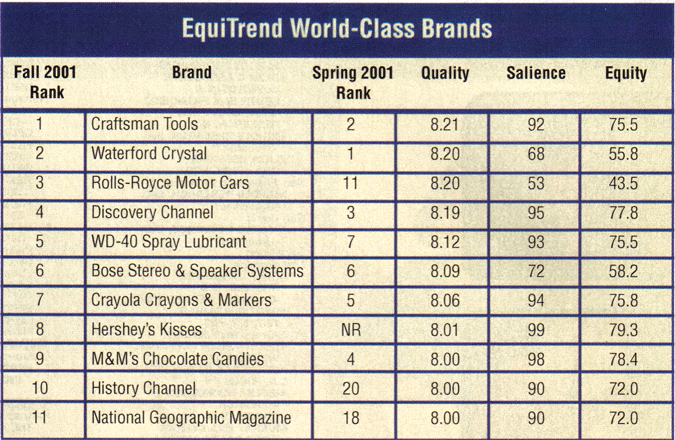
Topping the best brands list was Craftsman Tools, with a quality score of 8.21 on a scale of 0 to 10 just nosing out Waterford Crystal, which had been first in the spring 2001 study. Newcomers into the "world-class" (a quality score of 8.00 or above) brands list were: #3 Rolls-Royce, #8 Hershey’s Kisses, #10 History Channel, and #11 National Geographic magazine.
But some other tenets were not reinforced in this post-9/11 study. "We expected to see some major changes in the scores of brands," says John Morton, senior vice president and founder of EquiTrend at Total Research/Harris Interactive. "Usually, a recession has a substantial impact on equity scores, let alone recession plus 9/11. In past recessions, quality scores of brands tended to drop in general - luxury brands more than everyday brands. But most well-known brands were stable through this period, with the quality scores of most brands that had 60 percent or higher salience changing by less than a tenth of a point on our eleven-point scale."
Other surprising insights:
- Comfort- and escape-brands tended to do well. For instance, Jack Daniel’s had the 3rd best improvement from March to November 2001, with Miller Beer and Fox Sports also on the 10-most-improved list.
- Travel brands did not generally lose equity during this period. Surprisingly, most of the major airlines experienced an increase in perceived quality. Westin Hotels ranked 15th in quality improvement, and Southwest Airlines (9th) and Japan Airlines (14th) did even better. While there are many possible interpretations and explanations of these results, there seems to be no evidence of any permanent damage to consumer goodwill toward travel brands. Automotive brands also tended to do well on the most-improved quality list, with Michelin (7th), Goodyear (18th), and Exxon (19th).
- Media brands, perhaps due to the "stay-at-home syndrome," or by virtue of their special value during risky times, tended to do well. For instance, CNBC (2nd), BBC (Sth), and The History Channel (10th), all made the 10-most-improved in quality list. AOL, which could broadly be considered a media brand, was the brand with by far the greatest quality improvement from March to November 2001.
- Luxury brands also tended to improve their quality standing unlike in other recessions. Among the top gainers are brands like Ferrari (4th), Michelin (7th), Rolls-Royce (11th), Coach (21st), Porsche (22nd), Plaza Hotels (23rd), The Wall Street Journal (24th), and Lord & Taylor (27th).
Less familiar brands generally lost ground. All of the 65 worst-performing brands (i.e., biggest decrease in quality) had salience levels below 50 percent. "In other words, people went for familiarity, comfort and quality. It is probably no coincidence that ominous-sounding Prophesy Apparel was the single biggest loser in quality during the study," Morton says.
The EquiTrend Fall 2001 brandswere rated by 30,935 consumers ages 15 and over. The survey was conducted online October 31 through November 6, 2001, and rated 950 brands, including 215 media (print and broadcast) brands. Each respondent was asked to rate 100 brands (out of the total 950 brands) - 20 "core brands" (asked of everyone) and 80 randomly-selected brands from the remaining 930 brands. All respondents were asked to rate the 20 core brands in order to calibrate the data. Two thousand respondents (minimum) were asked to rate each of the remaining non-core brands. The study measures: quality - on a scale of 0 to 10 with 5.00 being very acceptable, 8.00 or above is considered world-class; salience - the percentage of people who feel aware and informed enough to rate the brand; equity - quality X salience.
Sporting goods industry slumps
Consumer caution, excess capacity and a weakening economy are the biggest factors affecting the sporting goods industry, according to the Sporting Goods Manufacturers Association (SGMA) in its annual State of the Industry report.
The core components of the industry – sporting good equipment, sports apparel, and athletic footwear – are profiled in this report. The only category to show growth in 2001 was athletic footwear and only slight increases are expected in 2002.
In 2001, sporting goods equipment sales were $16.6 billion – a 4.0 percent decrease from 2000. The top two categories for equipment sales in 2001 were exercise machines and golf. Only two major categories showed positive signs in 2001: soccer gear and outdoor equipment.
Sports apparel sales last year were $20.0 billion, a 3.5 percent drop vs. 2000. This slow rate of growth is a reflection of the overall clothing market – an excess of retail space, an ever-shifting kaleidoscope of brand names, a constant explosion of new fashion trends, and severe price competition. Despite the overall decline in sports apparel sales, spending for weomen’s apparel has increased at a greater rate than spending for men’s. Why? This is partly due to the rise in sports participation by females.
Athletic footwear sales in 2001 were $9.5 billion – a 1.1 percent increase over 2000. Sales are expected to increase about 2 percent 2002. The top two categories of athletic footwear are running and basketball. Through August of 2001, sales of athletic footwear were up by 7 percent vs. 2000. The terrorist attacks of September 11 had a significant impact on athletic footwear spending patterns, as they did on all spending patterns in the economy. According to The NPD Group, 5.2 percent of athletic footwear sales were conducted online in 2001 vs. 4.7 percent in 2000. According to NPD, when in-store purchases fell in September and October, online purchases jumped 64 percent and catalog buying rose 33 percent.
Sleep, eat, drink beer?
Worries abound for parents who send their children off to college. Financial irresponsibility, skipping class, and even binge drinking and drag experimentation are all fears parents face. A study released by Questia Media reveals how college students actually spend their time.
The good news: Most parents need not worry that their student is abusing his or her college education. Rest assured, today’s college student is aware of the importance of attending class and mindful of spending too much money.
Following are some highlights from Questia’s survey of 1,500 college students and parents.
On leisure time:
- 53 percent of students watch less than two hours of television per day;
- 49 percent of students go out socially one to two nights per week, but 63 percent rarely or never drink, and 64 percent have never experimented with drugs;
- 69 percent of students admit to catching more than seven hours of shut-eye per day;
- 19 percent of students admit to not calling home enough.
On study habits:
- 66 percent of students deny skipping class even once a week;
- 40 percent of students spend one to two hours online per day;
- 87 percent of students polled prefer to conduct late-night research via the Internet from home or in their dorm room rather than trekking to the library, and 81 percent spend three hours or less at the library per week.
On finances:
- 28 percent of students claim to sometimes ask for a handout from morn and dad, while 53 percent of students pay for at least half of their college life;
- 75 percent of students spend $50 or less per week on entertainment such as dining out and shopping.
Questia’s survey was conducted online and analyzed by Greenfield Consulting Group. Sixty-four percent of the survey participants were freshmen or sophomores; 20 percent were juniors; and 16 percent were seniors.
AOL names top 10 teen wired cities
America Online, Inc., has announced the top 10 teen wired cities in America based on a national survey of more than 6,700 parents of teens and teens conducted by Digital Marketing Services, Inc. (DMS). The results are based on the amount of time that teens, ages 12-17, spend online on a weekly basis and also reveal what teens do while they’re online, including e-mail, homework, instant message, listen to music, research current events, play games, and more.
According to the study, the top 10 teen wired cities in the U.S. are No. 1 Pittsburgh, No. 2 New York, No. 3 Cleveland, No. 4 San Diego, No. 5 Miami-Ft. Lauderdale, No. 6 Hartford and New Haven, No. 7 Los Angeles, No. 8 Detroit, No. 9 Philadelphia, and No. 10 Milwaukee.
Teens aged 12-17 years living in Pittsburgh are online an average of 15.82 hours per week and teens living in the No. 10 teen wired city -Milwaukee - are online an average of 12.85 hours per week.
The DMS survey also reveals that the Intemet is increasingly becoming an integral and essential part of teens’ daily lives, spanning the full range of their everyday activities. Here is a snapshot of what teens are doing online.
Communication: The survey found that the Internet has, in many ways, become the primary communication tool for teens, surpassing even the telephone for some teenage groups. Eighty-one percent of teens betweenthe ages of 12-17 use the Intemet to e-mail friends or relatives while 70 percent use it for instant messaging. When you look at older teens, age 18-19 years, these statistics jump to 91 percent for e-mail, 83 percent for instant messaging. Fifty-six percent of teens aged 18 and 19 years prefer the Intemet to the telephone.
According to the recently released AOL Roper ASW Youth Cyberstudy, the Intemet has become such an essential communication resource that the majority of today’s youth (55 percent) would rather bring a computer with them to a deserted island over a telephone or television. The same survey shows that most teens agree that more people will know their e-mail address rather than their phone number within 10 years.
Education: In addition to communicating with friends and participating in online recreational activities, the DMS survey reveals that teens depend onthe Intemet as an educational resource, relying on online resources to complete school assignrnents and research news and current events. Fifty-eight percent of younger teens (12-17 years) consult online resources for guidance on their homework assignments while 61 percent of older teens (18-19 years) turn to the Intemet for help completing their schoolwork. Additionally, more than a quarter (26 percent) of younger teens go online to access news and current events while almost two-thirds (61 percent) of older teens do the same.
Recreation: The study also demonstrated that teens turn to the Internet when they want some downtime from their busy lives. Fifty-five percent of younger teens between the ages of 12 and 17 years go online to listen to and download digital music; this figure jumps to an impressive 65 percent for older teens aged 18 and 19 years. Playing games online is another fun distraction for teens; 70 percent of younger teens and 60 percent of older teens use the Internet to play games. Fifty-one percent of older teens rely on the Web when planning vacations and searching for travel information. Other online recreational activities that register with the teen audience include downloading the latest news and gossip on celebrities and music groups (40 percent for younger teens, 35 percent for older teens), participating in online chats (36 percent for younger teens, 46 percent for older teens), and accessing sports information (25 percent for younger teens, 19 percent for older teens).
As teens continue to rely more and more on the Intemet for their everyday activities, they are also beginning to take advantage of wireless devices. Twenty-five percent of parents surveyed indicated that their teens currently use cell phones with instant messaging and/or e-mail capability, When asked which wireless devices their teen would most like to own, 51 percent responded a cell phone with messaging capability.
Consumption of personal care products rises
Annual consumption of personal care products has jumped to 40.5 packages per person in 2000, up from 38.4 packages per person in 1990, and, according to a newly released study by Kline & Company, changes in the demographic composition of the U.S. are largely responsible for this growth.
The first part of the research study series, titled Demographic Series For The Personal Care Industry, states that while the U.S. population grew by 13.2 percent from 1990 to. 2000, the unit volume sales of cosmetics and toiletries expanded by 19.3 percent during the same period. "These numbers indicate that, on average, each American is using 5.4 percent more personal care products now than in 1990," says Lenka Contreras, manager of consumer products at Kline & Company, a market research and consulting firm based in Little Falls, N.J.
Skin care product usage, for example, experienced a 22 percent increase over 1990 levels to reach 4.8 skin care products per person in 2000. The category, was driven by the ongoing searchby aging Baby Boomers for products that will help them maintain " a youthful appearance. Another contributing factor to growth in this category is the large population of teenagers purchasing skin care products for the first time to address their concerns for oil-free skin and pore size.
Another category that registered high consumption growth is hair coloring products. On average, Americans used 70 percent more hair coloring products per person in 2000 than in 1990. This surge is attributed in part to trend-setting teens entering the user base and aging Boomers covering gray hair. Also fueling the increase is higher usage among ethnic groups, particularly Hispanics. According to the report, more than 55 percent of Hispanics purchased haircoloring products in 2000 the highest percentage of any race or ethnic group. This tendency, along with a 58 percent jump in the U.S. Hispanic population over the last decade, has contributed significantly to the sharp rise in hair coloring product consumption.
Not every category experienced such robust growth during the 1990s. In fact, several categories reported stagnant or declining per capita usage from 1990 to 2000, including fragrances, nail care products, and bar and liquid soaps. "Marketers will need to better understand how shifts in diversity, household structure, and population distribution will affect consumer demand for these and other personal care products in order to gain an accurate perspective of the market," says Contreras.