
Taking a break from breakfast?
Only half of all Americans eat breakfast every day, with one out of 10 skipping breakfast all together. Breakfast foods aren’t just being eaten for breakfast anymore, according to research from Chicago-based Mintel. The most popular "dual role" of breakfast foods is as snacks, cited by nearly a third of respondents. This trend is more prevalent with younger Americans, as 71 percent of those age 18-24 say they eat breakfast food throughout the day, compared to just 45 percent of those age 65 and older who say they do so.
Mintel’s research found that respondents are equally divided between diet and health concerns and taste or preference in their choice of breakfast foods. This reflects a general dichotomy seen in the U.S. regarding diet and health - increased numbers of Americans are overweight, but more are exercising. The popularity of lowfat and fat-free foods reached its peak in the mid- 1990s, and consumers have moved back to more indulgent foods, but in moderation.
More than three-quarters of respondents eat breakfast at home (77 percent), with nearly equal numbers eating breakfast at work, in the car, or on the go (8 percent and 7 percent respectively). Just 7 percent eat it at a restaurant or coffee shop. It appears consumers are partial to home-prepared breakfast items, though it is not clear to what amount of trouble they will go to prepare these items themselves.
Women surveyed are more likely than men to eat breakfast at work, while men are more likely to buy breakfast - 19 percent of men eat their breakfast in the car or on the go, or in a restaurant or coffee shop, compared to just 9 percent of women. Those respondents with the highest income level (over $75k) are the most likely to eat at work (17 percent).
Yogurt, breakfast meats and breakfast pastries al! registered the largest increases in popularity, while categories such as frozen breakfast foods, cereal and cereal bars, and breakfast baking mixes lost market share.
TV is tops with American kids
Even though American kids seem to be getting busier and busier, they still find ample time to watch TV. According to a poll by Chicago-based C&R Research’s KidzEyes.com, the average American child between the ages of six and 14 watches 3.6 hours of TV on a typical weekday, and 38 percent of kids report watching six or more hours of television on a typical weekday. Interestingly, even though the majority of kids (51 percent) think "TV is a great way to spend my free time," many (44 percent) also recognize that "Too much TV is bad for kids."
Why are kids watching so much TV? Because they can! Sixty-six percent of kids have their own TV, and 53 percent have their own VCR. Interestingly, the percentage of kids who have their own TV is highest among the lowest income bracket, and this trend declines as income increases. Three-fourths (75 percent) of kids from families with household incomes of $35,000 or less have their own TV, as compared to 66 percent of kids from families with household incomes between $35,000 to $99,000, and 52 percent of kids from families with household incomes of $100,000 or more. African-American kids are also significantly more likely to have their own TV. Eighty-one percent of African-American children have their own TV as compared with 73 percent of Latino kids and 66 percent of Caucasian kids.
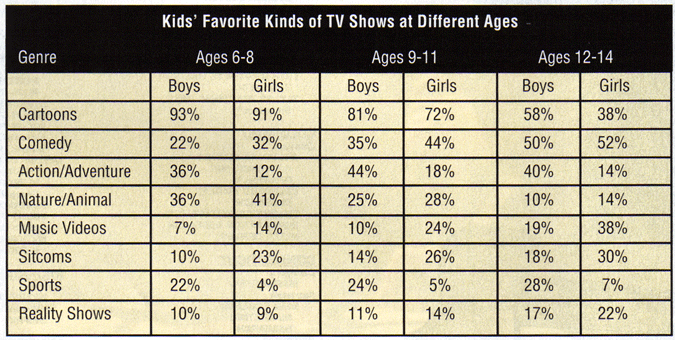
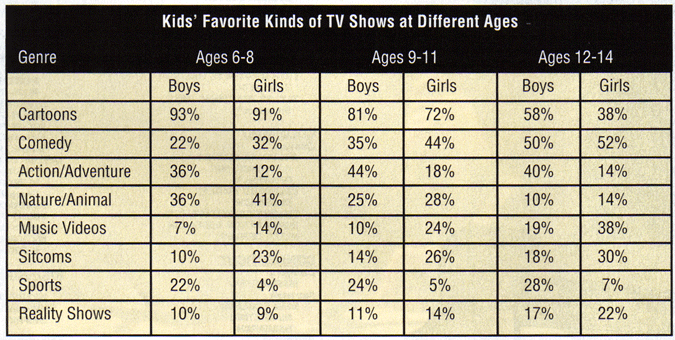
So what kinds of shows are kids tuning into? Cartoons are far and away the favorite among kids, but this genre drops in popularity as kids, especially girls, mature. Reality shows, on the other hand, attract the attention of older kids more than younger kids. Regardless of age, girls tend to prefer sitcoms and music videos, whereas boys are inclined to watch action adventure and sports programming. Nature/animal shows are popular among both boys and girls, especially younger ones.
When it comes to advertising, kids are sprit on their feelings about whether they like it or not. While 22 percent claim they like watching ads, and another 25 percent say they don’t mind watching them, 53 percent say they don’t like watching them. Boys enjoy watching commercials more than girls (24 percent vs. 20 percent) do. So what makes for a good commercial? Kids report that they like commercials that are funny (57 percent) and have good music (20 percent). The music component of commercials is especially important for girls 12-14 with 30 percent of them reporting that music will make or break a commercial.
The study was conducted among 3,888 children nationwide between the ages of six and 14 and inquired about kids’ TV watching habits.
Super Bowl scores for advertisers
Research conducted 24 hours after Tampa Bay’s decisive win over Oakland in Super Bowl XXXVII showed that adult male television viewers who watched the game could recall many of the ads shown throughout the contest, a study by advertising research firm Ipsos-ASI found.
The 2003 Super Bowl was a blowout, with little doubt about the outcome after the first half. But audience advertisement awareness was not affected by the lopsided contest. The Norwalk, Conn.-based company found that Super Bowl XXXVII far exceeded other football gamestested as a vehicle for memorableadvertising to the hard-to-reach male audience.
The study found that male television viewers were three times more likely to report having watched all the advertisements in a given quarter of the game (compared to men watching college bowl games or the AFC championship game), and were able to remember up to four times as many advertisements than other championship games.
The results are based on interviews comparing advertisement recall among men watching the Super Bowl with advertisement recall among men who watched the AFC conference title game or a college football bowl game (the Fiesta Bowl or the Rose Bowl).
This year, the company found that 37 percent of the audience reported to have watched all of the 60 or so paid ads in any given quarter during the Super Bowl compared with only 4 percent for the Rose Bowl, 13 percent for the Fiesta Bowl, and 7 percent for the AFC Championship game.
The critics’ choice is not necessarily the most effective advertisement, the study also showed. Reebok advertisements won critical and popular acclaim, but did not win, place or show on the list of advertisements male Super Bowl viewers were most likely to recall.
Neither did advance Super Bowl hype necessarily improve recall. Some 39 percent of viewers reported having heard something about specific Super Bowl advertisements prior to the telecast, but this hype-exposed group was actually less likely than average to remember any advertisements.
Ipsos-ASI conducted interviews via telephone with 1,200 adult males this month after each of the four biggest football games of the year, and found that:
- 87 percent could remember without prompting the name of at least one of the advertisers in the Super Bowl, while only 33 percent could remember an advertiser from the Rose Bowl game, 53 percent from the Fiesta Bowl and 54 percent from the AFC championship game.
- The average viewer could remember unaided 3.5 advertisers in the Super Bowl (up from 3.2 advertisers during the 2002 Super Bowl game), compared to only about one advertiser for the college and AFC championship games.
- 48 percent claimed to have watched all the ads during the Super Bowl halftime show - up from 40 percent in 2002. By comparison, only 14 percent watched all the ads during halftime of the Rose Bowl, 21 percent during the Fiesta Bowl and 16 percent for the AFC championship game.
- Budweiser and Pepsi fared the best during the Super Bowl: 66 percent of the audience could remember advertising for Budweiser, and 44 percent remembered ads for Pepsi. Ads from these two companies also fared best in 2002, Ipsos-ASI found.
What’s your party affiliation?
For the second year in a row, Rochester, N.Y.-based Harris Interactive reports, those who think of themselves as Democrats (regardless of how they actually vote) declined in 2002. The Democratic lead in party identification over Republicans has fallen from eight points in 2000 to five points in 2001 and only three points in 2002. Those who think of themselves as Democrats now outnumber Republicans by only 34 percent to 31 percent, with 24 percent describing themselves as Independent, and the rest as not sure (6 percent) or something else (5 percent). This is the smallest Democratic lead recorded since Harris Interactive began measuring party identification in 1969, when Democrats enjoyed a 17-point lead over Republicans.
These numbers are based on replies to 13 nationwide surveys of adults surveyed by Harris Interactive between January and December 2002. These surveys were conducted by telephone with a total of over 13,000 adults (ages 18+). The numbers for previous years, since 1969, were all based on 10,000 or more interviews each year.
In the polls conducted in the 1970s Harris found, on average, a 21-point Democratic lead over the Republicans, with a peak of 25 points in 1975, the year President Nixon resigned. In the 1980s and 1990s, this Democratic lead declined to 11 and seven percentage points, respectively. In the first three years of this decade (2000 through 2002) the Democratic lead has averaged only five points.
There has been little change in the proportion of adults who describe themselves as conservative (35 percent), liberal (18 percent) or moderate (40 percent) over the last several years. Indeed the numbers have been remarkably stable over the last 30 years. However, this is the first year since 1995 that conservatives have outnumbered liberals by more than two to one.
Those who think of themselves as moderate have been close to 40 percent for 30 years. Conservatives have been close to 35 percent for several years after peaking at 40 percent in 1995, after the "Republican revolution" and their mid-term election victory of 1994.
Self-described liberals have never risen above 20 percent (in 1979) or fallen below 15 percent (in 1974). Since 1975, moderates have never fallen below 38 percent or risen above 42 percent (most recently in 1992).
While most people who identify as Democrats or Republicans tend to vote for candidates of these parties, very large numbers of them do not. Furthermore, in recent elections, a majority of voters split their tickets and only a minority cast all their votes for candidates of one party (The Harris Poll #62, November 21, 2002).
For much of the last 30 years, more Democrats voted for Republican candidates than vice versa, and majorities or pluralities of independents voted Republican. Otherwise, Republicans would have won far fewer elections. So obviously, the continuing decline in Democratic identification does not bode well for.Democratic candidates.
Outdoor revolution: new lifestyle or state of mind?
In the last few decades, as we have sharpened our ecological awareness and further refined our appreciation of nature, the consumer marketplace has stalked this development on a parallel path, inventing and saturating us with "rugged chic" - a staggering commercialization of the outdoors theme that shows beyond any doubt the existence of an "outdoors revolution." But the so-called revolution - despite its apparent unanimity in the public mind - is merely a state of mind, largely unrelated to rigorous participation in outdoors activities. This conclusion was derived in part from the 15th annual Superstudy of Sports Participation, conducted in January 2002 among 14,276 Americans nationwide by American Sports Data, Inc. (ASD).
The proliferation of highly visible cultural symbols that have little to do with rugged outdoors participation - Jeeps, Hummers, parkas, ski jackets, cargo pants, hiking boots, camouflage, backpacks and climbing walls - makes it almost impossible to deny the presence ofa"Great Outdoors" revival. On the other hand, abundant statistics document our passive bond with nature and the environment, but these only muddy the waters - promoting the misconception that Americans are flocking to the outdoors.
While the number has declined from a decade earlier, in 1999, exactly one-half of all Americaus (50 percent) considered themselves environmentalists. According to the 2001 National Survey of Fishing, Hunting and Wildlife conducted by the U.S. Fish & Wildlife Service, in 2001 more than 66 million adults participated in feeding, observing and photographing wildlife - up from 62.9 million in 1996. Since 1980, total recreational visits at national parks have increased by 27 percent - not a huge gain in view of population growth, but, against the backdrop of declining overnight visits by campers and hikers, suggestive of a healthy (if passive) interest in the outdoors. A less salient (and perhaps less relevant) indicator of our growing outdoors consciousness may be do-it-yourself home gardening among Americans - which, according to the 2001 National Gardening Survey - is at its highest level in five years.
But a closer look reveals that over the past few years, the quintessential outdoors activities ofhildng and camping have either stagnated or declined. From 1998-2001, the number of day hikers in the U.S. dropped by 4 percent to 36.9 million, while overnight hiking/ backpacking fell from 6.8 million to 6.0 million participants, a drop of 12 percent.
During the same three-year period, tent camping, the most popular outdoors activity, grew by only 2 percent, to 43.5 million participants. The 19.1 million RV campers projected in 2001 represent an increase of 5 percent over the 18.2 million measurement of 1998, but 16 percent below the 1987 estimate of 22.7 million. From 1980-2001, overnight RV camping visits at national parks plunged from 4.4 million to 2.4 million. On the other hand, tent camping - according to ASD survey research - claims a 23 percent rise since 1987, but most of this growth can be attributed to population expansion. Over this 14-year period, real (per capita) gain for the activity would be about 7 percent. In 2001, overnight tent camping visits at national parks numbered only 3.3 million - down from 3.9 million in 1980. During the same period, ’"backcountry" overnight visits declined from 2.4 million to 2.0 million.
From 1990-2001, the number of "active" outdoors enthusiasts (those who participated at least 15 days per year in at least one of the more rigorous activities, excluding camping) declined from 15.8 million to 15.3 million. Since 1998, the number of mountain bikers has plunged by 28 percent to 6.2 million, while the contingent of technical (rope and harness) mountain/rock climbers has dropped 9 percent.
From 1998-2001, the performance of the outdoors sector is redeemed by strong gains in only two activities: artificial wall climbing (+57 percent) and kayaking (+35 percent).
Against the massive groundswell of public sentiment for environmental concerns, a growing affinity for nature, wildlife and the outdoors - all of which are being fueled by the green revolution and authenticated by liberal consumer spending for rugged outerwear, footwear and certain camping products - these lackluster outdoors sports participation findings appear counterintuitive; the collective impact of a soaring product market and the ubiquitous outdoors look provides evidence that outdoors sports must also be enjoying unprecedented growth. But all too often, fashion trends and product sales have nothing to do with sports participation.
For example, by the late 1990s, after nearly two decades of the traditional "white shoe" look in athletic footwear, Americans were primed (if not desperate) for novelty. As a consequence, hiking shoes, athletic leisure styles, sandals and brown casua!s easily infiltrated the non-performance niche of athletic footwear, capturing the allegiance of bored consumers who had absolutely no intention of ever sweating in these new fashion offerings. As industry parlance studiously (or innocently) avoided the distinction between hiking participation and hiking shoe purchases, "hiking" was soon decreed a trend.
In addition, record sales of backpacks had far more to do with schoolbooks and lunches than the Great Outdoors; and to a lesser extent, sleeping bags were purchased for sleepovers. But these artificial indicators of an outdoors revolution have been dwarfed by a colossal fashion statemerit provided by the rugged outdoor apparel industry. While offering the same functionality that could have been satisfied by any number of mundane street styles, heavy parkas, ski jackets, safari Vests, cargo pants, farm overalls and camouflage transport the urban high-rise dweller to the tundra, jungle, desert, farm or any other natural habitat of his or her vicarious selection.
And in poetic affirmation of this ersatz outdoors revolution, artificial wall climbing - a decidedly indoor activity performed in climbing studios and upscale health clubs - has, as previously noted, registered a 57 percent participation gain from 1998-2001.
However, industry claims to recordselling sales of high-performance products - such as frigid-weather sleeping bags - must be acknowledged; it is possible that a tiny, but flourishing "barkeater" segment of core outdoors participants has simply gone undetected by the radar of large-scale population surveys. But even if this is true, survey research offers no comfort for those who cling to the myth of booming outdoors participation trends.
The major disconnect between the new eco-consciousness and outdoors participation is somewhat analogous to what has been observed of American attitudes toward physical fitness. Changes of attitudes and values in the national psyche can be swift. But corresponding changes in behavior can be far less dramatic - even glacial. ASD research has consistently shown that the vast majority of Americans (80 percent+) have already been persuaded of the virtues of physical fitness; yet only 20 percent are active fitness enthusiasts. Quite simply, our collective fitness behavior has kept pace with neither enlightened attitudes about the health benefits of fitness nor symbolic identification with the fitness lifestyle. One is reminded of the decidedly overweight "velour runners" of the 1980s who donned elegant running suits with matching headbands, and expensive running shoes - as they smoked incessantly on the sidelines of the New York City Marathon: Fitness folklore assures us that a good number of these emulators joined the growing army of fitness walkers in the late 1980s; some later became joggers - or in a few rare instances, marathoners.
The same dynamics and behavioral principles apply to outdoors sports/activities, where rigorous participation seems to lag a more generalized but passive appreciation of nature and the environment. Following the well-established laws of human nature which urge us away from inconvenience, pain or discomfort, the greatest numbers of people will opt for the paths of least resistance. Outdoorsspectatorship (such as recreational visits to national/state parks) and light recreational involvement (bird-feeding, gardening, photography, walking) recruit the largest populations; less convenient forms of participation such as camping attract smaller (but relatively large) followings, while the most rigorous pursuits (hiking, climbing) will claim the fewest devotees.
The Superstudy of Sports Participation was conducted in January 2002 and based on a nationally repgesentative sample of 14,276 people over the age of six, who were among 25,000 respondents targeted in a sample drawn from the consumer mail panel of NFO Research, Inc. Over 100 sports and activities were measured along over 20 demographic, attitudinal and behavioral dimensions. Data were also collected on health club membership and other subjects pertinent to physical fitness.
American cooks prefer fresh vegetables
With the hectic lives Americans are leading today, cooking with the freshest, most nutritious vegetables for a healthy lifestyle - those grown in one’s own garden - is not always possible. Instead, Americans are relying on fresh farm stand and store vegetables to fulfill their needs for freshness coupled with convenience, according to a study by Opinion Research Corporation, Princeton, N.J. Half of American consumers (50 percent) prepare home-cooked meals with fresh vegetables purchased from stores or farm stands. The use of fresh vegetables far surpasses - by more than two to one - other vegetable choices such as frozen/prepackaged (21 percent) and canned (18 percent).
When asked about their preferences versus what they actually cook with now, four out of 10 (41 percent) American consumers would prefer to prepare home-cooked meals with vegetables grown in their own garden, although only 10 percent now do. Very few Americans prefer their veggies frozen (8 percent) or canned (5 percent).
The "Vegetables Sources" study was conducted by Opinion Research Corporation’s CARAVAN among a nationally representative sample of 1,042 adults October 18-21, 2002. The study has a margin of error of +/-3 percent at the 95 percent confidence level.