
Most are satisfied with telephone service
According to a recent national survey by Maritz Marketing Research, the majority of Americans are pleased with the quality of service they receive from telephone companies. Six often people (60%) are satisfied, and 31% are very satisfied. Only 7% are dissatisfied or very dissatisfied. The survey shows women are somewhat happier than men with the service they receive. Women outnumber men in the very satisfied category by eight percentage points.
Billing that's easier to understand tops the list of improvements Americans would make at the phone company. Almost one in five people (19%) say billing is a problem. Second on the list of improvements is better sound quality, chosen by 14% of respondents. Then comes faster handling of problems (13%) and knowledgeable employees (12%). Closing out the top five is greater dependability, cited by 6% of respondents. The only significant difference in how men and women rank improvements is that men place better sound quality second. Women rank it fourth.
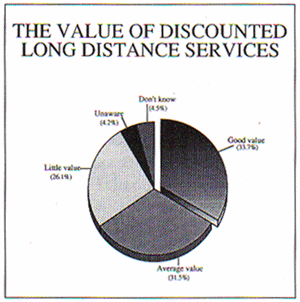
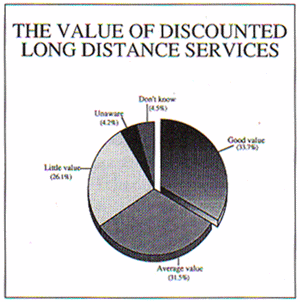
Discounted long distance plans are highly touted by almost all carriers. But, according to the poll, many people remain unconvinced of their worth. About one-quarter (26%) think they are of little value, while 32% rate them an average value. Only 34% of people say the plans are a good value, men are more critical of the plans, giving them lower marks than women.
According to the survey, the one-telephone household has almost become an anomaly. Seventy-three percent of homes now have more than one telephone. Of those, 38% have three or more and 6% have five or more.
Consumers rate banking service
A survey of Michigan residents by Harrington Market Research, Kalamazoo, Michigan, asked respondents how satisfied they were generally, with the customer service at their bank, S&L, or credit union. 91% were somewhat or very satisfied. In addition, they were asked how often they actually visit their bank, whether in person, via the drive-thru or phone. 82% of respondents said they visit, drive-thru, or call their bank once a week or more often. In the third question, respondents were read a list of four common customer complaints about banks, savings and loans, and credit unions and asked to state which was most irritating to them. Forty-two percent felt that banking hours were too short or not convenient; 41% agreed with the statement that the lines are too long; and 13% felt that tellers weren't knowledgeable enough to answer customer questions.
The naked truth about sleeping in the nude
The percentage of Americans sleeping in the nude has increased from 12% in 1985 to 16% in 1991, according to research by Bruskin Associates of New Brunswick, New Jersey. While the proportion of women who wear nothing has remained at 6%, the proportion of bare men has increased from 19% to 26%. The 1985 study revealed that people 25-35 years old were most likely to sleep in the nude. Sleeping in the nude is now prominent among those 25-49. The practice is most popular among people living in the West (19%), followed by people living in the North Central and Southern regions (16%), and least popular among Easterners (13%). Men who wear garments at night are most likely to be found in pajamas (31 %), underwear (29%), T-shirts or undershirts (9%), or sweat pants (7%). Women are most likely to wear a nightie or a nightgown (55%), pajamas (20%), T-shirts or undershirts (10%), nightshirt (9%), or sweat pants (5%).
Single copy magazine sales fell
Although continuing arecord sales pace through the first half of 1990, single copy (retail) magazine sales fell off in the second half, down 9.3% versus the same period a year ago, according to the Periodicals Institute, West Caldwell, New Jersey. For the same period, magazine units were off 9.8%. Paperback book sales were off 13.6%. The $3.6 billion in magazine sales achieved for full year 1990 showed an increase over full year figures for 1987 and 1988. In fact, first half 1990 figures are higher than first half 1989.
However, because of unprecedented growth in the second half of 1989, sales comparing full year 1990 magazine sales to full year 1989 show a 4.1% decline. "The recession afflicting so many products, industries, and services hit publications hard in the last half of 1990. Rising unemployment and lower household income threw up barriers to impulse sales, severely afflicting magazines and books, which are among the highest in impulse sales at retail," says Jack Fitzmaurice, president, Periodicals Institute.
Hispanics say President Bush is most admired
President George Bush has surpassed Pope John Paul II as the person most admired by U.S. Hispanics, according to the latest MDI Hispanic Poll, a telephone study of more than 700 self-identified Hispanics conducted by San Diego-based Market Development, Inc. In response to the question, "What well-known person living today do you most admire?" respondents in each of the six major U.S. Hispanic markets surveyed and in all demographic subgroups voiced strong admiration of Bush. Pope John Paul II ranked second behind Bush in the current poll, in contrast to the pope's "most admired" status among Hispanics in the MDI Hispanic Poll conducted in June 1990. Admiration of Bush was especially high among U.S.-born Hispanics.
The high admiration of Bush among U.S. Hispanics is consistent with other, previously released, MDI Hispanic Poll results, which showed that two-thirds of those polled approve of the way the president is handling his job and the situation in the Middle East. Even Hispanics who gave less-than-satisfactory marks to Bush for his support of Hispanics in education, business opportunities and political appointments, expressed approval of Bush;s overall performance.
Following Bush and the pope among the top ten individuals "most admired" by U.S. Hispanics (with their June-1990 ranking are: singer Julio Iglesias (3rd); former President Ronald Reagan (4th); actor Andres Garcia (unranked); singer Vicente Fernandez (unranked); singer Juan Gabriel (unranked); singer/actor Jose Luis Rodriguez (unranked); Mother Teresa, who fell from fifth to ninth place, overall; and actor Charles Bronson (unranked) and Mikhail Gorbachev (sixth), who tied for tenth place.