To coupon or not coupon?
Despite efforts to create a one-size-fits-all couponing model, couponing trends continue to reflect diverse markering objectives within individual companies, categories and brands, as illustrated by two new studies by Wallace Marx & Associates. "Saying ’coupons are going down’ is to agree that if it is true in one area, it is true in all. But this assumption does not accurately portray what is happening with coupons," says Wally Marx, principal, Wallace Marx & Associates, and spokesperson for the Promotion Marketing Association of America Coupon Council. "The goal of these annual studies is to more clearly define coupon use and to set straight the many negative assertions about coupons as a marketing tool."
According to Marx’s "1996 Top 100 Couponers" study, Campbell Soup increased the number of coupons distributed in 1996 across all its independent operating businesses. For other consumer packaged goods companies, increases were noted in various food categories. And, while Procter & Gamble decreased couponing in its Laundry & Cleaning and Paper divisions, increases occurred in the Beauty Care, Health Care and Food & Beverage divisions.
The Top 10 couponers for 1996 were:
- Phillip Morris
- Procter & Gamble
- General Mills
- Unilever
- Grand Metropolitan
- Kellogg
- Nestle USA
- Ralston Purina
- Campbell Soup
- ConAgra
This list features the consumer marketing companies that distributed the largest number of coupons via freestanding inserts (FSIs), magazines, direct mail and in-store coupon machines throughout 1996. All consumer packaged goods categories were included, such as food, health and beauty aids, and household products. This annual survey tracks the number of coupons distributed into the marketplace, the total value of all coupons distributed by company and the number of coupon "events" that a company had throughout a given year.
To achieve these numbers, Marx audited all versions of FSI books weekly. The study also included all Actmedia ICM grocery and drug chains, all 164 Carol Wright geographic marketing areas, Publishers Clearinghouse and 100 magazine rifles. According to CMS, the North Carolina-based coupon clearinghouse, these vehicles account for over 93 percent of all coupons dropped.
"A major issue facing manufacturers is the required 55-cent+ face values in markets with retailers that doublecoupons to attract customers," Marx says. "When most or all retailers double coupons (usually to a 50-cent limit) the competitive balance is back to where it started - only with higher costs to retailers."
Because retailers can’t seem to end this high-cost practice by themselves, they pressure manufacturers not to use 20- to 50-cent coupons (which could be doubled), according to Marx, but to use 55-cent values. These higher value coupons cost more for the manufacturer, not the retailer.
The Marx analysis shows, however, that not all consumer product companies and their coupon companies abide by the "55-cent+ role." Companies with strong brands, such as Procter & Gamble and Lever, use whatever values suit their brands, even if the retailer has to double the coupons. Other companies, however, agree to only place
coupons with values of 55 cents+ and incur the higher costs on each coupon redeemed.
"If manufacturers employed the practices of companies such as P&G and Lever for example in valuing coupons," Marx says, "they could eliminate the incremental costs of 55-cent+ coupons in most markets. This savings will positively impact a company’s bottom line."
Today’s pediatrician may not be who you think he is
The 1)raditional image of the pediatrician as a middle-aged family man with a satisfying, full-time job in a goup practice misses the diversity of modern pediatric physicians, according to a new pediatric specialty survey, "A Profile of Pediatricians and their Practices," conducted by the journal Contemporary Pediatrics. The findings reflect the responses of a nationally representative sample of more than 500 pediatricians.
Today, 42 percent of all pediatricians and 58 percent of practicing pediatricians under the age of 45 are women, according to the survey. In. 1995, 63 percent of pediatric interns were female. The AmericanBoard of Pediatrics forecasts that, if current trends continue, women in active pediatric practice will outnumber men by the year 2004.
"This type of change in the profession is more than just of academic interest," says Thomas Pizor, publisher, Contemporary Pediatrics. "Marketers trying to reach the pediatrician through adverrising, detailing, direct mail, and or any other form of communication need to have a clear view of the audience for their messages. Marketing strategies and tactics are most effective when they are built on an understanding of the audience and how it will react to the product."
Although it is difficult to predict the impact of this majority shift on the practice of pediatrics, there are differences between male and female pediatricians’ pegsonal lives and professional experiences that are worth noting. At any age, the female pediatrician is more likely to be single and childless than her male colleague. Among those under 45, only 6 percent of male pediatricians are single compared to 16 percent of female pediatricians. Only one out of 10 male pediatricians under 45 is childless compared to more than one out of four females under 45. Among pediatricians over 45, 12 percent of female pediatricians are childless versus only 3 percent of the male pediatricians.
In addition to personal characteristics, the survey addresses training, information sources, prescription practices, and practice characteristics, including managed care and patient relationships.
Consumers draw line between on-line information and privacy invasion
A new study by Cyber Dialogue, a New York firm specializing in on-line research, tifled "Capturing Visitor Feedback: An Investigation Into Business’s Need for Information vs. the Consumer’s Need for Privacy" identifies ways for corporations to gather consumer feedback on-line without turning away valuable customers.
While concerns about privacy and receiving unwanted solicitations are barriers to interaction, the survey reveals that for most "netizens" (76 percent), submitting personal information on-line is seen as a positive way for companies to learn about customers.
Ninety-two percent of respondents are willing to indicate hobbies and special interests on-line in exchange for customized content; and a strong majority are also willing to participate in short surveys (77 percent) and fill out demogaphic information about themselves (73 percent) in order to have online services tailor content to their specified needs.
Willingness to interact with sites is high, the survey reveals, but drops significantly as information requested becomes more personal. Nine in 10 online consumers surveyed report openness to submit information about their interests and attitudes, even their age and education (89 and 90 percent respectively). However, likelihood to share drops off significanfly for more personal information such as name (67 percent), salary (29 percent) and particularly credit card numbers (4 percent).
According to the survey, site registration can play an important role in profiling site traffic, if used constructively and non-intrusively. Roughly one-third of on-line users feel registration forms are a waste of time (including 10 percent who feel it is a direct invasion of privacy). However, more netizens (38 percent) surveyed consider the sign-up process to be a positive way for the site to interact with customers or a mechanism for identifying and delivering relevant customized content (34 percent). "Customers willingly appreciate the need for gathering visitor feedback if they receive something of value in exchange for their efforts," says Kevin Mabley, Cyber Dialogue’s director of research. "To avoid leaving visitors with a bad taste, incorporating registration forms on a site should be optional, non-intrusive and positioned as a way for customers to receive added value from the site on their next visit."
The majority of on-fine consumers surveyed revealed what they desire in return for taking time to register at a Web site is not what they believe they actually get. Rewards such as enhanced access (77 percent), customized content (68 percent) and ability to chat (53 percent) are what people want from a site, but visitors perceive their information is really being used for solicitations and distribution fists (51 percent) and junk mail at home (49 percent).
The research was conducted on-line monthly from August through December of 1996. The report represents a compilation of findings from each of the five monthly studies, in which between 300 and 500 respondents participated. These respondents were selected from within the Cyber Dialogue network of on-fine consumers.
Global study finds most believe in environment/health link
A majority of people in all but one of 17 countries studied believe that environmental problems now affect their health. In most countries with comparative data, these health concerns are significantly deeper than was the case five years ago. The results would seem to contradict the belief among many policy-makers that the environment is fading as a concern for their citizens.
These are the findings from a question fielded to representative national samples of average citizens in 17 countries during the fall of 1996. The research was conducted by International Research institutes (IriS), a globalnetwork of independent market research and consulting firms. Iris member companies asked over 15,000 citizens in participating countries the following question: "Please tell me how much, if at all, you believe environmental problems now affect your health - a great deal, a fair amount, not very much, or not at all?" In all but one of the countries surveyed (the Netherlands being the sole exception), a majority of citizens responded that their health was affected "a great deal" or "a fair amount" by environmental problems.
People living in developing countries and southern Europe are by far the most likely to believe that their health has been affected by environmental problems. In fact, Greece and Cyprus are the two countries where there is an almost unanimous belief among citizens that this is the case. In Cyprus 90 percent believe that their health has been affected a great deal (64 percent) or a fair amount (26 percent) and in Greece the corresponding percentages are 66 and 23, respectively. Other countries which are at the top of the list in terms of people believing that their personal health has been affected by environmental problems include Chile (84 percent, a great deal or fair amount), Peru (80 percent) and Portugal (80 percent).
In wealthier and more developed countries, this belief by residents that their own health has been affected by environmental problems is also very high. These include Finland (75 percent), Germany (69 percent), the United States (69 percent), Spain (65 percent) and Australia (63 percent). Majorities also feel that their health has been affected in Great Britain (60 percent), Canada (59 percent), Sweden (55 percent), Belgium (54 percent) and Japan (51 percent). The only exception is the Netherlands where only four in 10 residents believe that their own health has been affected by environmental problems.
In general, women and younger people are most likely to believe that their health has been affected, although in most countries a majority of men and older people also believe this to be the case.
The extent to which people believe that their health has been affected by environmental problems has increased over the last five years in almost every country for which tracking data is available. In nine of the 17 countries surveyed by IriS companies, the same question had been posed in 1992 in the Health of the Planet Survey conducted by the Gallup International Institute. In seven of these cases, the proportions show a significant increase: Switzerland (up 31 points since 1992), Chile (up 28 points), Japan (up 28 points), Portugal (up seven points), Great Britain (up seven points), Canada (up seven points) and the Netherlands (up five points). In Germany, while overall health concerns have gone down two points since 1992, those believing their health has been affected "a great deal" has increased by 10 points. In the United States (up two points), there has been no significant change in health concerns over the last five years.
International Research Institutes (IriS), with offices in Brussels, currently includes 23 member companies coveting North and South America, Western and Eastern Europe, the Middle East, Asia and Australia.
A number of IriS member companies are currently participating in a more extensive survey of environmental public opinion: the first annual International Environmental Monitor survey. This subscription-based research study is currently interviewing over 30,000 average citizens in 28 countries to explore global public opinion on a range of environmental and resource issues, including 10 tracking questions asked on previous international surveys.
Sprint offers the right price, but AT&T is still consumer’s choice
As telecommunications giants battle for more customers, a new study by Aragon Consulting Group’s Research Division in St. Louis reveals that 34.8 percent of adults in the United States, who were not lured by AT&T’s 15-cent flat-rate offer would make the change if offered a nine or 10-cent-per-minute rate for toll calls.
Still, Aragon, a management and marketing consulting firm that specializes in telecommunications, reports that 19.7 percent of non-AT&T customers are not interested in switching to AT&T at any price.
"However, if all long distance carriers were to offer the same flat-rate pricing option and consumers were then asked to pick their provider, AT&T then becomes their top choice," says Gary Miller, president of Aragon Consulting Group. "Nearly 51 percent of people we interviewed would select AT&T in this situation, while the next most frequently given response (15.5 percent) was the local telephone company."
Approximately 41 percent of AT&T’s customers say they are aware of the company’s 15 cent flat-rate; however, only 6.4 percent of those who are aware report that they made the switch to AT&T as a result of the 15-cent offer. Nearly 85 percent of these people were already AT&T customers.
"There doesn’t appear to be an advertising effectiveness problem. People understand that they have fiat-rate options available to them via various carriers," Miller says. "In fact, mote than half (50.4 percent) of the people we surveyed tell us that they have heard about fiat-rate services."
When the consumers who say they are aware of flat-rate offers are asked to identify companies with fiat-rate programs, most mention AT&T (52.0 percent); 27.7 percent say Sprint; 24.8 percent say MCI; and 6.9 percent say LDDS, WofldCom or WilTel.
"Since most consumers are familfar with current flat rate programs, the phone companies need to employ another strategy to win the telecommunications turf war," says Miller, who suggests bundling other services with flat-rates.
"To use the AT&T 15-cent offer as an example: Nearly three-fourths (73.7 percent) of non-AT&T consumers say they are not interested in that offer while 14.7 percent express at least some interest," says Miller. "However, the pendulum swings in the starts to sweeten the pot with additional services?"
Aragon’s research shows that cellular and mobile service customers express more interest in a 15-cent offer when the cellular service is added to the package. Interest climbs to 49.5 percent among these consumers while the percentage of those who are not interested declines to 39.7 percent.
Likewise, consumers who have PCs at home are more interested in the 15-cent rate for toll calls when the deal includes free Internet access, according to the Aragon study. Interest increased to 53.9 percent among home computer users while the not interested goup shrunk to 40.4 percent.
"When you offer consumers who use a PC at home a package that includes 15-cents-a minute flat-rate for toll calls and cellular/mobile service, and free Interuet access, 50.0 percent say they’re interested," says Miller. "And on the flip side of this equation, 42.3 percent say they’re not interested.
"The message for the local and long-distance phone companies is: Bundle your services under a fixed flat-rate that includes cellular, long-distance and Internet access," says Miller.
A national random sample of 401 was drawn to complete Aragon’s research, which produced results within a +/-5 percent margin of error.
FDA too slow in approving drugs
American consumers think that the FDA takes too long to approve prescription drugs for over-the-counter use, according to a recent survey conducted by CDB Research & Consulting, Inc., the research subsidiary of the public relations agency Creamer.Dickson Basford, New York.
"The buying public wants access to medications formerly available only by prescription because they are perceived as being more powerful than existing over-the-counter products," says Dr. Larry Chiagouris, executive vice president and managing director of CDB Research & Consulting, Inc.
In fact, these disgruntled consumers are nearly twice as likely as those satisfied with the FDA’s approval process to believe that over-the-counter products once dispersed only through prescription are safer than other over-the-counter products (50 percent vs. 27 percent).
More members of dollar-conscious HMOs believe the FDA simply takes too long to authorize prescription drugs for over-the-counter use (42 percent critical vs. 32 percent understanding). Those served by HMOs dominated the survey sample (74 percent of the insured participants belong to an HMO).
Although both sexes were almost equally impatient with the FDA (62 percent men, 69 percent women), age seems to play a role with Americans’ tolerance of the FDA process. Those respondents aged 18-34 and 55+ were more critical than not of the FDA process (age 18-34, 31 percent critical vs. 26 percent understanding; age 55+, 34 percent critical vs. 24 percent understanding). However, respondents aged 34-54 were more accepting of the FDA process (35 percent critical vs. 50 percent understanding). Education also influenced survey results. People with a high school education or less are more likely than those college educated to be critical of the FDA (73 percent vs. 60 percent).
Telephone interviews were conducted the fast week of November 1996. The sample consisted of a national cross-section of 250 adults, ages 18 years or older. The margin of error is +/-6 percentage points.
Twentysomething women declare themselves primary purchasers
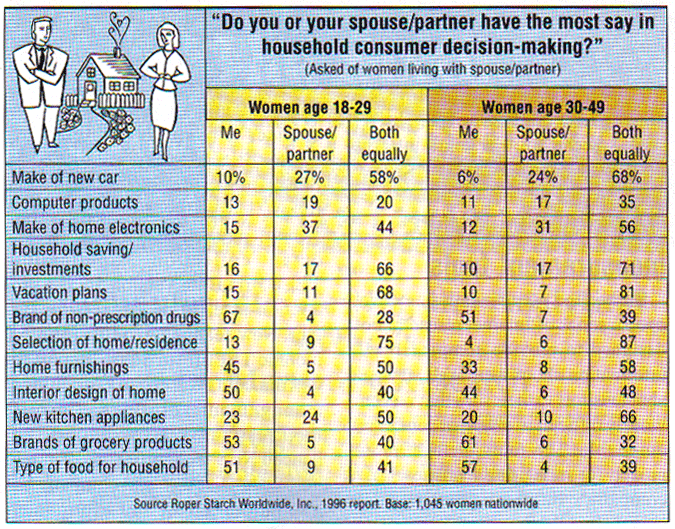
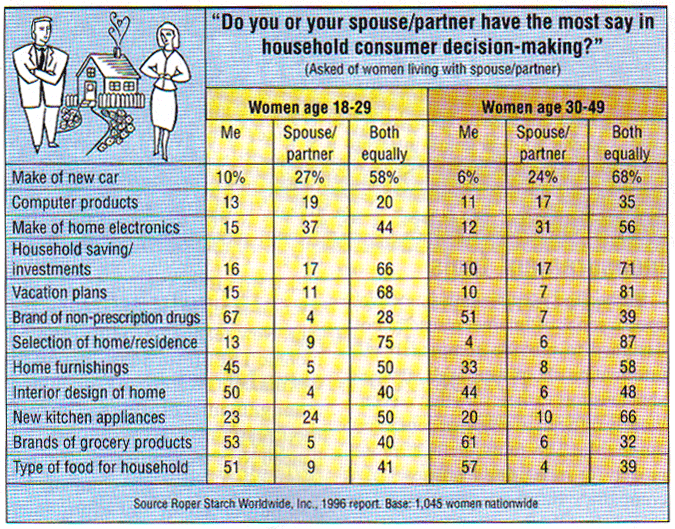
Although millions of baby-boomer women rejected the June Cleaver role model, the majority are still locked into traditional roles when making purchasing decisions. Today, while most household purchasing decisions are made jointly, the latest MlleMeter report from Mademoiselle magazine and Roper Starch Worldwide finds that twentysomething women are more likely than their baby-boomer counterpart to declare themselves the primary decision-makers for cars, computers, electronics - everything except grocery products.