Private labels find public favor
According to results from the 1999 MarketLink Shopper Survey, a majority of survey participants (61 percent) consider the taste of private label food products to be "as good as name brands." One in four consumers regard the taste of private label foods to be "inferior to name brands" - the lowest percent with these negative attitudes in five years. MarketLink, a Thomasville, Ga., research firm, conducts the Shopper Survey each year to examine food shopping attitudes and behavior and the role of brands in food shopping decisions.
The 1999 survey reveals a continuation of a rebound in the claimed importance of private label brands that was first evidenced in 1998’s study. The percent of consumers who regard private label brands as either very or somewhat important now stands at 56 percent - the highest percent in five years. Meanwhile, the percent of consumers who regard them as either not very or not at all important now stands at 44 percent - the lowest percent in five years. Value continues to be the main reason people buy private label food products: 45 percent - the highest in five years - said that the one reason they buy private label foods is because private label is as good as the name brand and costs less. The secondmost mentioned reason for buying private label foods is price: 35 percent of respondents said that they buy private label foods because they are cheaper.
Kids not bored with board games
Research by Simmons Market Research Bureau, NY, shows that the No. 1 type of toy owned by kids today is a traditional board game. Even in this high-tech age, the majority of children (88 percent) said they like to play most with board games. And what topped their lists? Monopoly, Guess Who and Twister (which they play with friends or family up to five times a week.)
When they are finished with their board games, American kids turn to a variety of traditional and high-tech toys. Here are their top picks: electronic home video games (73 percent); crayons (72 percent); Beanie Babies (60 percent); stuffed animals (60 percent); puzzles (58 percent); hand-held video games (53 percent); and dolls (51 percent).
When it’s time to plead for a new toy, youngsters first turn to mom. The majority of kids polled said that she’s the one who comes home most often with the toys. Just over half said that dad bears the toys, with grandma or grandpa following close behind. Youngsters as a whole may like TV, but theads they see don’t always send them shopping. A quarter of those polled said TV ads make them buy the toys.
Cleveland loves its baseball
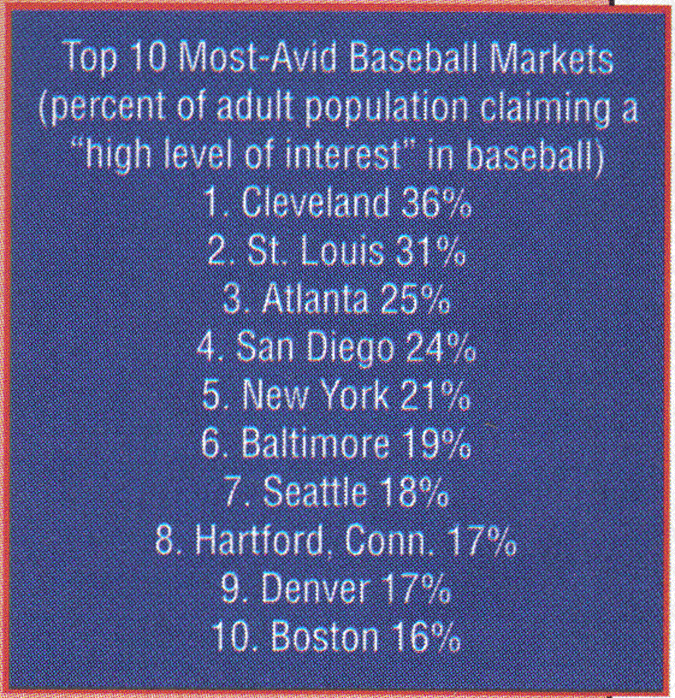
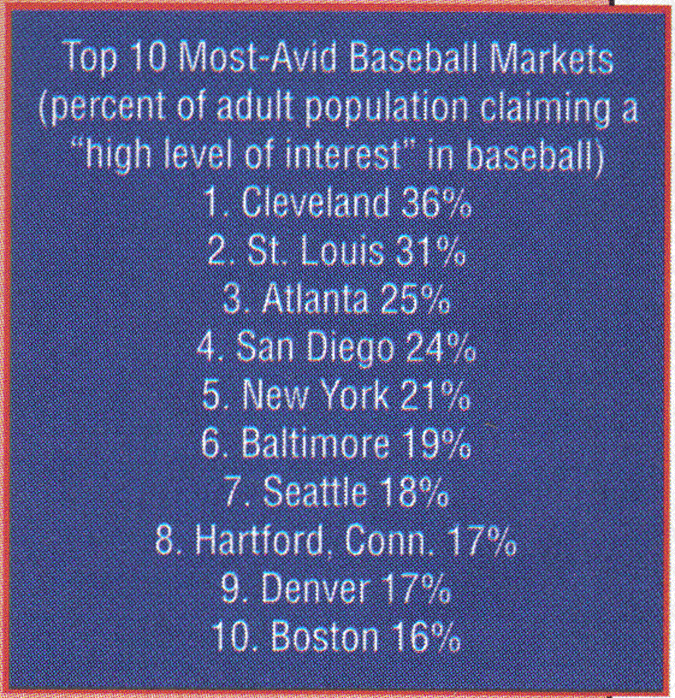
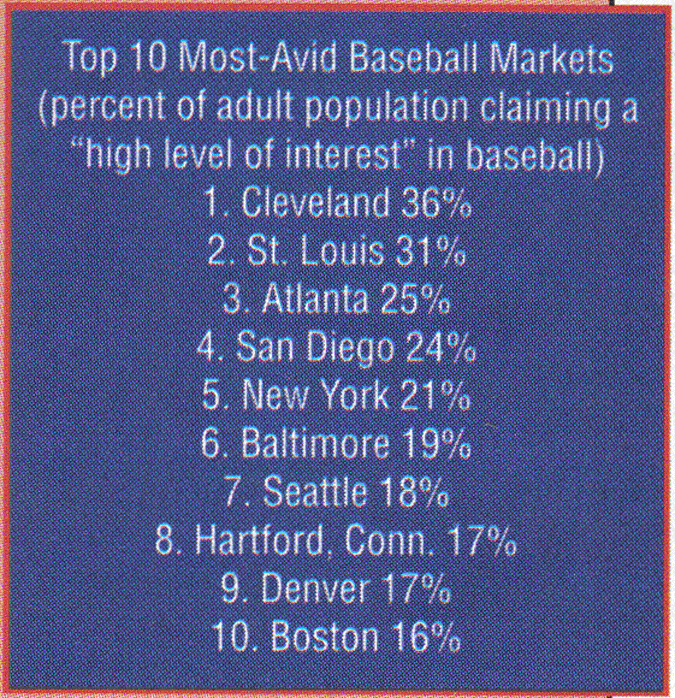
According to a new study by New York-based Scarborough Sports Marketing, Cleveland (36 percent), St. Louis (31 percent) and Atlanta (25 percent) score the highest concentration of avid major league baseball (MLB) fans. A quarter or more of the adult population in these three cities have a “high level of interest” is the national pastime, contrasting with a national average of 15 percent.
How do cities without a home team rank? Major league baseball is also popular (and above the national average) in a few select cities including Hartford, Conn., with almost one-fifth (17 percent) of its adult population very interested in major league baseball; differing by only one percentage point is Birmingham, Ala. (16 percent).
The major league city with the lowest percentage of avid baseball fans is Detroit (6 percent); Minneapolis (8 percent) followed closely. The lowest ranking cities without a major league team are Salt Lake City (4 percent); Lexington, Ky. (5 percent); and Grand Rapids, Mich. (6 percent).
The study also revealed that MLB fans tend to be male (63 percent), married (58 percent) and a large portion of the group falls between the ages of 35-54 (40 percent). In addition, over half (54 percent) of baseball fans have attended college and more than two-thirds (67 percent) own their residence.
The data for this report was compiled from August 1998 to September 1999 from release two of the 1999 Scarborough 12-month database. Scarborough Sports Marketing measures local market consumer and lifestyle information by interviewing over 170,000 adults (ages 18+) in 64 U.S. markets including all professional sports markets.
Most Americans satisfied with their weight
Though you wouldn’t guess by the number of weight-loss and fitness programs on the market, a Maritz Poll from Maritz Marketing Research, St. Louis, found that 68 percent of Americans say they are satisfied with their weight.
Not surprising, more men than women (77 percent compared to 59 percent) are happy with the numbers that register when they step on the scale. Young people are also more likely to be content with their weight. Seventy-nine percent of respondents ages 18-24 are happy with their weight, compared to 64 percent of respondents 55 and older.
Even so, 40 percent of poll respondents tried to lose weight last year. Forty-seven percent of women attempted to lose weight, as did 33 percent of men. Seventy-seven percent of those who attempted to slim down claimed to have been successful in their efforts.
Contrary to all the fad diets and quick fixes that flood bookstore shelves and television airwaves, most Americans do practice the most tried-and-true methods of weight loss: eating right and regular exercise. Sixtynine percent of those who tried to lose weight did so by eating right/watching calories/watching fat. Forty-one percent of respondents said they participated in a regular exercise program in hopes of shedding pounds.
More than half (56 percent) of respondents said they regularly take vitamins. Women are better about taking vitamins than men (62 percent vs. 49 percent), as are adults 45 and older compared to those younger (67 percent vs. 46 percent). Nineteen percent of Americans regularly take herbal supplements, such as ginseng, echinacea, and St. John’s Wort.
Survey results are based on telephone interviews with American adults. Accuracy of the results is within +/-3.09 percent.
Movie site visitors less brand-loyal
Intensive on-line entertainment users are more fickle and less brand-loyal than other on-line adults when it comes to movies, according to Cyber Dialogue, a New York Internet customer relationship management company. Data from Cyber Dialogue’s Cybercitizen Entertainment Survey shows that while 28 percent of on-line movie fans reported their opinions of movie brands had changed as a direct result of visiting movie-related Web sites, the figure rises to 42 percent among more intensive on-line movie fans.
Intensive on-line movie fans are an extremely valuable target audience because of their high levels of movie consumption and spending. On average, intensive on-line movie fans watch two movies in the theater per month versus one for the general on-line population, they watch nine movies on cable TV or pay-per-view per month versus eight for the general on-line population, and they rent 14 videos per month versus only six for the general on-line population.
In terms of spending, this translates to $15 per month spent in theaters for intensive on-line movie fans versus $7 for the general on-line population, $44 per month on CATV spending versus $37, and $42 dollars per month on video rentals versus $19.
In addition, as a result of movie site visits, 39 percent of intensive on-line movie fans said that they watch more movies in theaters; 37 percent say they watch more movies at home; and 20 percent said that they rent more movies to watch at home.
Cyber Dialogue also identified 11.8 million on-line movie fans that say they are interested in paying for a service to enable them to download movies directly to their TV, and 6.8 million who said they would pay for a service to enable them to download movies to their PC.
The findings are from Cyber Dialogue’s Cybercitizen Entertainment Program (CCE). Cybercitizen Entertainment consists of in-depth interviews with 1,000 Internet users and 1,000 non-users conducted quarterly.
College students are on-line buyers
A study revealed that nearly half (45 percent) of college students go on-line every day and that the average student has made four on-line purchases totaling $305 during the past year. The most popular items purchased on-line include: music (46 percent); general books (42 percent); tickets (31 percent); computer peripherals (24 percent); and general software (19 percent).
The study, "Student Attitudes and Behaviors: Online Shopping," is the latest installment in the Student Watch Campus Market Research series conducted on behalf of the National Association of College Stores (NACS), Oberlin, Ohio.
Textbooks rated sixth on the list with just 18 percent of students reporting an on-line textbook purchase. Nearly three-quarters of the respondents reported their college store’s Web site as the most likely source for textbook purchases despite aggressive advertising by dot.com textbook sellers.
"The data in this study clearly corresponds to earlier NACS research where students indicated some hesitancy to buy textbooks on-line due to security concerns," says Julie Traylor, NACS director of planning and research. "College stores offer easy pick-up options, good return and exchange policies, buyback options and by virtue of their on-campus presence, may also offer on-line student shoppers some security as a well-known, local source."
The Student Watch study was developed and funded by the College Stores Research and Education Foundation, a subsidiary of the National Association of College Stores, and conducted by Sterling Research, St. Petersburg, Fla. Five additional volumes of data examine students’ attitudes towards textbooks and course materials, technology and apparel and backpacks.
Americans divided over women’s rights
What do Americans really think about women’s status? A study released by TNS Intersearch and GIA (Gallup International) revealed that Americans are essentially divided about women s rights in America, with 47 percent claiming they have equal rights with men and 52 percent saying that they do not.
However, there was agreement on equal political leadership abilities among men and women and their equal right to a job. The results of the study revealed that almost half (47 percent) say that women in the U.S. have equal rights with men, while the other half (52 percent) disagree. The figures differ by gender, with 56 percent of men, compared to 39 percent of women, saying that women have equal rights with men.
In terms of women’s role in the workforce, almost three out of four men and women (73 percent and 74 percent, respectively) said that both husband and wife should contribute to household income. Even in times of job shortages, Americans believe that women have the same right as men to earn an income. Men disagreed by 83 percent and women by 81 percent to a question about giving men more rights to a job than women when jobs are scarce.
More than three-fourths of Americans believe than men do not necessarily make better political leaders than women. A combined 76 percent disagreed with the statement "On the whole, men make better political leaders than women do."
Eight in 10 Americans disagree with the statement "A women needs to have children in order to be really fulfilled." But women felt stronger about this issue, with 86 percent disagreeing compared to 74 percent of men disagreeing.
Americans also believe that women must support the fight for women’s rights in developing countries. Nearly three-quarters (73 percent) agree that women in advanced countries must promote the rights of women in the developing world.
The Millennium Survey polled over 50,000 participants in 60 countries about the same core issues addressed in the U.S. part of the study. The complete U.S. and Canada survey results as well as information about the other regions of the world in the study are available at www.intersearch.tnsofres.com.
Some on-line shoppers would like a CSR; new car seekers search Net
On-line shoppers said they would buy more products on-line if they could speak with a customer service representative at the time of their purchasing decision. According to a survey conducted by NFO Interactive, a Greenwich, Conn., research firm, nearly 35 percent of 2,321 recent online shoppers said they would buy more if they could interact real-time with a salesperson from an e-commerce site.
The results of NFO Interactive’s weekly on-line net.query survey also found that of those on-line users who have not yet purchased a product online, 13.7 percent would buy on-line if they could speak directly with a customer service representative.
"As Web site developers search for ways to attract people to their sites, they may well be missing a crucial element of effective retail strategy: personal interaction. Customer service is key to success; a helpful salesperson goes a long way to effecting a purchase," says Charles Hamlin, president NFO Interactive.
"Introducing live salespeople into the sales process - either through on-line chat or direct telephone connection as in conventional catalog sales - would serve to boost on-line sales. As manufacturers consider automating their channels, they should not lose sight of the effectiveness of personal contact."
The prospect of purchasing autos on-line was also posed to the 2,321 on-line shoppers through NFO Interactive’s net.query. Clearly, online shoppers look to the Internet for information on prospective auto purchases, as more than 47 percent said they would use auto-oriented Web sites to gather information on dealer invoice/pricing information. Nearly 45 percent said when they shop for their next car, they will use auto Web sites to seek out independent evaluations and reviews. Interestingly, 10.6 percent said they would consider purchasing a car online without ever visiting the dealership in person.
This is crucial news for the automotive industry, as the affluent online community comprises more than 37 percent of American households and controls more than 50 percent of U.S. household income. "While the number of households that have or plan to actually buy a car on-line is still relatively low, the Internet is now perhaps the strongest communication medium for automobile manufacturers to convey the features and benefits of their product. This could well bring about major change in the industry’s choice of advertising media as well as the roles and responsibilities of the dealer networks," Hamlin says.
Participants for the NFO Interactive study were acquired from the NFO//net.source, an on-line consumer panel. Among on-line shoppers, the collected data possesses a statistical accuracy of +/-3.54 percent.