
Mom wants to hear from you
A new survey commissioned byMorgan Hill, Calif.-based Cidco, Inc., maker of the Mivo 200 personal e-mail appliance, reveals that today’s Mom doesn’t necessarily want jewelry or flowers for Mother’s Day. What she wants most is to feel close to her children, and to hear, "I love you."
According to the survey, almost half of moms (48 percent) believe the best gifts they could receive for Mother’s Day are to have their adult children keep in touch with them more often during the year, and to hear them say, "I love you." In fact, the vast majority (82 percent) want to hear from their children at least once a week, and for 22 percent, once a week isn’t nearly enough - once a day is more like it.
Even among tangible gifts, moms would prefer those that keep the family connected and strengthen family bonds, such as brunch or dinner out (22 percent) or a Mother’s Day card (8 percent). Other "luxury" items, such as a spa treatment, flowers, perfume, jewelry, chocolates, and clothes, received comparatively low scores (4 percent, 3 percent, 2 percent, 2 percent, i percent, and 1 percent, respectively).
Sadly, Mom’s adult children are largely unaware of her preferences. In fact, 38 percent of adults are planning to give Mom flowers for Mother’s Day, 13 percent will shower her in jewelry, and 16 percent are going to give her clothes. Less than two in 10 will promise to keep in touch with her more often all year long.
According to the survey, e-mail is indeed gaining in popularity, especially among morns in the West, who are more likely to communicate via the service than moms in other regions (50 percent in the West versus 35 percent in the Northeast, 36 percent in the North Central states, and 40 percent in the South).
Additional findings from the survey shed some light on what keeps kids from checking in with their moms more often during the year. More than one-third (34 percent) say they are just too busy, 21 percent say that long-distance telephone charges are too expensive, and 15 percent admit to procrastinating or being "too tired/lazy" to make the effort. A surprising 38 percent can’t provide any answer for not keeping in touch with Mom as often as they should.
The survey also revealed some differences between adult sons and daughters regarding their communication habits with Mom. Fifteen percent of daughters keep in touch with their mothers several times a day either by phone, in-person visits, email, or letters, while only 5 percent of sons do. In addition, 28 percent of daughters contact their mothers once a day, while a mere 15 percent of sons do. Sons are also more likely to be honest and ’fess up to procrastinating or being too tired/lazy when it comes to not keeping in touch with Mom (19 percent of sons versus 10 percent of daughters).
The Cidco survey was conducted January 18-22, 2001 among a nationally representative sample of 2,000 adults 18 years of age and older. A total of 447 interviews were completed with women who have adult children 18 years of age and older who live outside their household. In addition, a total of 448 telephone interviews were conducted during the same period among a nationally representative sample of adults 18 years of age and older who have a mother who lives outside their household. The interviews were conducted in Caravan, a national telephone omnibus survey. This survey was developed for Cidco, Inc. by Leflein Associates, Inc., Fort Lee, N.J., and fielded by Opinion Research Corporation, Princeton, N.J. The margin of error is +4.5 percentage points.
Macintosh owners most loyal, but Gateway not behind
Rochester, N.Y.-based Harris Interactive’s Consumer TechPoll study shows that Compaq is the overall unit share leader among PC buyers, followed closely by Hewlett-Packard (HP) and Gateway. Together, these three brands accounted for about half of the consumer PCs purchased in the first three-quarters of 2000, Gateway was the number one brand among first time PC home buyers. Its share among first-time buyers was nearly 50 percent higher than its overall share and significantly higher than its share among repeat buyers. HP also had a higher share among first-timers than repeat buyers did, but its share was more balanced Gateway’s. In contrast, Compaq was stronger among repeat buyers than among first-timers, although its share was also relatively well balanced.
The survey of more than 140,000 Internet users, including more than 6,500 who purchased a home PC in the first three quarters of 2000, examined brand shares among first-time home PC buyers and brand loyalty among repurchasing home PC buyers.
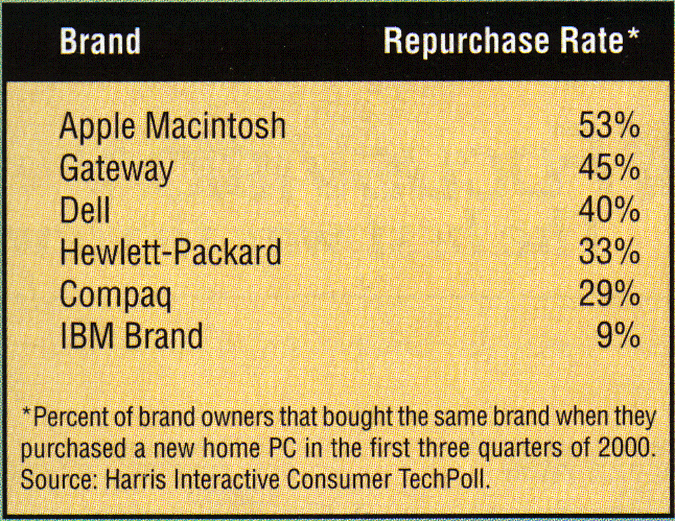
The study found wide disparity in repurchase loyalty among the top PC brands. Apple Macintosh owners were most-loyal – just over half the Mac owners who bought a personal computer in the first three-quarters of 2000 repurchased a Mac. Gateway’s customer loyalty was highest among Wintel brands with a 45 percent repurchase rate. IBM had the lowest repurchase loyalty among the top brands, with only 9 percent of IBM PC owners buying another IBM brand PC when they bought a new home PC. (see table.)
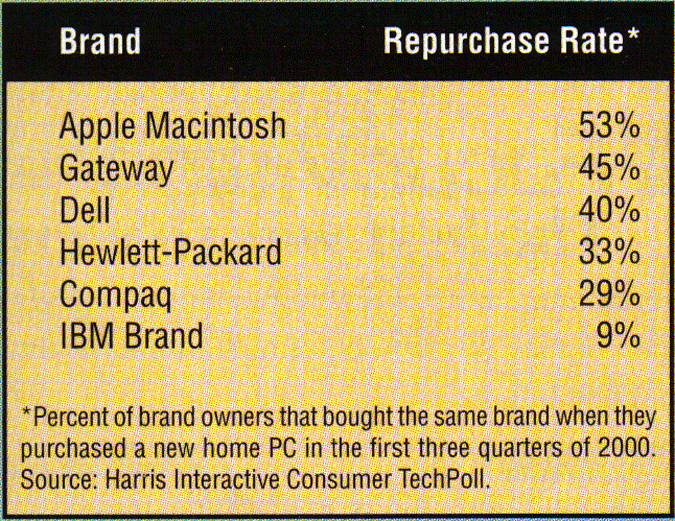
“As the consumer PC market matures, repurchase loyalty is a key measure for PC brands,” says Dave Tremblay, director of technology research for Harris Interactive. “First-time buyers account for only about one-fifth of all consumer PC purchases. While strength in that segment is a bonus, you can’t build a business relying on these buyers. The easiest buyers to capture should be a brand’s current users. If a company cannot successfully sell to its own customers, it will likely have problems selling to its competitors’ customers. IBM is a good example of this. When IBM de-emphasized its traditional retail consumer distribution channels, its customers abandoned the brand; fewer than one in 10 IBM brand PC owners repurchased an IBM brand PC. While strong repurchase loyalty is not enough – witness Apple’s high loyalty but declining share – it is a very good place to start.”
Americans into not-so-fast food
Fast-food customers are most satisfied with the more specialized regional chains, especially those in the emerging "quick-casual" segment, according to findings from the quarterly syndicated Quick-Track research program conducted by Sandelman & Associates among 68,600 fast-food users across 62 U.S. markets during 2000.
"Over the past year, we have seen increases in the availability and popularity of chains in the so-called quick-casual segment," says Bob Sandelman, president of the Villa Park, Calif., market research firm. Quick-casual restaurants usually provide limited service like typical fastfood restaurants, but the quality of the food and the prices are more similar to full-service, sit-down restaurants. "These chains are raising the bar for the fast-food industry," Sandelman says, "and seem to appeal to somewhat older consumers who grew up on fast-food fare but are now ready for a better product and are willing to pay a bit more for it."
Based on ratings provided by the study’s respondents on fast-food chains they visited in the past three months, Sandelman & Associates announced the second annual Quick-Track Awards of Excellence for the top-rated chains. For the second consecutive year, the highest-rated chain overall was In-N-Out Burger, a California-based, family-owned chain with only about 160 units in California, Nevada, and Arizona. Since 1948, this relatively small chain has been serving a limited menu of burgers, fries, and shakes that are made-to-order. Fully 59 percent of In-N-Out’s past-three-month patrons rated their last occasion as "excellent," the top-box rating on a 5-point scale, beating out 75 other chains for the top honor. In-N-Out’s Overall rating was even three percentage points higher than last year. In-N-Out also scored higher than all other chains on several key attributes, including taste of the food, quality of ingredients, temperature of the food, friendliness/courtesy of employees, order accuracy, and cleanliness of the restaurant.
The remaining chains in the top 10, ranked by overall rating of the last occasion, include two chicken chains, five pizza chains, a quick-casual sandwich chain, and a quick-casual Mexican chain. Each of these chains were rated "excellent" by at least 44 percent of their recent users.
Chick-fil-A, a chicken chain with fairly broad distribution, was the second highest ranked chain overall, up from its third place finish last year. The other chicken chain in the top 10 was Florida-based Pollo Tropical, which ranked No. 10 overall. Davanni’s was the highest-rated pizza chain, ranking No. 3 overall. This popular chain has just 17 locations in the Minneapolis-St. Paul area and offers hot hoagies in addition to pizza. Other pizza players in the top 10 are all regional players - Me ’n Ed’s, La Rosa’s, Papa Murphy’s, and Jet’s. Schiotzsky’s, a growing quickcasual sandwich chain with locations in 38 states that also serves pizza, salads, and soups, was the sixth-ranked chain overall this year and the top sandwich chain. The Mexican segment was headed by Baja Fresh, another regional quick-casual chain with a fresh-food focus, which was ranked ninth overall.
Although no major national chains made the top 10 again this year, some were rated highly on an overall basis as well as on specific attributes. Boston Market was the highest-rated major national chain, with 40 percent of its users rating their last occasion as "excellent," ranking No. 13 among all chains. Subway was the highestranking national sandwich chain at No. 15, while Papa John’s Pizza headed the pizza category, ranking 23rd overall. Sonic was the highestranking major burger chain at the No. 26 spot. Not surprisingly, McDonald’s outscored all other chains on convenience of locations and was the second-highest rated chain on overall appeal to kids.
The three most important factors to fast-food users in their selection of a quick-service chain to patronize are the cleanliness of the restaurant (82 percent rated this "extremely important"), taste or flavor of the food (78 percent), and order accura-cy (73 percent). The highest-rated chains for cleanliness were In-N-Out, Papa Murphy’s, and Baja Fresh. Taste/flavor of food was rated best at In-N-Out, Pollo Tropical, and Schlotzsky’s. For order accuracy, the top three chains were In-N-Out, PapaMurphy’s, and Rubio’s. Quality of ingredients is also highly important (63 percent) and was rated best at In-N-Out, Baja Fresh, and Schiotzsky’s.
Given that food taste and quality are so important to fast-food users, it is not surprising that several quick-casual chains are rated highly overall. Seven chains in the top 25 overall can be characterized as quick-casual - Schlotzsky’s (No. 6), Baja Fresh (No. 9), Rubio’s (No. 11), Boston Market (No. 13), Biscuitville (No. 14), Koo Koo Roe (No. 17), and Quizno’s No. 22). All of these chains either improved their ranking from last year or showed up on the ratings list for the first time this year.
And these quick-casual customers are willing to spend more when visiting these chains. In a national Quick-Track study conducted in the fourth quarter of 2000, respondents said they spent an average of $7.02 per person when visiting quick-casual restaurants, compared to $4.42 when visiting fast-food restaurants in general.
Shoddy service may drive shoppers from stores forever
More than 20 percent of customers walk out without making a purchase and an equal number stop shopping at a store altogether where they experience bad customer service, according to a national telephone survey of more than 1,000 consumers, sponsored by MOHR Learning, the retail training unit of Boston-based Provant, Inc. Moreover, 26 percent tell their friends about the experience and urge them not to shop at the store.
"While the most common response to poor service is to complain to a store manager, says MOHR Learning CEO Michael Patrick, "many people seem to protest with their pocketbook instead. Retailers need to recognize the less visible impact of bad service - the quiet erosion of their customer base."
"Some retailers assume customers don’t care about service and that it’s something they can take for granted," says Patrick. "But our research suggests people really get upset - even if they’re reluctant to say anything. In fact, some customers who would never complain to a store manager will do so to their friends. And word-of-mouth can be as powerful in retailing as it is in the motion picture business."
Retailers have to assume that every customer who complains represents two others who experienced the same frustration, but didn’t voice it, Patrick says. "It’s not enough for store managers simply to address individual customer complaints. The better solution is to provide training and supervision to employees so that such incidents are not repeated."
Among the survey’s other findings:
- The more affluent a customer, the more likely he/she is to walk out without making a purchase (26 percent of those making $50,000+ vs. 16 percent of those making $15,000-$24,999).
- Men are more likely than women (26 percent vs. 19 percent) to walk out without making a purchase, while women (44 percent vs. 34 percent) are more likely to complain to a manager.
- Customers aged 45-54 are least likely to ignore bad customer service, while those over 55 are most likely (9 percent vs. 18 percent).
- Customers in the Northeast (34 percent) are more likely than those in any other region to walk out without making a purchase, while those in the South (16 percent) are least likely.
- The less-educated a customer, the more likely the person is to ignore poor service and to continue shopping at the store.
- Customers in non-metropolitan areas were more likely than their urban counterparts (21 percent vs. 14 percent) to ignore poor service. The EXCEL Omnibus Survey of 1,024 consumers was conducted by Media, Pa.-based International Communications Research.
Study examines Web habits of packaged goods consumers
Chicago research firm Information Resources Inc. has released the results of its study "CPG Online: What’s Not Clicking for Manufacturers, Retailers, and Consumers." The research shows discrepancies between shoppers’ true use of the Web for consumer packaged goods (CPG) and manufacturers’ and retailers’ perceptions. The study, which was conducted by IRI’s e.Ventures group, focused on the effectiveness of three primary Internet activities of the CPG industry: brand Web sites; advertising, promotions, and e-mail communications; and e-retailing.
The survey found that basic Web sites satisfy the majority of consumer needs, which include company contact and product information. Consumers are also interested in online coupons and offers for free samples, but among the 75 percent of manufacturers with brand Web sites, only 20 percent provide coupons and 22 percent provide free samples.
Consumers expressed low interest in elaborate Web site content such as lifestyle editorial, games and online chat. "Consumers go online with an agenda - to contact the brand or to get product information," says Brian Murphy, IRI e.Ventures partner. "The rule should be to build basic Web sites, and only invest more when brand-specific research indicates that an exception applies."
Manufacturers are underutilizing online promotions and e-mail marketing. The study found that while consumers are receptive to online coupons, sweepstakes and free sampies, one-third or fewer of manufacturers surveyed used these promotions. Similarly, two-thirds of consumers are interested in receiving email communications from manufacturers, but only one-third of manufacturers participate in e-mail marketing.
Banner ads also play an important role in online CPG marketing, as they drive high awareness among consumers, even if click-through rates are low.
Despite recent failures among CPG e-retailers, consumers are optimistic about the Internet’s potential as a viable sales channel:
- Trial is relatively high: 23 percent of primary shoppers who are online have purchased a CPG product online more than once in a three-month period.
- Shoppers plan to increase spending: Currently 10 percent of online CPG consumers purchase 25 percent or more of their CPG products online. Next year, the number of online CPG consumers exceeding the 25 percent mark is expected to triple.
- Online CPG shoppers are satisfied: Half of online CPG shoppers are very satisfied with the current state of CPG e-retailing, and more than 75 percent have encouraged their friends to shop online.
The study revealed several factors that will limit the growth of e-retail if not addressed, however. For instance, e-retailers do not have a clear picture of the primary reasons that consumers do and do not shop online; The leading reason consumers shop online is that they value the ability to shop any time of day, but only half of e-retailers surveyed placed this among the top three drivers. On the flipside, e-retailers underestimate the impact of delivery charges and the desire to review products in person as deterrents.
IRI’s e.Ventures group surveyed about 8,000 online consumers with Harris Interactive of Rochester, N.Y., and interviewed 75 retailers and manufacturers with PERT Survey Research of Bloomfield, Conn. McCusker & Associates of Suffield, Conn., participated in study design and analysis.