Bad teeth, good breath?
Less than one in 12 people in Britain say they have bad breath, compared to an average of 15 percent across the rest of Europe, according to findings from Taylor Nelson Sofres ITNS). Levels of bad breath were measured by asking people if they had experienced specific dental problems in the past six months, with bad breath as an option.
The research carried out by TNS’ European Toiletries and Cosmetics Database (ETCD) compared perceived levels of bad breath amongst men and women in France. Germany, Italy, Spain. and Britain.
The findings show that 28 million people in Europe regularly use mouthwash at least once a week. British women are slightly more concerned about having fresher breath than British men, with three million women using mouthwash compared to 2.7 million men.
The market for breath-freshening toothpaste is substantial in Britain, with more than 43 percent of adults specifying ’"fresh breath" as a primary reason for using toothpaste rather than for "dental health" or "whitening."
"The higher levels of fresh breath amongst people in Britain, compared to other European countries, may be related to cultural differences such as diet," says Matt Stockbridge, account director of ETCD, Taylor Nelson Sofres. "The growing number of people in Britain who are selecting toothpastes for the purpose of leaving their breath fresh has resulted in oral care manufacturers developing a wide range of new fresh breath products, from toothpastes to chewing gums. The expansion of the oral care market looks set to continue and new, innovative products are anticipated during 2002."
Additional findings from Taylor Nelson Sofres’ Superpanel indicate that, on average, Britons buy a new toothbrush twice a year, with people in the South buying the highest number of toothbrushes. Manual toothbrushes remain the most popular, with around 80 percent of buyers purchasing manual brushes, compared to just 20 percent opting for electric/battery-operated brushes.
More workers planning to travel this year
According to the February 2002 Xylo Report: Vacation Habits of Working Adults, 94 percent of American workers feel that time off from work increases their productivity, compared to similarly high proportion last year. (93 percent).
In spite of the rough economic landscape over the past year, more workers are planning vacations this year – more than three in four (77 percent) are planning to take time off in the upcoming year, compared to 70 percent in 2001. Seventy-two percent of workers also believe that they will travel during their time off, indicating an 8 percent increase from last year.
The Xylo Report is a national survey on work/life issues conducted six times yearly by the Wirthlin Worldwide for Xylo, Inc., a Bellvue, Wash., provider of employee management systems. The company commissioned Wirthlin Worldwide to survey 1,003 U.S. adults over the age of 18 during the period January 18-21, 2002. Fifty-nine percent of the 1,003 respondents qualified for this survey by being employed. For a sample size of 592, there is a margin of error of +/- 3.1 percent.
The report studied the changes in public opinion today on vacation habits as compared to responses to the same questions asked a year ago in January 2001. The topics revisited include:
- how workers feel vacation time affects their productivity;
- how many employees plan to take a personal vacation in 2002;
- what vacation activities are most popular.
More than nine in 10 adults (94 percent) feel that time away from work makes them better employees, with 70 percent reporting that it makes them feel a lot more productive – a slight increase from 65 percent last year. Singles are more likely than married workers to say that time off makes them a lot more productive (78 percent vs. 66 percent). Age also factors into time off and productivity, as almost eight in 10 (79 percent) workers under 35 report that vacation time makes them a lot more productive, compared to less than seven in 10 (67 percent) workers between ages 35 and 54.
Compared to 2001, singles are 18 percent more likely this year to report that time off makes them a lot more productive (78 percent vs. 60 percent). Almost three in four women (72 percent) also report that vacations make them a lot more productive, an 11 percent increase from last year (61 percent).
More workers are planning vacations this year, and more are planning to travel. The majority of survey respondents (77 percent) plan to take vacation time this year, indicating a 7 percent increase from last year. Seventy-two percent of workers believe that they will travel during their time off, compared to 64 percent last year.
Married respondents are most likely to travel – 77 percent are planning to travel during their vacations, compared to 66 percent of singles and 64 percent of divorced/separated respondents. Certain trends have developed relating to vacation plans and an employee’s marital and premarital status:
- 83 percent of married parents plan to take vacation; 76 percent will travel;
- 87 percent of married non-parents plan to take vacation; 84 percent will travel;
- 65 percent of single parents plan to take vacation; 60 percent will travel;
- 70 percent of single non-parents plan to take vacation; 67 percent will travel.
Workers who are taking time off work in 2002 plan to do the following (respondents were allowed to name more than one activity):
- outdoor activities (39 percent);
- visiting museums, famous landmarks, national parks, or sightseeing (28 percent);
- beach and water activities (27 percent);
- resting and relaxing (20 percent);
- socializing, visiting family and friends (17 percent);
- shopping (5 percent).
Cell phone ownership grows 29 percent from 1999-2001
A study from Scarborough Research, New York, shows a 29 percent growth rate for cell phone ownership over the past two years with almost two-thirds (62 percent) of American adults owning a cell phone.
The study shows Houston leads the nation with almost three-fourths (74 percent) of adults owning a cellular phone. Other cities that have a high concentration of cell phone ownership are Atlanta (73 percent), Honolulu (70 percent), Miami (69 percent), and Dallas (69 percent) - all above the national average. Ranking on the low end with the lowest percentage of wireless adults are Roanoke, Va. (49 percent); Albany, N.Y. (49 percent); Wilkes-Barre, Pa. (46 percent); Buffalo, N.Y. (45 percent) and Charleston, W.Va. (39 percent).
Scarborough’s market trending data shows that in 1999, slightly less than half (48 percent) of American adults owned a cell phone. In 2000, more than half (55 percent) of U.S. adults owned a cell phone and in the latest 2001 study, cell phone penetration numbers are up to 62 percent. All indicators demonstrate that the numbers will continue to grow since 9 percent of American adults plan to purchase a cell phone in the next year.
"Overall, it is clear that wireless phone penetration continues to increase but what is important to note is the variance by local market," says Alisa Joseph, vice president of advertiser marketing services, Scarborough Research. "While some local markets have extremely high penetration for wireless users, other cities rank well below the national average for cell phone ownership. For the wireless industry, this points to a need to target these consumers where they live, work, socialize, and commute. A targeted local campaign or wireless service package designed specifically around local market dynamics is essential to reach current and untapped customers."
This study also examined the average amount spent on monthly cellular bills. In the past month, more than one-third of cell phone owners (41 percent) paid more than $50, while almost a quarter (23 percent) paid more than $75 for their cellular service. In addition, the study shows a correlation between the amount of time spent commuting and the size of wireless phone owners’ cell phone bills. Cellular phone owners who commute an hour or more are 66 percent more likely to have a cell phone bill of $150 or more.
Who is the wireless adult? He or she is tech-savvy, with almost three quarters (72 percent) accessing the Internet and two-thirds (66 percent) using e-mail. Almost a third (31 percent) shop online and close to a quarter (21 percent) play games online. Cell phone users are 25 percent more likely than the average adult to pay bills online and 22 percent more likely to purchase items or services while surfing the Web.
Cellular phone owners are slightly more often female (52 percent) than male (48 percent), age 25-54 (64 percent), and married (59 percent). Over a quarter (27 percent) of cellular households have two or more children. The cell phone consumer is affluent, with 71 percent owning their own home. In addition they are 26 percent more likely than the average adult to have a household income of $75,000+.
Influence of word-of-mouth rising dramatically
Goodmind, a New York research firm, has released a study demonstrating that shared opinions about product experiences, both good and bad, are increasingly affecting the purchase decisions of others. Goodmind’s study on the impact of word-of-mouth shows that 92 percent of survey participants had made a purchase within the last 12 months based upon the word of another. Seventy-four percent had made a "considered purchase," such as a computer (36 percent), consumer electronic (24 percent), or an automobile (18 percent) after having first checked the opinions of someone else. "While word-of-mouth has always been a factor, the rise of the Internet coupled with ever expanding product choice is creating a class of consumers that are more and more word-of-mouth dependent," says Peter Mackey, president of Goodmind. "People are building and using networks for opinion exchange through e-mail, online customer ratings, discussion groups and other methods." The study showed that consumers use both friends and a global network of peers for purchase decisions of all types:
- Nearly one-third of the total sample stated that the influence of word-of-mouth was greater today than it was just three years ago. Among those who say that the influence of word-of-mouth is increasing, a significantly greater 46 percent claim to use online ratings and opinions.
- A solid subset of shoppers (38 percent of the total sample) say word-of-mouth is extremely/very influential in their decisions.
- 35 percent of respondents use online customer ratings and opinions in their purchase decisions.
- 12 percent claim that online customer ratings are the most important source of word-of-mouth.
Another significant finding is that women are more likely to be influenced by word-of-mouth than men. More women than men state that word-of-mouth is extremely/very influential (42 percent vs. 33 percent). Further, more women than men state that the influence of word-of-mouth is increasing (35 percent vs. 25 percent). The study looked at the specific causes of the increase in word-of-mouth as well as the categories of products that are most influenced by word-of-mouth. The study was comprised of a survey among a random sample of 1,000 American households followed by an online qualitative discussion among 30 individual shoppers.
Americans OK with O’Donnell’s candor
Three-quarters (75 percent) of all Americans - heterosexual, gay, lesbian, bisexual, and transgendered - who are also aware of talk show host Rosie O’Donnell’s disclosure that she is a lesbian agree that it has no effect on their feelings towards her, according to a national Witeck-Combs/Harris Interactive study. O’Donnell made news in March in her ABC News interview with Diane Sawyer by speaking up for adoption by gay parents and revealing that she, herself, is a lesbian parent.
Respondents were also asked whether O’Donnell’s disclosure had an effect on their likelihood to purchase brands that she endorses. Eight out of 10 (80 percent) of all Americans said it made no difference, with 2 percent reporting they were more likely and 18 percent saying they were less likely to purchase endorsed products. Almost nine out of 10 gays and lesbians (88 percent) said it made no difference, while 9 percent said it would make them more likely to purchase.
Among O’Donnell’s most popular audience, namely American women between the ages of 35 and 44, when asked specifically if the disclosure about her sexual orientation would better, worsen, or leave unchanged their opinion at all about her, 73 percent of women between ages 35 and 44 said it made no difference. Ten percent said it improved their opinions, while 18 percent said their opinions of her had worsened.
When 35-to-44-year-old American women were asked whether the disclosure changed their feelings about O’Donnell’s product endorsements, 85 percent said it made no difference, while 12 percent said they would be less likely to purchase products endorsed by her; and 3 percent said they would be more likely to purchase products she endorses.
The findings are from a study of 2,017 adults surveyed online between March 12 and 14, of whom 7 percent self-identified as gay, lesbian, bisexual, or transgender (GLBT). The survey was conducted Online by Rochester, N.Y., research firm Harris Interactive and Witeck-Combs Communications, Inc., a Washington, D.CI, marketing and communications firm.
"The case of Rosie O,Donnell provides an excellent snapshot that aids in understanding the perceptions and the risks of the marketplace for openly gay celebrities," says Wesley Combs, president of Witeck-Combs Communications. "In general, we find that younger adults and women state a higher degree of acceptance and generally favorable impressions - all critical to Rosie O’Donnell’s continued strength in the market. What is most compelling are the overwhelming numbers who say Rosie’s public disclosure of her sexual orientation has not really affected their opinion, or their consideration to purchase the products she endorses."
Seventy-six percent of women aged 35 to 44 indicated they hold a favorable impression of her, while only 24 percent said they had an unfavorable opinion. A substantial majority (84 percent) also said they had seen, heard, or read about O’Donnell’s disclosure, while 15 percent said they had not.
Canadians getting food to go
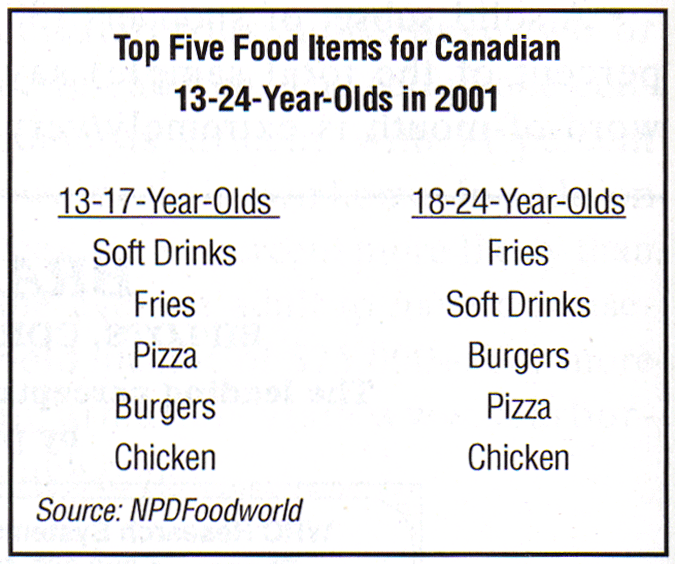
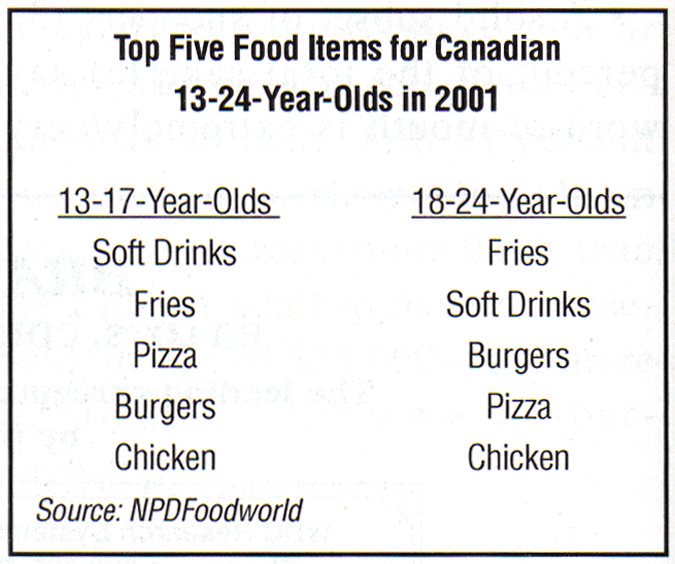
Research firm The NPD Group has found that Canadians in the 13-to-24-year age group are becoming increasingly important to the members of the Food and Consumer Products Manufacturers of Canada, a trade association of 165 Canadian companies that manufacture and market food and consumer products. In addition, NPD reported the number of meals Canadians take home from restaurants has grown faster than across the border in the United States. These issues were discussed at the 10th Annual Foodservice Interchange Conference in Toronto by Ailene MacDougall, vice president, NPDCanada, and Harry Balzer, vice president, The NPD Group.
Among the findings MacDougall shared were those from NPDCanada’s CREST Study regarding restaurant traffic by age group. The 13-24 age group has become increasingly important to sandwich and pizza operators during the past seven years. As the consumers of the future, this age group is bringing their off-premises quick-service restaurant habits with them. Sandwiches, chicken, and pizza are popular choices, with chicken gaining in popularity, while pizza is declining.
"It’s important to see where the 13-24-year-olds are going because 24-35-year-olds, whether single or in two-adult households, spend an average of 15 percent more per eating- out occasion than other age groups. In addition, their restaurant visit frequency is up 19 percent versus the market which went up by 10 percent during the period of 1994 to 2001," says MacDougall.
"Both Canadians and U.S. citizens make and eat most of their meals at home. But more and more they prefer not to cook," says Balzer. The annual number of meals per Canadian household taken out from restaurants increased by 34 percent between 1994 and 2001, while meals eaten in a restaurant went up only 2 percent during the same period. Meals eaten at home, but prepared in a restaurant, increased 15 percent in U.S. homes, while Americans ate only 3 percent more meals out in 2001 than in 1994. The use of restaurants as a source of food to be consumed at home has been steadily increasing in both countries during this time period.
Dieting is another area of difference between Canada and the U.S. Sixty-three percent of Americans claim that they would like to lose 20 pounds, while only 53 percent of Canadians make the same claim. Twenty-five percent of U.S. residents are on a diet today, although only 17 percent of Canadians say they are currently dieting. However, more Canadians than people living in the United States think that one should avoid fat (66 percent vs. 60 percent).