
Happiness, as defined by the world
The United States is expected to maintain its slow but steady growth in the global economy in 2007 with consumers’ overall opinion on their personal lives becoming slightly more upbeat, according to San Diego-based Luth Research’s IndicatorEDG, a quarterly online study surveying a total of 6,000 respondents around the world. The comparison of eight key regions of the global market also indicates that consumer optimism continues to be vibrant in India, China and Scandinavian countries, with a 50 percent lead over the U.S., U.K., Europe (mainland) and Japan. (Findings about India and China should be considered with caution as these reflect primarily the facts and views of the more affluent and influential segments due to the still-limited Internet penetration in the two countries. And, due to a small sample size, the findings for Japan are not conclusive but nevertheless are likely indicative of general opinions in that country.)
People in the U.K, Europe and Japan are most likely to say their life would be the same in 2007. What are the driving factors behind this disparity in consumer confidence and sentiments? The tracking study points to a few indicators within the local cultural and economic dynamics.
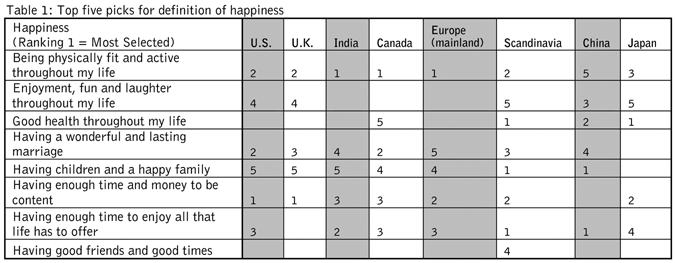
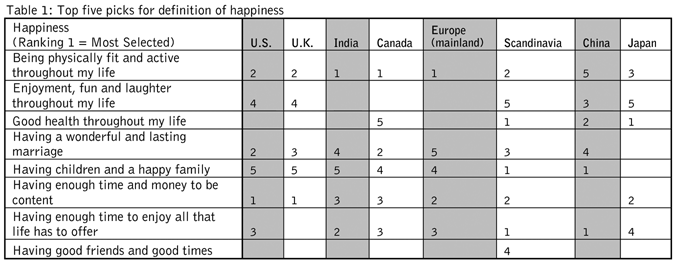
- Defining happiness: With increasing interactions between the members of the global village, the nascent trends in the local market have subtle but intrinsic differences. Children and family are notably more important to the Chinese and Scandinavians than to people from other regions. While people from Western countries strive for physical fitness and active lifestyles, those from China and Japan value good health in a general sense. A good marriage also remains in the top five ingredients for happiness, but is more essential to Americans and Canadians.
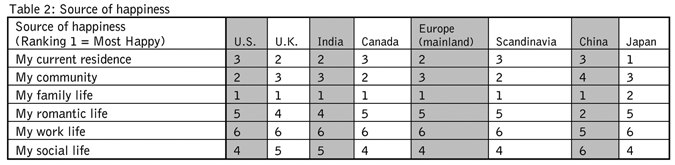
When it comes to the specific things that make us happy, we are globally similar; we draw the most satisfaction from our family life, which is a dramatic shift from 20 years ago when satisfaction was primarily associated with success in the professional realm. Work life is becoming a markedly low priority and source of happiness in the lives of consumers around the globe. Although people’s satisfaction with their residency and community is comparable across countries, people from the U.K. and Europe are more inclined to live in another country and Americans are the least inclined to do so.
- Time and money: The universal theme is the desire for sufficient time and money to be content. Yet, the way consumers are spending their time and energy differs vastly across the globe. The British spend the most time with their spouse or partner – an average of 50 hours per week. As for professional endeavors, people in India and China work the most hours during a typical week (an average of 44 hours), while those in the U.K. only average 24 hours. Workers in Scandinavian countries and Canada also work fewer hours, averaging 23 hours in a typical week. This gap in work hours between regions is expected to widen in 2007 and the following years.
Financially, people in India and China are saving more and spending one extra hour per week managing their personal finances than people residing elsewhere. Individuals in the U.K. and Scandinavian countries spend the least amount of time (1.5 hours on average) managing their personal finances.
Time has become a predominant concern in India and China, where people feel rushed in their daily lives as they try to keep pace with their ever-changing environments. Americans and Canadians, however, are much more likely to articulate their frustrations with time, indicating that they never have enough time and feel a great deal of stress.
- Media usage: The U.S. Census recently projected that Americans will spend five months in 2007 watching television, surfing the Internet, listing to radio and text messaging. According to IndicatorEDG, Americans are not alone in their seemingly extreme devotion to media. On average, people around the world spend 70 hours per week with various types of media, accounting for 42 percent of the 168 hours in a week.
The Chinese and Americans certainly share the same affinity for the Internet, despite the two governments’ continuously different perspectives in international trade and currency policies. Both countries posted more than 19 hours a week of Internet usage in 2006. India is another country where Internet usage is accelerating.
When it comes to messaging, India and China both enjoy the most usage of SMS (2.8 hours per week) and instant messaging (five hours per week) with North America (U.S. and Canada) trailing the group. Entering into 2007, however, the usage of instant messaging will diminish, and SMS growth will slightly decelerate everywhere except in Scandinavian countries. Blogs will continue to be strongly embraced in China, Scandinavia and the U.S., which are already the global leaders when it comes to the amount of time spent reading and creating blogs.
Although watching television currently accounts for 20 percent of the total time people spend consuming media in a typical week, time allocated for television is expected to shrink by more than 8 percent globally in 2007. Movie theaters across all countries are also anticipated to continue to see a similar decline in interest. On the other hand, newspapers remain an attractive medium in India and China, where people are spending twice as much time reading newspapers as those in more developed countries. According to IndicatorEDG, one can expect 2007 to continue to be a good year for newspapers in India and China.
- General worries: Towards the end of 2006, the concern over a possible terrorist attack waned considerably in favor of concerns that were more immediate. Escalating health care costs, rising gasoline prices, declining moral standards, lack of retirement funds and declining educational standards now top the list of consumer worries in the United States. People are anxious for changes in policy and market priorities to address these key concerns in 2007.
American concerns are, unsurprisingly, shared among people in other parts of the world. Declining moral standards is one of the top three overall worries across all borders. High concerns about declining environmental quality, escalating health care costs and lack of retirement funds also resonate with citizens of all countries. Regionally, Internet security is causing the greatest anxiety in Europe, Scandinavia and China. Rising gasoline cost, on the other hand, affects India and North America most.
- Ideas to go: The overall health consciousness of consumers not only means continued prosperity for the organic food industry but also suggests the likelihood of more vertical integrations similar to the combination of CVS and MinuteClinic or CVS and CareMark. The rising cost of health care is especially troublesome to the U.S. economy, as health care spending represents more than 16 percent of the country’s GDP while averaging 10 percent in most industrialized countries. Currently, businesses are bearing most of the costs associated with health care. This financial burden could result in the erosion of additional capital investment for corporate development and expansion, and subsequently diminish the country’s innovative edge. The year 2007 could see stronger business initiatives in attempting to drive health care reform involving government policies, consumer responsibilities and business practices.
2007 will also produce an influx of technologies and services that further connect the offline and online worlds. Consumers’ increasing reliance on the Internet manifests the universal desire for versatility in communication and information relevance. Consumer demand in these arenas can be attributed to innovative companies like LocaModa, whose Wiffiti technology allows people to text-message their thoughts and blogs to flat-panel displays in public and social venues, creating a space where the boundaries between cyberspace and the real world are invisible. Another example are the new quick-response (QR) codes included on McDonald’s food packaging in Japan. They appear old-fashioned to the naked eye, but the QR codes are actually quite sophisticated and can be scanned by mobile phones to retrieve ingredient information. If traditional businesses can create solutions to address the consumer desire for technological innovation they will also thrive.
Furthermore, emerging indicators suggest a need to mix and match marketing channels to adapt to regional lifestyle habits. The Web is no doubt the center of attention. But there are clearly regional variances in media preference. In countries like China where Internet security is of great concern, it would be smart to leverage the traditionally well-recognized newspaper medium to lend credibility to online businesses. In the U.K., where new online ideas such as blogs are not as popular with consumers, radio is a medium still favored by many segments in the population.
IndicatorEDG is a quarterly tracking study monitoring six general indicators about consumer sentiment and market forces: consumer confidence, happiness and life goals, weekly activities (work and leisure), likelihood to purchase technology products, general worries, and what’s hot and what’s not. Each wave of the study surveys 6,000 respondents randomly selected worldwide from Luth Research’s online SurveySavvy panel. The ending sample for each country is weighted to reflect the population demographics documented by the census or government statistical bureau in the individual country. For more information visit www.luthresearch.com.
Traditional outlets spur online product searches
Though there is no question that online searches are becoming more popular among consumers, what exactly triggers an online search? In a recent analysis of BIGresearch’s Simultaneous Media Survey (SIMM 9) conducted for the Retail Advertising and Marketing Association (RAMA), consumers say they take cues from traditional advertising to determine when and where to search for merchandise online.
Consumers said that they were most motivated to begin an online search after viewing advertisements in magazines (47.2 percent), newspapers (42.3 percent), on TV (42.8 percent) and from reading articles (43.7 percent). Women were more likely than men to be motivated by coupons (41.8 percent vs. 29 percent) and in-store promotions (29 percent vs. 24.5 percent) while men were more driven to start an online search based on a face-to-face conversation (36.1 percent vs. 29.5 percent).
“When it comes to advertising, retailers always need to be careful not to put all of their eggs in one basket,” says Mike Gatti, executive director of RAMA. “While search engine marketing continues to be a popular strategy, retailers should not lose sight of traditional advertising channels to promote products and services.”
After searching, online consumers said they are most likely to communicate with others about their search through face-to-face discussion (68.9 percent), though e-mail (53.1 percent), telephone (50.9 percent), and cell phone (30 percent) communication were also popular choices. Young adults 18-24 are also taking advantage of an influx of new media, communicating about services, products and brands by instant messaging (37.5 percent), text messaging (23.7 percent) and through online communities like MySpace and Facebook (20.6 percent).
“Retailers must realize that online communities are now producers and through their stories are able to extend the distribution of traditional media with a trust and truth not even approximated by mass media,” says Joe Pilotta, vice president of Worthington, Ohio-based BIGresearch.
Shoppers continue to use the Web as a resource before determining which items to buy and where. According to the survey, 92.5 percent of adults said they regularly or occasionally research products online before buying them in a store. Products that are most often researched online before being purchased in a store include electronics (50.8 percent), apparel (31.9 percent) and appliances (27.0 percent). Men were twice as likely as women to shop for automobiles online (20.2 percent vs. 10.2 percent), though women research home décor products more often than men (18.9 percent vs. 11.6 percent).
The SIMM 9 survey is a survey of 15,287 consumers which is conducted two times each year. SIMM measures consumption across media, retail channels and products. SIMM 9 was collected in November and December, 2006. The SIMM Survey has a margin of error of plus or minus 1 percent. For more information visit www.bigresearch.com.
Americans map the path to good corporate citizenship
According to the second edition of I-Rep, a biannual survey on perceptions of large companies conducted by Paris-based researcher Ipsos, Americans overwhelmingly say that companies do not pay enough attention to their social and environmental responsibilities (60 percent) and should work to improve the wider impacts of their products and services (77 percent). Only one-third (35 percent) say that companies are listening and responding to the public’s concerns.
Americans identify environment and wildlife protection as the area large companies should contribute to the most (45 percent), placing this slightly ahead of fighting poverty in the United States (42 percent) and education and schools for children and teens (33 percent).
Americans say providing affordable health care for employees (39 percent) and dealing with inflation and oil prices (31 percent) are the two most pressing issues for large companies over the next few years. However, the environment places fifth in issues mentioned (cited by 20 percent), on par with managing costs (21 percent) and competing with emerging economies (21 percent).
“While quality of products and services is the most important factor for consumers judging companies, environmental and social responsibility is as strongly related to goodwill as customer service and value for money,” says Annabel Evans, vice president of Ipsos Public Affairs and author of the study. “Companies that are spontaneously thought of as particularly responsible are primarily recognized for their environmental initiatives.”
That said, Americans find it difficult to judge the social and environmental performance of individual companies. Only one-third (35 percent) can think of a company they feel acts particularly responsibly and no company stands out as a leader among more than 2 percent of the population. “Companies that receive high ratings for social and environmental responsibility are those with widely reported philanthropy or environmentally-friendly products,” says Evans. “Companies that attract high negative ratings and are criticized across most aspects of their business tend to operate in sectors that are perceived as environmentally damaging and are corporate goliaths in terms of their overall revenue and profitability.”
Companies that put good social, environmental and ethical behavior at the core of their business have great potential for winning the hearts, minds and wallets of increasingly ethics-savvy consumers. Americans who are aware of good corporate practices act on their knowledge: one in five (19 percent), for example, have bought a product or service because of an established link to a charitable organization. However, most consumers find it difficult to know which products are better for society and the environment (61 percent) and they claim that more information about companies’ social, environmental and ethical behavior would influence their purchase decisions (62 percent).
Ipsos has identified a group of men and women who are more vocal and opinionated about companies than others and could help large corporations spread the word about their ethical standpoint. Around one-quarter of Americans fall into the group Ipsos calls Ethical Advocates: people who regularly advise their friends, family, colleagues and others to use - and more often, not to use - a particular company due to their beliefs about whether it acts responsibly or not.
Online interviews were conducted as part of Ipsos’ i-Rep American Public program between February 23 and March 5, 2007, with a nationally representative sample of more than 1,000 adults aged 18 and over from Ipsos’ U.S. Internet panel. The margin of error is ±3.1. The research investigates the expectations for and perceived performance of major companies from a variety of sectors on a range of reputation metrics. For more information visit www.ipsos.com.
Ads sent via cell phone must have payoff for recipient
According to a study by Harris Interactive, Rochester, N.Y., a surprising 35 percent of adult cell phone users are willing to accept incentive-based advertisements. Of these adults, 78 percent say the best incentive would be cold, hard cash, followed by free minutes (63 percent), free entertainment downloads (e.g., ring tones, games; 40 percent) and discount coupons (40 percent).
The research examined current levels of consumer interest in mobile phone advertisements, preferred advertising formats and the willingness of consumers to be profiled.
“Historically, U.S. mobile phone users have been resistant to receiving mobile phone advertisements, but according to our research, cell phone users are more willing than ever to receive advertising,” says Judith Ricker, president of the marketing communications research practice at Harris Interactive. “To make their mobile campaigns more effective, advertisers should take note of how cell phone users are most interested in being contacted. Advertisements need to have a clear value proposition, be relevant and allow recipients to control how they are profiled.”
The survey further reveals that over half (56 percent) of those who are at least somewhat interested in receiving ads on their cell phone say they would prefer to receive them via text message, while 40 percent would like to receive them as a picture message. Less than one-quarter of adults would choose to receive them as videos (24 percent), while others would have them transferred automatically to e-mail (23 percent), as a voice message (22 percent) or something else (7 percent).
Just under three-quarters (70 percent) of respondents who are at least somewhat interested in receiving mobile advertising are also willing to provide information about themselves to their cell phone provider in exchange for an ability to customize the service to their needs. Among them, 30 percent are willing to receive the ads for the right incentive, while 20 percent would receive them if they have control to turn them on or off and 20 percent are willing to receive the ads if they can choose who the information is sent to.
Adult mobile phone users who are at least somewhat interested in mobile advertising also feel that the following could lower the pain associated with watching these ads:
- the ability to opt out (66 percent);
- choosing the type of ads to be received (56 percent);
- choosing the number of ads to be received in a given period of time (48 percent);
- providing a profile of desired areas of interest so only specific ads are sent (43 percent);
- different/discounted plan if ads included (42 percent);
- choosing specific times when ads would be received (40 percent).
This online survey was conducted within the United States between February 7 and 14, 2007 among 903 adults (aged 18 and over) who use a cell phone. (344 say they are at least somewhat interested in mobile advertising if some incentive were offered.) Data were weighted to reflect the total U.S. adult population on the basis of region, age within gender, education, household income and race/ethnicity. For more information visit www.harrisinteractive.com.