
Trends threaten cable growth
Demographic trends in the 1990s are unfavorable to easy growth in the cable television industry. The demographic segments that have historically provided the strongest growth for cable - middle- and upper-middle class traditional families - show the lowest growth rates. This means that continued steady growth nationally requires higher penetration in segments that have not been strong for cable in the past. These findings were reported by Mark Capaldini, senior vice president, marketing at Claritas Corporation, who presented the infor-mation to a conference of the National Cable Television Association in New Orleans.
The cable television industry has already responded to the growing diversity and complexity of consumer markets. The broad range of programming available today reflects the wide-ranging diversity in cable audiences. However, a fragmentation of consumer markets continues. Capturing these fragments, Capaldini noted, will require marketing directed at precise consumer segments.
Several demographic trends present challenges to the industry:
- Immigration, especially from Latin America and Asia, accounted for about one-fourth of the U.S. population growth in the 1980s. As a result, foreign-language programming will increase in importance.
- Traditional families in the middle and upper-middle class - the strongest segment for cable historically - is one of the slowest growing demographic segments.
- Older Americans, a large and growing segment of the demographic pie, often resist cable.
- Married couples without children are a larger segment than couples with children, and their cable preferences differ from their counterparts with children.
Capaldini forecasts the use of neighborhood-level, lifestyle segmentation systems to help cable television marketers achieve more effective targeting of specific consumer groups.
Survey studies men's shopping habits
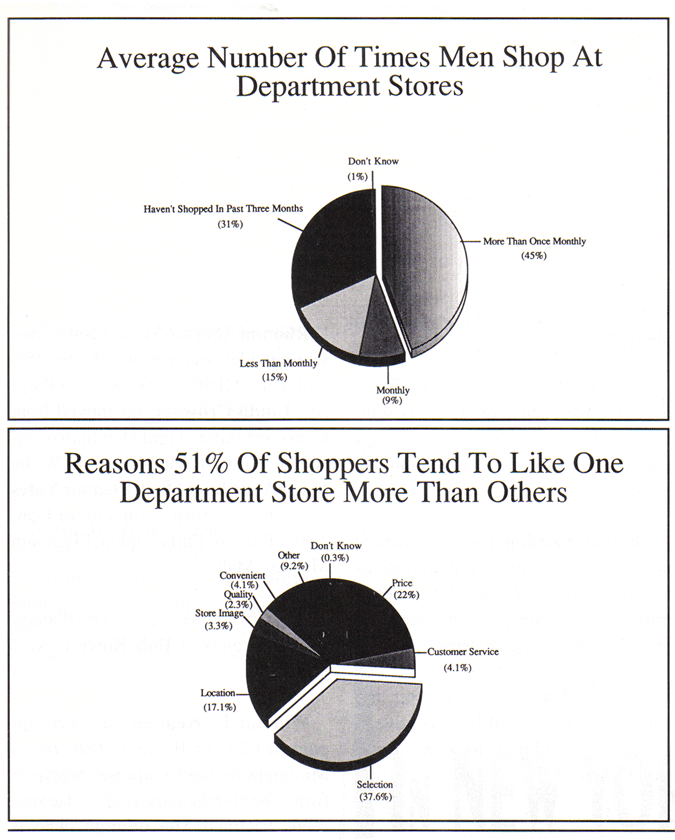
Results from a new national survey by Maritz Marketing Research Inc. show 68% of American men shop regularly at department stores. The results, based on stated shopping habits over the past three months, could offer opportunities to an industry seriously affected by attitudinal shifts, changing consumer markets, and intense competition.
On average, 45% of men shop departments store more than once per month, 9% monthly, and 15% less than monthly. About one third of men (31%) have not shopped at department stores in the past three months. Although an earlier Maritz survey shows that men are shopping somewhat less at department stores now than a year ago, the drop is not as severe as the drop for women. The current survey finds 82% of women shop at department stores - 53% average more than once per month, 11% monthly, and 18% less than monthly. Sixteen percent of women have not shopped at department stores in the past three months.
"Men are no strangers in department stores these days, probably as a result of more women working outside the home," says Beth Nieman, Maritz research manager. "Retailers may want to capitalize on this situation by marketing more to men. They don't want to ignore this important segment."
According to the study, men are not just shoppers in department stores - they are buyers, too. Ninety-five percent of men who shopped department stores in the past three months made one or more purchases, as did 94% of women.
Overall, 47% of shoppers are paying cash for purchases; another 18% are paying with a check. Only one-third of department store shoppers say they are currently paying for their purchases with credit cards. "This finding seems consistent with our January 11, 1991 poll, which indicates 45% of consumers plan to reduce overall debts this year," Nieman says.
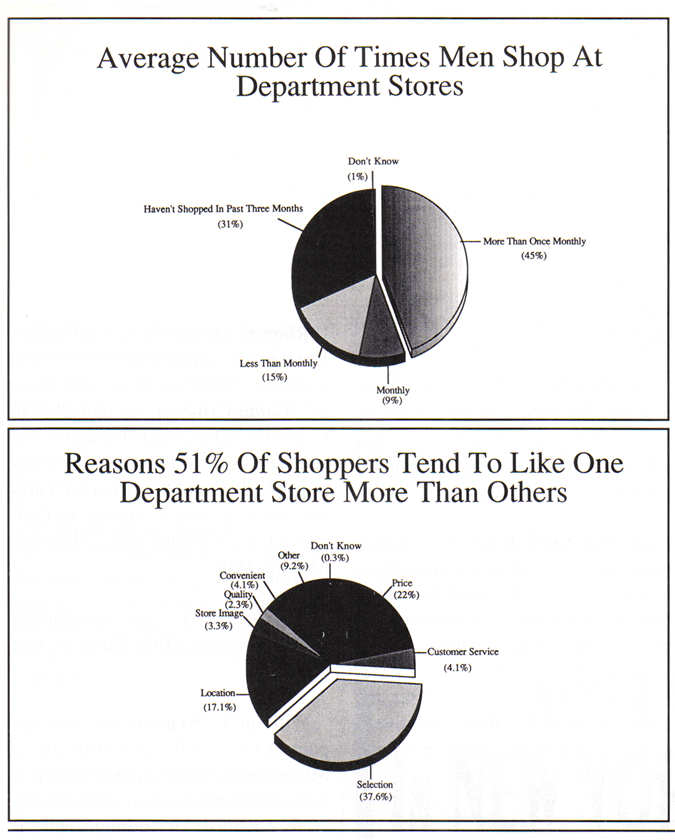
Fifty-one percent of department store shoppers tend to shop at one store more often than others. Top reasons for their loyalty include: selection of merchandise (38%), price (22%) and location (17%). However, 48% of shoppers demon-strate less store loyalty and may be highly receptive to the competition.
"Retailers need to offer greater value and selection in their products and services to capture more of this group," says Nieman. "Factors like sensitivity to customer satisfaction will become increasingly important as merchants look for ways to build market share."
Study finds gap between employee and customer ratings of service
Compared to customers, employees give their companies higher marks on service quality, according to an Opinion Research Corporation study of the American work force and service quality. There is a large gap between customers' ratings of the service quality provided by the typical company and employees' ratings of their own companies' service quality. Employees across the board believe that their own organization's service compares favorably with the best companies.
Employees' optimism may come from their sense of the improvements their companies are making. "Our research shows that teamwork, empowerment and training are key drivers of ratings of overall service quality," says Brian Morgan, ORC senior vice president. "Compared to what they were doing a few years ago, today's companies are empowering employees more, increasing the levels of teamwork and doing a better job of training. Still, there is room for improvement in all of these areas. Companies have not yet struck the right balance between running lean and delivering the quality levels they need to be competitive."
Companies are stretching theirpeople more than ever. Half of the work force believes that the amount of work they do is taking some toll on overall quality. In addition, rewards and resources have not kept pace with increased demand. As a result, organizations may be negating many of their accomplishments.
The study is reported in "Employee Attitudes: ORC's Architecture For Aligning Organization, Customer and Market Realities," to be released this Fall. The report explores these issues, using data from the 1991 American work force study and trends from ORC's employee attitude database and service quality database.