
Consumers soured by recent fast-food experiences
Could the mealtime domination of familiar fast-food restaurants be coming to an end? According to a new study by NFO WorldGroup, Greenwich, Conn., the answer is maybe - as traditional quick-service restaurants (QSR) across the nation are failing to satisfy customers on a basic level.
NFO’s research, which evaluates customer satisfaction at some of the nation’s largest chain restaurants, reveals that customer expectations about the "casual dining out" experience are rising, fueled by standards set by a rapidly growing restaurant category referred to as fast-casuals, which are similar to fast-food/quick-serve outlets but offer a promise of higher quality food and atmosphere. While QSRs dominate the marketplace - 80 percent of people eat out at them regularly - one-third of QSR customers claim dissatisfaction with several aspects of their dining experience. This compares to fewer than 5 percent of customers expressing dissatisfaction with the fastcasual restaurants they frequent.
According to the study:
- Well-balanced, nutritious meal choices are not what customers are looking for when they choose a McDonald’s or Taco Bell for a meal or a snack.
- Reasonable wait times are important to customers. However, they are Willing to wait for freshly prepared meals at a Subway or Panera Bread.
- Promotions and rewards have a moderate impact on customer loyalty, but personalized service is far more important to regular customers. It has a much higher impact on their satisfaction and loyalty.
The study says that while 60 percent of restaurant diners are strong advocates for their favorite eateries, it isn’t basic features such as menu options and price promotions that keep them coming back but rather special touches such as improved and personalized customer service. Meanwhile, consumers said that many of the largest fast-food chains straggle to deliver a basic level of service that is consistent across all locations.
"With chains providing so many of today’s eating options, consumers are crying out for a generic experience to be turned into a personal one. So while each visit may be predictable and consistent, it is also friendly and familiar. Our research shows that this keeps customers coming back time and again. Fast-casuals are setting high standards in this area, but the quick-serves are failing and are likely to face a loss of market share in the long run," says Shubhra Ramchandani, North American stakeholder management practice leader, NFO WofldGroup, and the director of the study.
While consumers are linking satisfaction with personalized and pleasant service, the QSR industry clearly is not -the majority of its marketing efforts promote new menu items, special deals or rewards. Service improvements are focused on reducing wait times, providing clean facilities and food at the right temperature. Are the quick-service restaurants out of touch with the needs of their core customers?
Ramchandani recommends that QSRs reduce the high level of dissatisfaction among their core customers by delivering the following:
- Friendly and polite service.
- Staff that is knowledgeable and able to answer questions.
- Staff that shows pride in their restaurant.
- A restaurant that demonstrates it is in touch with special needs of its customers.
- An enjoyable overall restaurant atmosphere.
"QSRs would be best served if they paid attention to their loyal customer needs. This will generate additional business through word-of-mouth recommendations - the key source of new customers in the restaurant category. For every dissatisfied customer, you lose at least 10 more through the spread of negative word of mouth, and that is a sorry price to be paid in lost revenue. With these results, and billions of dollars at stake for the QSR industry, the question is, will the fastcasual chains succeed in duplicating their winning service recipe at outlets across the country? Or can the qui~kserves fix themselves before that happens?" says Ramchandani.
The study was conducted in the summer of 2003 from a nationally representative sample of consumers. Over 600 consumers were asked to rate the performance of restaurants they visited most often in the last two months. These restaurants were grouped into three categories: quick-service, fastcasual and full-service restaurants.
In measuring customer loyalty, fastcasual outperforms all others, garnering an A+ grade on overall performance. This rating is driven by consumers’ perceptions of high quality food and service. In general, this group of restaurants boasts less than 5 percent of dissatisfied customers. On the contrary, the quick-service category receives an overall B grade, with specific chains receiving close to failing scores (equivalent of a D grade).
While the overall message to the restaurant industry is that an emphasis on the basics is key to maintaining customer satisfaction and loyalty, the exact prescription varies by category. The best course of action is for each category to review its weaknesses and based on its strengths. These include:
- QSRs must improve basic staffservice skills and wait times.
- Fast-casuals would do well to add locations, with a continued emphasis on maintaining quality of service staff. Increasing price-value of their offerings would strengthen their position.
- Full service restaurants must excel in service and restaurant atmosphere to justify price levels.
Europe, U.S. largest private label markets
Sales of private label consumer packaged goods are a large and growing global phenomenon, according to a study by ACNielsen. In the 36 countries and 80 categories studied, consumers spent 15 percent of total value of sales on private label consumer packaged goods, but with widespread diversity across both markets and product types.
Europe remains the region with the largest private label share of total retail sales, at 22 percent, with North America second at 16 percent. Even excluding Wal-Mart’s private label sales, the United States remains the largest single market for private label sales in absolute dollars, while Switzerland has the highest private label share at 38 percent. More than 95 percent of private label sales are found in Europe and North America.
In terms of the rate of growth for private label products, however, the study revealed a decidedly different picture. Latin America, Asia-Pacific and the emerging markets all have very small private label markets in terms of overall retail sales, but are experiencing much more rapid sales growth. For example, the emerging markets of the Czech Republic, Hungary, Poland and South Africa saw a collective growth rate of 48 percent compared to 2002, while Latin America and Asia-Pacific saw year over year growth rates of 16 percent and 14 percent respectively. European growth was 6 percent, while NorthAmerica, excluding Wal-Mart in the U.S., remained unchanged from 2002. Overall, growth rates for private label products outpaced those of manufacturers in nearly two-thirds of the countries studied (22 of 36).
"The high growth rates for private label in the developing markets are directly related to the expansion of global retailers beyond their traditional geographic borders. As they build in~astmcture, they build their private label brands," says Jane Perrin, ACNielsen managing director of global services.
The study’s findings are based on ACNielsen sales data from 36 countries in North America, Western Europe, emerging markets, Asia-Pacific and LatinAmerica, representing 65 percent of the world’s gross domestic product. A representative sample of 80 product categories was selected for review, chosen to provide a cross-section of private label activity across product types. Data was collected for the 12-month periods ending in April 2001, 2002 and 2003. For the purposes of this study, any consumer packaged goods brand that is sold exclusively by a specific retailer or chain is defined as private label.
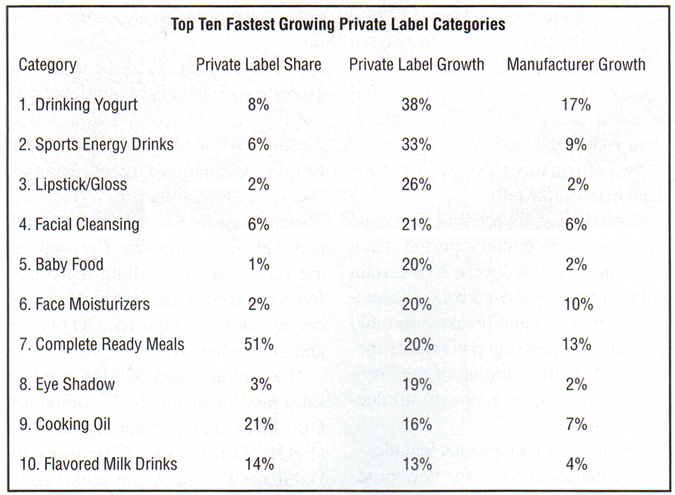
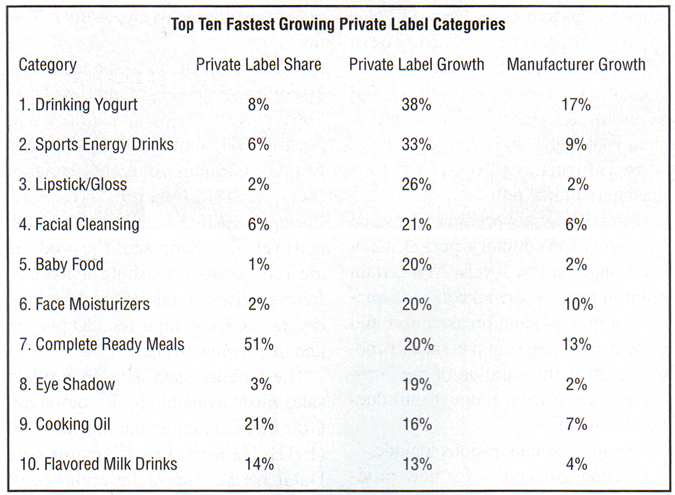
As expected, some of the largest private label categories were within traditional strongholds that are often viewed as commodities, like the paper products, plastic bags and wraps area. For instance, nearly half (46 percent) of aluminum foil sales were private label products, while plastic wrap/rolls and kitchen paper/towels attributed 33 percent and 32 percent respectively of their sales to private label. In the food area, complete ready meals (often offered in a special section of a store) had a 51 percent private label share, while private label milk represented 44 percent of the total market and more than $11 billion in actual value sales.
Looking beyond traditional categories, some distinct trends begin to emerge. In today’s private label market, a different level of products has come to the fore: the premium "branded" private label product. These products offer consumers a quality private label choice as well as providing retailers an additional selling point for their stores. Some of these quality products may be branded with the retailer’s name or even have a brand image all of their own (e.g. President’s Choice).
Due to this "premium" phenomenon, some categories once deemed unreachable by private label are starting to see significant growth rates. Non-traditional categories such as lipstick/gloss, facial cleansing, eye shadow, baby food, drinking yogurt and sports energy drinks represent very small actual private label sales, but are all experiencing rapid growth rates versus comparable manufacturer brands (see chart).
"In areas like beauty products and baby food, trust is a vital element to success," says Perrin. "Private labels’ growth in these areas shows that retailers are marketing effectively to consumers beyond the simple ’low cost, high-volume’ approach of the past."
In its analysis, ACNielsen found that in the 36 countries and 80 categories studied, private label products were on average 31 percent cheaper than their manufacturer counterparts. This differential has remained fairly consistent since ACNielsen’s previous global study in 1998. Within the countries and categories studied, however, important variances exist. For instance, in Poland the differential was 50 percent, where in Hong Kong it was only 10 percent. Europe, with its private label market share dominance, was home to seven of the top 10 countries with the biggest different atial between private label and manufacturer brands. The United States had the average differential of 31 percent.
At the category level, the product categories found in personal care and health care often had the largest price differential (greater than 40 percent). Private label pain relief products, for example, were found to be 55 percent cheaper than manufacturer brands. At the other end of the spectrum, categories found within many food areas had the lowest differential, with a category like frozen fish (including shellfish and seafood) offered at less than a 10 percent difference.
One interesting finding uncovered byACNielsen is that in some categories private label prices were found, on average, to be equal to or even higher than manufacturer-branded products. One of the many drivers behind this trend is the previously mentioned retailer strategy of offering consumers premium branded private label products as a high-quality option and a unique selling point for the store. Other factors include the presence of private label products sourced from imports (which are thus more expensive than domestic manufacturer brands), differences in product package sizing, and manufacturer brands being more often found on promotion than private labels, thus bringing their average price down.
European economies show dramatic differences in innovativeness
A study of 137 new product launches in 16 European countries shows the persistence of major regional disparities in the era of the European Union, according to an article in a journal of the Institute for Operations Research and the Management Sciences (INFORMS). "While we expected some differences, we were surprised by the size of the differences," the authors write. "We were also surprised by the fact that Scandinavian countries tend to have the shortest ’time-to-takeoff’ of all European countries. In contrast, the large economies of Europe France, Germany, Italy, Spain, and the United Kingdom mined out to be less innovative than the Scandinavian countries."
Based on their research, the authors recommend that European marketers introduce new products first in a few countries, employing what is called a waterfall strategy, rather than in many countries at once, what marketing literature calls a sprinkler strategy.
"The International Takeoff of New Products: The Role of Economics, Culture and Country Innovativeness" appeared in the spring 2003 issue of the INFORMS journal Marketing Science. The authors are Gerard J. Telis of the University of Southern California, Stefan Stremersch of Erasmus University, Rotterdam, and Eden Yin of Cambridge University.
Normally, a new product is marked by a long introductory period when sales linger at low levels. At a certain point in time - the takeoff - a successful new product breaks into rapid growth and a large jump in sales. Time-to-takeoff is the duration of the introductory stage from product introduction to takeoff.
The authors’ conclusions include:
- "Time-to-takeoff’’ for new products differs dramatically between countries (for example, 3.3 years for Denmark and 9.3 years for Portugal). On average, time-to-takeofftakes about half the time in Scandinavian countries (four years) as it does in Mediterranean countries (7.4 years).
- Cultural factors partly explain these differences. In particular, the probability of takeoff increases in countries that place high in an index of achievement and industriousness and low in uncertainty avoidance.
- Sales of most new products display a distinct takeoff in various European countries, at an average of six years after introduction.
- Time-to-takeoff differs dramatically across product classes. The mean time-to-takeoff is eight years for what are described as "white" goods (kitchen and laundry appliances) and two years for "brown" goods (entertainment and information products).
- The probability of a new product’s takeoff in one country increases with prior takeoffs in other countries.
Because managers are under great pressure to pull the plug on a product that has not taken off, the authors suggest that introducing a product in a few countries that are expected to show early takeoffcan win internal corporate support. The strategy lets marketers use sales data in one country to forecast sales in other countries where they plan to launch the product. Unfortunately, the authors observe, most European marketers do not introduce new products gradually and pay a penalty in failure.
The authors analyzed the takeoff of 10 consumer durable categories across 16 Western European countries: Austria, Belgium, Denmark, Finland, France, Germany, Greece, Ireland, Italy, the Netherlands, Norway, Portugal, Spain, Sweden, Switzerland, at the United Kingdom. The products afe refrigerators, washing machines, freezers, dishwashers, color televisions, dryers, VCP, s, computers, CD players and microwave ovens.
The authors used data on product sales made available by Euromonitor, GfK, The Economist Intelligence Unit (EIU), TableBase of Responsive Database Services, the archives of appliance manufacturers in various European countries, and a private observer.
Do Not Call is more like Do Not Know
Provo, Utah-based data collection firm Western Wats announced the results of a nationwide survey conducted among a sample of Americans concerning the National Do Not Call (DNC) registry. The study was conducted via telephone among 300 households selected at random using RDD sampling methodology, with a 95 percent confidence level and a 5.7 percent confidence interval. The survey took place during the week following the Federal Government’s open registration of the DNC list that prohibits telemarketers from dialing registered numbers.
After only one week following open registration, 28 percent of respondent households had placed their phone numbers on the DNC list. Another 46 percent said they intended to register at some point in the future. That left 12 percent who said they did not intend to sign up and 14 percent still undecided.
Most (95 percent) survey respondents had heard of the National DNC list without being prompted by an explanation, but many were unsure as to exactly what types of calls will be blocked. Only 80 percent said they thought telemarketing calls would be blocked as a result of registering. Sixty percent said they thought market research calls would be blocked, 52 percent thought telemarketing calls from companies they currently do business with would be blocked, 47 percent thought calls for donations to charitable organizations would be blocked, 41 percent thought political polling calls would be blocked, and 21 per-cent thought customer service calls would be blocked.
Though enthusiasm for the National DNC list is great, Americans are still generally willing to receive certain types of calls. When given a list of various types of phone calls, 65 percent said they would be willing to receive a reminder call for something like a doctors appointment or oil change, 35 per-cent would be willing to talk to someone asking for their opinions about products or political issues, and 19 percent said they would be willing to speak with someone about contributing to a charitable organization. Only 7 percent said they would be willing to talk to someone selling something, but 17 percent said they would be willing to speak to someone about additional products or features related to something they already own.
Survey participants were skeptical about the effectiveness of the National DNC list. When asked how likely telemarketers would be to call even though their number was on the DNC registry, 43 percent of respondents said they believed telemarketers would call them anyway. For more information visit www.westernwats.com.
Get in the car, turn on the radio
In-car radio listening has increased over the past five years, gaining 34 percent of total listening, according to The National In-Car Study: Can Radio Defend Its Turf?, a study by Arbitron Inc. and Edison Media Research. However, among persons age 12-24, CD players and cell phones minimize radio's stronghold as "one essential" in-car companion.
Over a third of Americans are spending more time in their cars than in 2002. On average, people are spending more than 15 hours per week on the road and surprisingly equal time is spent in the car on weekend days as weekdays. While both sexes report equal time in the car on weekends, men report more time in the car than women during weekdays and overall, men use in-car radio more frequently than women.
The study reveals that workers make many stops on the commute home. Seventy-seven percent stop by the grocery store, and more than half go to convenience stores or large retail stores. Since two out of five consumers decide at the last minute to make many of these stops, it is an advantage to target them close to the purchase.
Advertisers can benefit from later-day advertisements, as 48 percent of listeners have heard advertisements for sales while listening in a car and visited that store later that day.
Consumers with household incomes over $100,000 are 42 percent more likely to make choices based on radio advertisements while they commute. Forty-five percent of men make last-minute decisions to shop at a store on the way home from work. Men are also 31 percent more likely to hear an advertisement and be motivated to visit that store.
Radio is used by 96 percent of Americans who drove or rode in a car in the last month. In addition, CD players and cell phones are used by more than half of in-car consumers. Of all devices currently used in-car, 75 percent of Americans who drove or rode in a car within the last month used the radio almost all or most of the time. When asked to choose only one device for their primary car, consumers chose radio by 69 percent above CD players at 16 percent and cell phones at 8 percent.
However, radio is less essential for 12-to-24-year olds. Only 49 percent chose radio as the most essential device in the car, while the CD player was chosen by 34 percent. Comparing time spent with radio, 78 percent of persons 25+ spend most of their time in the car with radio, while only 61 percent of persons age 12 to 24 spent most time with radio in the car.
Telephone interviews were con-ducted in July with 1,505 of a random sample of Arbitron Spring 2003 diarykeepers age 12+. Ninety-eight percent of the sample had driven or ridden as a passenger in non-public transportation vehicles (car/truck/van, etc.) in the last month. For the full study go to www.arbitron.