Brother, can you spare a dime?
The findings are from the ACNielsen Online Consumer Confidence Study, a twice-yearly global survey that gauges consumers’ confidence in the economy, spending and saving patterns, and major concerns. This survey marks the fourth in the series; the first was conducted in October 2004.
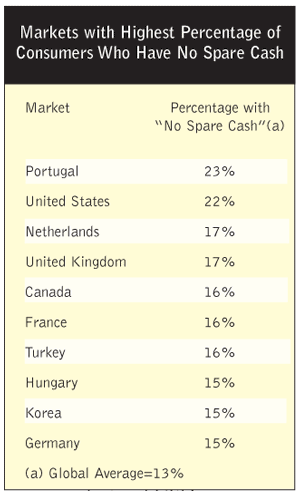
The percentage of American consumers who say they have no spare cash remains the same from the last survey, conducted in November 2005, after dropping from 28 percent in the May 2005 survey.
The survey also showed that Americans say they tend to funnel what spare cash they do have into savings or debt relief, rather than new clothes or expensive technology purchases. Paying off debts was claimed as the top use of spare cash (41 percent), with putting money into savings close behind at 38 percent.
“While Americans are notorious for overspending and building debt, these findings show a desire for financial responsibility when it comes to discretionary income,” says John J. Lewis, president and CEO, ACNielsen U.S. “Perhaps because the idea of living from paycheck to paycheck is so prevalent, consumers who have a little extra cash would rather use it to shore up their finances than spend it right away.”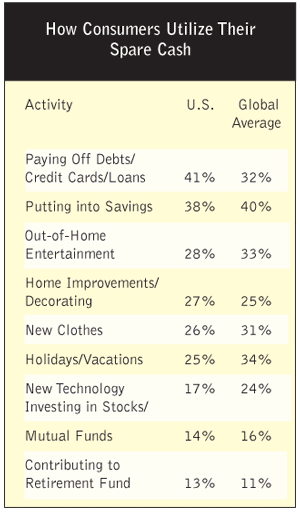
“Clearly the cost of energy, particularly gasoline, and a slowing housing market are having a negative impact on the U.S. consumer’s purchasing attitudes,” says Lewis. “Whether this attitude will ever actually materialize in hard economic terms is yet to be seen.”
The survey, which took place in June 2006 over the Internet, polled 21,779 respondents in 40 markets: Australia, Austria, Belgium, Canada, Denmark, Estonia, Finland, France, Germany, Greece, Hong Kong, India, Indonesia, Ireland, Italy, Japan, Korea, Latvia, Lithuania, Malaysia, Netherlands, New Zealand, Norway, Philippines, Poland, Portugal, Russia, Singapore, South Africa, Spain, Sweden, Switzerland, Taiwan, Thailand, Turkey, United Kingdom, United States, Czechoslovakia, Hungary and Vietnam. For more information visit www.acnielsen.com.
TV viewing on the rise
New York-based Nielsen Media Research reported that average American television viewing continues to increase in spite of growing competition from new media platforms and devices such as video iPods, cell phones and streaming video. During the 2005-2006 television year, which ended on September 17, 2006, traditional in-home television viewing continued to hold its own with audiences and even gained among technology-savvy teenagers.
The total average time a household watched television during the 2005-2006 television year was 8 hours and 14 minutes per day, a three-minute increase from the 2004-2005 season and a record high. The average amount of television watched by an individual viewer increased three minutes per day to 4 hours and 35 minutes, also a record. Meanwhile, during prime time, households tuned to an average of 1 hour and 54 minutes of prime time television per night, up 1 minute, and the average viewer watched 1 hour and 11 minutes, which was the same as last year.
Although teenagers typically drive the consumption and development of new media platforms, teens age 12-17 viewed 3 percent more traditional television during the full day than in the 2004-2005 television year. This increase was driven primarily by teenage girls, who increased their Total Day viewing by 6 percent. Increases among teenage girls were particularly high during early morning (6:00 a.m. to 9:00 a.m.) and late night (11:30 p.m. to 2:00 a.m.) viewing, which were up 12 percent and 6 percent, respectively.
Younger children age 2-11 also watched more television during 2005-2006, increasing their Total Day viewing levels by 4 percent. Viewing by children increased 3 percent during prime time, 5 percent during early morning and 6 percent during late night.
During 2005-2006, African-American and Hispanic Total Day viewing levels increased 4 percent and 3 percent, respectively, with significant increases among children and teenage girls. African-American viewing among children age 2-11 and teen girls age 12-17 increased 10 percent and 9 percent, respectively, while viewing among Hispanic children and teenage girls increased 14 percent and 6 percent, respectively.
“These results demonstrate that television still holds its position as the most popular entertainment platform,” says Patricia McDonough, senior vice president of planning policy and analysis at Nielsen Media Research. “At this point, consumption of emerging forms of entertainment, including Internet television and video on personal devices seems not to be making an impact on traditional television viewing.” For more information visit www.nielsenmedia.com.
Seekers of weight loss info sated by the Web
According to a study of consumers’ use of the Internet as a resource for researching weight loss information, 60 percent of those investigating weight loss now utilize the Internet to find condition-specific information, including options for healthy eating/nutrition and details on specific weight loss programs and diets. Additionally, more than half (53 percent) report visiting a Web site specifically for information on weight loss drugs.
Nearly half (43 percent) of respondents to the survey by comScore Pharmaceutical Solutions, Reston, Va., reported a high level of satisfaction with online weight loss resources. Likely a result of consumer satisfaction, many weight loss Web sites are attracting large numbers of visitors. According to data from comScore Media Metrix, three of the most popular weight loss-related Web sites each drew more than 3 million unique visitors in July 2006: AOL Diet and Fitness (4.0 million), eDiets.com (3.2 million), and WeightWatchers.com (3.1 million).
Not surprisingly, nearly all researchers (95 percent) also utilize more traditional offline resources when researching their condition. While general weight loss information is sought both online and offline, the study found a clear distinction between the types of information that researchers prefer to receive online versus offline. The study concluded that weight loss researchers turn to the Internet when seeking information requiring very specific details and when seeking resources that engage them in managing their condition.
For example, 62 percent of weight loss researchers look for information on specific programs and diets online, while a lower 51 percent of researchers look to offline resources for this information. When seeking information on weight loss drugs, 39 percent of researchers turn to the Internet, likely a result of an abundance of TV and print ads that promise more specifics at associated Web sites. In comparison, only 24 percent of researchers use offline resources to find information on weight loss drugs. Additionally, when researchers look for details on specific treatment options, 27 percent use the Internet, while 19 percent rely on offline information sources.
More than twice as many rely on the Internet versus offline resources for weight management tools - including interactive applications such as body fat calculators and calorie counters. In fact, nearly half (46 percent) of researchers head online to take action related to their weight loss quest - utilizing tools to track their progress and chart their course, while less than half as many (22 percent) seek such information offline.
Importantly, the comScore study found online information about weight loss is important in matters of compliance and persistency. Forty-four percent of online weight loss researchers consider online information to be extremely/very influential in helping them to stay compliant with weight loss programs. Further, nearly one-third (30 percent) found online information to be influential in helping them to stay compliant with their weight loss medication.
More than one-third (39 percent) of researchers reported that the use of online resources had influenced them to learn more about a particular drug for weight loss and 35 percent were influenced by online information to speak to a doctor about weight loss programs. More than one-quarter (27 percent) consider information found online to be influential in prompting them to speak to their doctor about a particular weight loss drug.
The study also concluded that online resources have a measurable influence on future actions. Nearly 40 percent of researchers indicated they are extremely/very likely to speak to their doctor about weight loss options as a result of weight loss information they read online. Further, 25 percent reported they were likely to specifically ask their doctor to prescribe a weight loss drug they had researched online, and 21 percent indicated they would ask their doctor to switch weight loss medication. Roughly one-third cited their likelihood to use a free coupon obtained online for a prescription weight loss medication. For more information visit www.comscore.com.
Stop the presses: newspaper Web sites contribute to audience growth
Scarborough Research, New York, has found that the online-exclusive audience of newspapers - or the audience that visits a newspaper’s Web site but does not read the printed edition - can account for 2 to 15 percent of a publication’s integrated newspaper audience - or the combined print/Web site audience. This represents a gain of hundreds of thousands of readers for many papers in larger markets.
Scarborough Research has issued a white paper on its integrated newspaper audience metric (available for download at www.scarborough.com/newspaperstudy/INA-WhitePaper.pdf ). The white paper draws upon Scarborough’s newspaper audience information in the top 25 local U.S. markets and interviews with industry executives to examine the potential of online newspaper audiences. The paper identifies several key factors that contribute to audience growth online, including unique Web site content, high local-market Internet penetration, heavy cross-promotion, and integration of the Web site into the core newspaper business.
“With all of the negativity the newspaper industry has been subject to, we are pleased to report that our analysis finds a positive story headline: newspapers are successfully extending their audience online. Newspaper Web sites are attracting people that may not read the printed paper, resulting in audience growth overall,” says Gary Meo, senior vice president, print and internet services, Scarborough Research.
Scarborough introduced the integrated newspaper audience metric last year to quantify the combined local-market reach of printed newspapers and their Web sites. As more consumers turn to the Internet for news and information, newspapers continue to be focused on extending their brands - and growing their audiences - online.
“One of the most pronounced success factors that emerged from our conversations with industry executives is that integration contributes to the success of newspaper Web sites,” says Meo. “At the newspapers we spoke with, their Web sites are an integral and essential part of the business strategy to grow audience. For these newspapers, the integration of the Web site into the company’s overall business is a key factor.”
The analysis also examined the demographic characteristics of the integrated newspaper audience. Newspaper Web site audiences are educated, affluent and young, dispelling a common misperception that young people are not engaged by newspaper content.
Integrated newspaper audience is the combined net reach of a newspaper’s weekly print and online audiences. The data in this report is from the Scarborough Local Market Studies, Release 2 2005 (12 months), in the top 25 markets. For more information visit www.scarborough.com.
Passion drives arts and crafts hobbyists
A study by Baltimore marketing firm Vertis Communications found that 34 percent of adults get involved in because they feel passionate about their projects. Vertis’ Customer Focus 2006: Arts and Crafts study also found that 22 percent of adult arts and crafts hobbyists are involved in arts and crafts because it is cheaper to make something than to purchase it at a store.
“When consumers feel passionate about their activities, they are more likely to invest time and money; marketers need to understand who these consumers are and how to approach them,” says Jim Litwin, vice president of market insights at Vertis.
In addition to finding the purchasing trends of arts and crafts consumers, the study also revealed how much consumers spend on materials. For example, hobby-item shoppers have spent approximately $227 within the last 12 months on ceramics, sewing, knitting and woodworking materials. On the other hand, arts and crafts shoppers have spent $170 on fabric, yarn, painting items and scrapbooking materials within the same time frame.
The Vertis Customer Focus 2006: Arts and Crafts study, which surveyed respondents via the telephone and Web, also revealed the following:
-
34 percent of women 18-34 and 33 percent of men 18-34 are passionate about their hobbies and projects, compared to 31 percent of women 35-49 and 39 percent of women 50 and older who also feel passionate about their arts and crafts projects.
-
24 percent of men 18-34 and 23 percent of men 50 and older say they get involved in arts and crafts projects because it is cheaper to make something versus purchasing at the store.
-
32 percent of men 35-49 get involved in arts and crafts projects by assisting their children with their school, camp or group projects, compared to 30 percent of women 35-49 who also assist their children.
-
20 percent of women 18-34 have spent $21-$50 on arts and crafts materials including frames, fabric, yarn, paper craft products, painting items and scrapbooking in the past 12 months, while 15 percent of women 18-34 have spent $201 or more.
-
19 percent of women 35-49 and 16 percent of women 50 and older have spent $21-$50 on arts and crafts in the past 12 months.
-
Additionally, 12 percent of men and 12 percent of women 35-49 have spent $201 or more on arts and crafts materials in the past 12 months.
-
10 percent of women 35-49 have spent $101-$200 on arts and crafts materials within the past 12 months.
According to the study, 11 percent of men 50 and older spent $101 or more on hobby items such as ceramics and woodworking materials, compared to 2 percent of men 50 and older who have spent $1-$20 within the past 12 months. In comparison, 11 percent of women 18-34 have spent $1-$20 on hobby items within the last 12 months, compared to 7 percent who have spent $101 or more. Nine percent of women 35-49 have spent $21-$50 on hobby items, compared to 7 percent of men 35-49. However, only 6 percent of women 35-49 have spent $101 or more on hobby items within the last 12 months, while 10 percent of men 35-49 have spent the same amount in the same period. For more information visit www.vertisinc.com.
Consumers say in-store media works
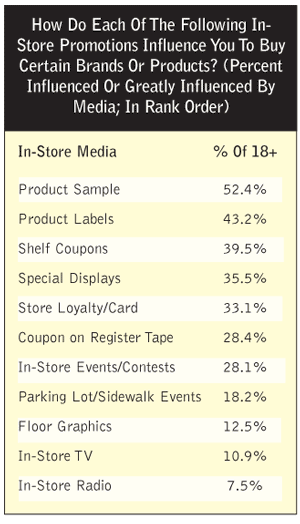
“The store is a medium of communication. Customers consume in-store media. They are not merely exposed. The old type of marketing was to slip in gross rating points as a surrogate for purchasing. Today consumption of media means the media has relevance and influence on a purchase decision,” says Joe Pilotta, vice president of research at BIGresearch.
“Even though in-store TV and radio trail with only 10.9 percent and 7.5 percent of respondents saying they’re influenced, it is still very significant when taking that number as part of overall weekly store traffic,” says Pilotta.
However, the figures differ when analyzed by BIGresearch’s Media Consumption Clusters. The clusters categorize consumers into eight unique clusters using media behavior only.
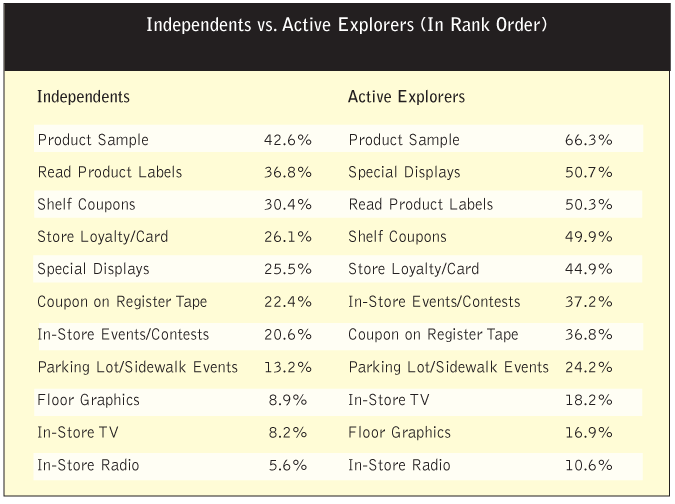
The message is clear: one in-store medium does not fit all. Special displays rank second with Active Explorers and fifth with Independents. Product labels are second with Independents and third with Active Explorers. The Independents’ intensity of influence is lower across the in-store media in comparison to the average consumer and the Active Explorers. For more information visit www.bigresearch.com and click on “Complimentary Top Line Findings.”