High schoolers high on higher education
A nationwide survey of college-bound high school juniors and seniors commissioned by the Stanley H. Kaplan Educational Center, Ltd. revealed that students are serious about their reasons for planning to attend college. The most popular responses to "Why do you plan to go to college?" were "to pursue a career goal," claimed by 50.2% of the respondents, and "to gain a general education," claimed by 42.3% of the students queried.
While 21.1% of the students believe college will help them "to get ahead," only 11.9% cited the goal "to make more money" as their reason for attending college.
Surprisingly, males were 39% more likely than females to say their motivation for going to college lay in gaining a general education. Females were 18% more likely than males to say they plan to attend college to pursue a career goal. However, more males than females cite their reason for going to college as "to make money."
Only 9% of the students said they planned to attend college to have fun. The same small number responded that their reason for going to college was "because I'm not ready to work" or "I want to leave home." While 9% of the males plan to go to college "to play college sports," none of the female respondents offered this reply.
Approximately half the students plan to attend graduate school. The top three reasons cited were "to get ahead," "it's necessary for a good job in business," and "to make more money." Males were more than twice as likely to say they would go to grad school to get ahead and to make more money. Both sexes felt equally that going to grad school was necessary for a good job in business. Females were much more likely (26.3% of females vs. 5.7% of males) to mention preparing for another specialty field.
Study finds American families caught between tradition, modern life
When it comes to family life, Americans present a paradox. According to the findings of The Church Today: Insightful Statistics and Commentary, a report released by the Glendale, California-based Barna Research Group, Americans are striving to retain some of the traditional concepts of family. However, while many people desire to live an "old fashioned" family life, few actually do so.
The report reveals that many people have conflicting opinions on family life today. In some cases, even opinions and actions disagree. For example, two-thirds of all adults (65%) believe it does not matter how much time a parent spends with his or her child, but that what counts is how well the time spent together is used. However, behavioral studies have shown that this approach often leaves children feeling cheated and unloved. In addition, 79% of all adults feel that most parents do not spend enough time teaching their children proper values, and 70% believe that parents today are less willing to discipline their children than were parents of previous generations.
Fifty-nine percent of all adults feel that religion has been very helpful in their family life. However, only 30% say that churches are very sensitive to the needs and difficulties of today's family.
Seven out of ten adults (70%) feel it is better for parents to get divorced if their marriage is not working than to keep the marriage intact for the sake of the children. However, 51% of all adults agree that getting a divorce should be made more difficult than it is now.
Fifty-four percent of all respondents think that women with young children should not work outside the home unless it is absolutely necessary to do so. Yet the number of working mothers continues to increase, and a majority of all Americans say that in today's world, it is often necessary for women to hold a job just to make ends meet.
Americans agree in principle that parents need to be more willing to discipline their children and spend more time teaching them proper values. However, life in today's society is so busy and complex that parents often do not spend time with their children but use that time for other pursuits. Instead, they have placed much of the burden for discipline and moral teaching on the schools and on churches. For instance, 54% of all teenagers spend less than an hour per week talking with their mother about things that really matter to them, and 74% spend less than an hour per week talking with their father about important subjects.
The report also found that despite efforts by many Christian churches to help traditional families thrive, most adults do not see the Church as very sensitive to the needs of families. "Many churches emphasize the importance of a traditional family life, and although many people claim to believe in this traditional approach, they do not act on these beliefs," says George Barna, president of the Barna Research Group. "Because of this, they are uncomfortable with what the Church is preaching.
Barna says that while many churches minister to traditional families, there are more and more non-traditional families in America - including single parent households, unwed mothers, blended families, multi-generational households, and unmarried partners with children living together. To reach these new types of families, churches will have to be able to address their unique needs more effectively.
Environmental concern affects restaurant choice
As Americans learn more about the environmental crisis, some are beginning to take their concerns with them when they go out to eat, according to a study entitled "The Environment: Consumer Concerns," drafted by the CREST (Consumer Reports on Eating-out Share Trends) division of The NPD Group, Inc. The study was conducted on behalf of the International Foodservice Manufacturers Association.
Almost all (91%) of the respondents said they were aware of the environmental issues covered in the study, ranging from waste management to food contamination to animal rights. Further, those who consider themselves very concerned about these topics represent fully half of those who are aware.
Food contamination concerns have the highest awareness of any of the environmental topics selected for inclusion in the study. Concern is very high, particularly for water pollution issues - areas where consumers tend to be actively involved as well.
Currently, 12% of those who are highly concerned about environmental issues state they avoid visiting a particular restaurant as a result of their views. Also, 16% claim they avoid a particular restaurant food. It seems that thought processes often precede changes in actual behavior. There was little evidence that all of these consumers did in fact alter their restaurant visiting.
"While there has yet to be any dramatic change in overall restaurant usage habits, there are growing indications that once those who are highly concerned actually start giving time or money to causes, their behavior does change," notes Doreen Zavada, vice president and general manager of CREST.
In general, she says, these highly concerned activists are a bit more likely to use midscale/full service restaurants and less likely to use quick service places than is the average adult customer. Proper food handling, water pollution and general health concerns (e.g. red meat and fried foods) are factors in this trend.
While those who currently avoid certain restaurants or food items represent less than 10% of those who are aware, "the number is likely to grow as these issues continue to surface and impose restraints on our living standards," Zavada says.
Leave a message at the tone, babe
According to figures published in The Frame, the newsletter of Survey Sampling, Inc., the top six MSAs for contact with an answering machine are all in California. Los Angeles and San Francisco lead answering machine disposi-tions with a 20% incidence. Sunday is the best day to complete an interview with an answering machine household (22%), while Saturday is the worst (10%).
Many use emergency medical services
A study released by Edelmann Scott, Inc. shows that 60% of all households have used emergency medical services within the past three years.
Consumers rate auto insurance rates, service
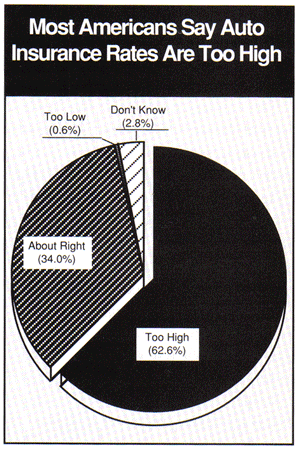
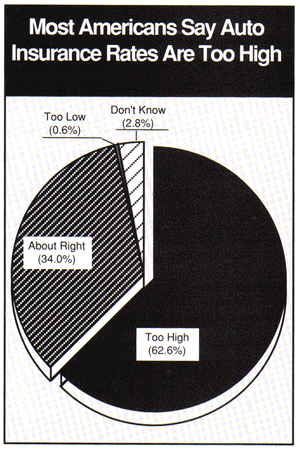
Most Americans think they pay too much for automobile insurance, according to a recent national Ameripoll survey by Maritz Marketing Research, Inc. The poll shows women are more satisfied than men with auto insurance premiums. Fewer females believe rates are too high, and more women than men say rates are about right.
The majority of Americans also believe the auto insurance industry needs more regulation. Sixty-one percent of respondents say further intervention is necessary to guarantee fair practices. Twenty-seven percent disagree, with 13% undecided. More men than women favor additional regulation.
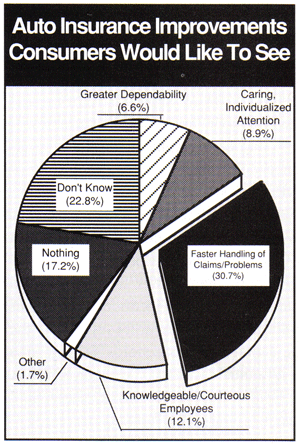
Other than price, responsiveness tops the list of improvements Americans would make at auto insurance companies. Thirty-one percent of respondents identify faster handling of claims and problems as top priority. Knowledgeable, courteous employees are an improvement 12% would make. Other areas include caring, individualized attention (9%) and greater dependability (7%). Aside from cost, 17% of respondents say there is nothing they would improve.
But despite rate concerns, 81% of those surveyed would recommend their auto insurance company to a friend. In fact, 30% say they are very satisfied with the service they receive, and half describe themselves as satisfied. Ten percent are neither satisfied nor dissatisfied.