
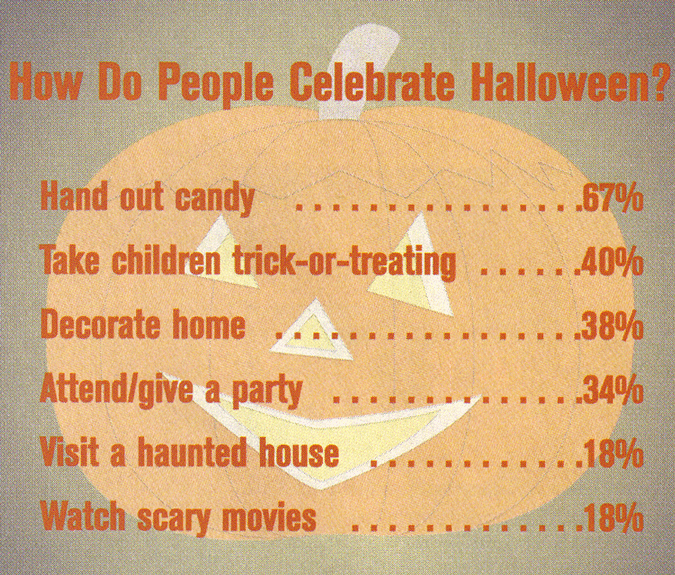
Adults love Halloween too
Sixty-one percent of Americans have someone in their household who participates in Halloween festivities, according to a Maritz Poll from Maritz Marketing Research Inc., St. Louis. While Halloween is typically thought of as a holiday for small children, 39 percent of those getting caught up in the Halloween hoopla are 45 and older. The survey also showed handing out candy, 49 percent; while taking children trick-or-treating, 27 percent; work, 26 percent; school, 7 percent. Almost half of respondents (48 percent) also have children in their household that will dress up in a disguise.
Half of them will buy their showed that participation increases slightly with income: 75 percent of respondents making more than $65,000 annually celebrate the scary event.
As October 31 approaches, there is a good chance you might see an adult sporting Star Wars-inspired apparel, an Austin Powers velvet suit, or even WWF spandex. That’s because 30 percent of adults celebrating Halloween said they wear costumes, the biggest group (65 percent) being 18-44 years old.
Following is a list of where they plan to don their Halloween ensembles: parties, 59 percent; while giving out candy, 49 percent; while taking children trick-or-treating, 27 percent; work, 26 percent; school, 7 percent.
Almost half of respondents (48 percent) also have children in their household that will dress up in a disguise. Half of them will buy their getup and their children’s, while 23 percent make their holiday attire. With all the candy, costumes, parties, and decorations that make up the Halloween celebration, it’s easy to see how the typical respondent spends about $40 on this holiday. Close to one-third (29 percent) of those participating in Halloween festivities spends more than $50. The biggest group of spenders? Twentynine percent of those spending more than $50 are 25-34 years old. Results are based on telephone interviews with American adults. Accuracy of the results is within +/-3.09 percent.
Travelers hate to wait
Although some American business travelers brush-off the recent bad press about airline performance and travel delays as "business as usual," most say that these and other events during business travel are quite stressful. According to a recent national survey of 1,000 U.S. households conducted by TNS Intersearch, Horsham, Pa., topping the list of travel stress factors is wasting time. Fifty percent of those surveyed admitted that waiting in line causes stress while traveling. Americans also overwhelmingly agreed that flight or train delays (42 percent), bad weather (40 percent), travel cancellations (37 percent) and overbooked planes (33 percent) top the list of travel stress factors.
Other causes of stress include: keeping up with personal life, 27 percent; driving, 26 percent; making your flight or train, 25 percent; driving in unknown areas, 24 percent; checking or claiming bags, 22 percent; packing, 21 percent; carrying luggage, 20 percent.
The study also revealed that men and women react differently to certain travel-related factors, while overall, 41 percent of Americans travelled on business away from home during the past year, more men than women traveled (53 percent of men traveled in the past year versus 30 percent of women). The most pronounced difference betwen men and women relates to waiting-in-line. Twice as many men as women reported that waiting in line is the most stressful aspect of business travel. Additionally, more men find it challenging to keep up with their persona lives. On the other hand, more women than men find their stress levels rising highest during packing, when flights or trains are delayed and when they are carrying luggage.
Respondents give lnternet research high marks
A look at research methodology by Cincinnati-based Burke Interactive has determined that respondents find the Internet a fast, friendly and functional tool for data collection. In a study of nearly 900 people - all with Internet access - Burke found that an online survey took respondents, on average, just 12.5 minutes to complete, compared with 19.4 minutes for a telephone survey. At the end of the survey, 33 percent of those completing the questionnaire online indicated they definitely would participate in future studies, compared with 18 percent of the telephone respondents.
"These results indicate that Internet surveys can be shorter and sweeter than phone surveys," says Jeff Miller, senior vice president, Burke Interactive. "Saving time is something that both the researcher and the respondent can appreciate, and the fact that participants are willing to help again adds to the appeal of Internet surveys." The study attempted to isolate differences in responses directly related to the survey method. Participants were recruited over the telephone using a random-digit dialing technique. Only those with access to the Internet were given an option to participate in the study and individuals were randomly assigned to take the survey using the Web or the telephone. Burke conducted 386 Web interviews and 500 telephone interviews for the project.
Other key findings from the study:
- The Web can be an excellent avenue for measuring opinions on social, political, or other sensitive issues. Survey findings, however, can be interpreted very differently depending upon whether a "don’t know/no response" option is included. If respondents are provided a "don’t know/no response" option in a Web survey, a significantly higher percentage will select it than do so in phone surveys - particularly on sensitive issues.
In most cases, there is not a compelling reason to include "don’t know/no response" options in Web surveys. If not ven this "out," respondents tend to answer the questions.
There was no greater tendency for Web respondents to terminate the interview if they were not provided these options, and these respondents actually responded more positively to the survey experience than Web respondents given the "don’t know/no response" option. - New-product demand forecasts might have to be readjusted if based on responses to Web surveys. Traditional purchase-intent surveys ask people if they "definitely will," "probably will," "might or might not," "probably will not," or "definitely will not" buy a new product.
Respondents to traditional phone surveys are more likely to use one of the extremes of the scale - "definitely will" or "definitely will not" - than are respondents to Web surveys. The study found, however, that question response options can be reworked in ways for which Web and phone respondents provide much more similar responses, opening the way for research progams to use combinations of phone and Web interviewing.
Despite the random assignment of respondents to cells, respondents who completed the survey over the Web tended to be more experienced Internet users than respondents who completed the survey over the phone. This suggests that any research on the Web is really done among a sub-sample of individuals with online access - those willing and able to make the necessary effort to complete the interview.
Barbecues not just for summer weekends
Eight out of every 10 adults grilled last year, according to a study by The NPD Group, Inc., a Port Washington, N.Y., research firm. People are grilling year-round, making barbecue grills one of the most popular heating appliances in the American home and creating new opportunities for marketers, reveals NPD’s latest "Grilling In America" report, a survey of 12,800 nationally representative households.
As consumers look for ways to simplify food preparation, more people are relying on their grills for fast, convenient family dinner meals. Seventy percent of grilled dinner meals take thirty minutes or less to prepare, compared to half of dinner meals overall.
In keeping with the changing needs of meal preparers, 31 percent of adults agree that grilling involves less cleanup, takes less time, and allows them to capitalize on convenience and health-consciousness without sacririfing taste, the number one reason that consumers grill.
"Americans turn to the grill for a few reasons," says Arnie Schwartz, NPD’s vice president of National Eating Trends. "While it adds taste varieties to the meal routine, it also makes life a little easier. There aren’t any pots and pans to clean up; the meals tend to be simpler; and if mom is clever, she can recruit dad to actually do the grilling since the numbers show that men cook on the grill more frequently than women."
This combination of taste and convenience is prompting Americans to fire up their grills throughout the week. Although grill usage skews more toward the weekend, especially Sunday, which accounts for 23 percent of all grilling, 60 percent of grilling takes place on weekdays. Nine out of every 10 grilled meals are prepared for family members only.
Summer months are peak season for barbecuing, but winter, spring, and fall are also popular. Surprisingly, growth is occurring in all regions during the winter season, with one out of every rive households grilling during the colder months. Gas grill users tend to grill more year-round than charcoal grill users.
While virtually all household segments have seen growth in grill usage over time, the research found that higher household income translates into higher grill usage. Of all the household segments polled, working parents have increased their use of the grill most dramatically over the past decade to become the largest sector of the population who grills.
Throughout the 1990s, the gas grill has advanced as the most popular type of grill. More households (over one-half) own gas grills than any other type of grill; 30 percent own charcoal grills and 14 percent own indoor grills.
The six most popular items for grilling account for two-thirds of all foods prepared on the grill. Steak (19 percent), chicken (15 percent) and burgers (13 percent), the top three, account for 47 percent. Hot dogs (8 percent) and pork chops (6 percent) are next on the list. One of the fastestgrowing foods grilled is potatoes, which doubled in popularity since 1996 (1996, 3 percent; 1999, 6 percent).
As Americans grow more accustomed to preparing their entrees on the grill, NPD predicts side dishes may provide marketers the next big opportunity. Despite potatoes’ grilling popularity, only 7 percent of dinner
meals include a grilled side dish.
"There’s an untapped opportunity to offer side dish products or packages that can be cooked on the grill, right next to the steak or chicken," says Schwartz. "Manufacturers who want to take advantage of this market should work towards creating goodtasting products that leave nothing to clean up afterwards."
The "Grilling In America" study is a combined study of more than 12,800 households surveyed from 1990 through 1999 by National Eating Trends, The NPD Kitchen Audit, CREST, and NPD Online. The sample is demographically and geographically balanced to U.S. Census Bureau statistics. Results are balanced to reflect total behavior across the U.S.
Study looks at e-shopping cart abandonment
"Click-Here Commerce 2000," a study of the success factors of online stores, has identified the source of the disturbing consumer disease: shopping cart abandonment syndrome. The research, by Shelley Taylor & Associates, a Palo Alto, Calif., consulting firm, found that online vendors, some of the hottest names in e-tailing, are responsible for the latest outbreak in customer frustration, anxiety and shopping cart abandonment, symptoms caused by poor Web site design. Further, the research has found that the disease is highly contagious and is spreading rapidly to business-to-business online purchasers.
The study evaluates 100 online stores - 70 U.S. and 30 U.K. - representing a cross-industry sample, including: apparel, books/CDs/entertainment, flowers & gifts, food & wine, health & beauty, home & garden, office supplies, pets, software, sporting goods and toys. Sites were evaluated using more than 350 proprietary evaluation criteria. Some of the online stores that have been evaluated include: Amazon.com, CDNow, Gigabuys.com, Nordstrom, Toys R Us, Victoria’s Secret in the U.S. and Boots, Debenhams, Thomas Cook, Waitrose and W.H. Smith in the U.K.
Web site content is extremely dependent on available navigation tools. If users cannot find needed information quickly and easily, the content - whatever its quality - is virtually useless. Only 8 percent of online stores provide telephone numbers on their home pages. Only 37 percent of U.S. and 50 percent of U.K. sites have a first-time user’s guide. The absence of pre-sale assistance is probably the No. 1 reason for shopping cart abandonment in the online store. Shoppers will simply leave without their desired goods if they don’t get answers to their questions.
The most useful product information to a critical shopper is most often neglected. E-commerce sites should therefore endeavor to provide multiple levels of product information and take advantage of traditional merchandising wisdom. Only 16 percent of U.S. and 3 percent of U.K. sites present customer reviews; even fewer provide third-party reviews. Only 8 percent provide feature/benefit comparisons of products.
A good way to frustrate and alienate customers is to have them decide to purchase an item and go through the trouble of entering credit card information - only to learn that the item is not in stock! Only 29 percent of U.S. and 13 percent of U.K. sites state whether products are actually available in the online shopping cart.
Post-sale product service and support determines customer loyalty. It gives customers the opportunity to voice their needs and creates a potent source of ideas for future product development. Building and sustaining relationships with existing customers creates the potential for repeat business and costs less than acquiring new customers. "Virtual" support must become actual support in order to create repeat business. Less than half of sites, 44 percent, contain some form of post-sale support. Only 14 percent of sites provide a direct link to a shopper’s order status on their global navigation bar and only 22 percent have a link on their home page.