
Don’t tip your hand when doing satisfaction surveys
Consumers who are notified in advance that they are to be questioned about a particular product or service are more likely to be critical when surveyed afterwards than are those who don’t receive such advance notification, according to research carried out by Chezy Ofir of the Jerusalem School of Business Administration at The Hebrew University of Jerusalem and Itamar Simonson of the Stanford University Business School. Their findings are due to be published in the Journal of Marketing Research.
The research was carried out under both laboratory conditions and in the field. Groups of consumers were tested for their reactions, some being notified in advance that they would be asked for their reactions and some not. "It seems logical to assume that consumers’ reactions will be more exacting regarding their experiences if they are asked for their reaction in advance," says Ofir. "One would predict that they will be more attentive to details at the time of purchase since they’re aware that theirevaluations should be based on solid information. This is in contrast to those consumers who have not been asked in advance for their evaluations, and whose reactions will be based only on vague recollections.
"Our research has proved, however, that one should not depend on what appears to be a commonsense assumption," Ofir says. "We found that notifying the consumer in advance that he will be asked for his reaction does not necessarily cause him to respond more accurately about the details of a product following purchase, but it does lead to him being more negative about it than if he had received no advance notification. This holds true both for products of known high quality, as well as for those of lower quality. And it is also applicable when the consumer is told that he should take into consideration both potentially positive as well as negative qualifies of the product."
Ofir explains that this tendency seems to come from the "tipped off’ consumer paying more than usual attention to his purchase, regarding it with a critical eye and looking for negative aspects more than he otherwise would have. And it is these details that seem to stick in his mind.
In some product and service areas, customers often expect to be surveyed in advance (hotel questionnaires, cars, educational programs, for example). Therefore, Ofir says, researchers should take the following points into consideration:
- It is preferable not to notify consumers in advance that they will be asked for their reactions regarding their satisfaction with a particular product or service.
- When such advance notification is given, one should factor in the tendency toward negativism in analyzing the results that are obtained.
- It is advisable not to do repeat surveys of the same consumers when one is trying to determine consumer trends. Such repeat surveys will always produce distorted results, the research found.
- When comparing results from different groups of consumers, one must take into consideration whether
any of them may have been aware in advance of their being surveyed.
Generally speaking, Western consumers have favorable expectations regarding products and services they purchase, and therefore negative aspects will stand out more than positive ones. Despite this, people in many cases still have highly positive responses when asked about goods and services they’ve used. This is not the case, however, when the consumer knows in advance he is going to be asked about a specific item; in such case, he pays much closer attention to judging the product or service and gives much greater weight to whatever negative aspects he may find in it.
This phenomenon was observed in questioning people in various settings, including shoppers at supermarkets and other stores, computer purchasers, visitors to museums, television viewers, students in courses and others. In one of the tests conducted by the researchers, consumers were asked to look only for negative aspects in what they were about to buy. In another test, consumers were told in advance to expect only poor service. As expected, these groups expressed dissatisfaction.
Control groups were approached in advance of purchase but were told only that they would be asked to express their leve! of satisfaction; their responses were similar in their dissatisfaction to those who were notified to look specifically for negative aspects or to expect poor service. This demonstrates how in any case prior notification results in a lower satisfaction level than one finds among consumers who are not told in advance that they are to be surveyed.
Non-buyers say Web sites still have influence
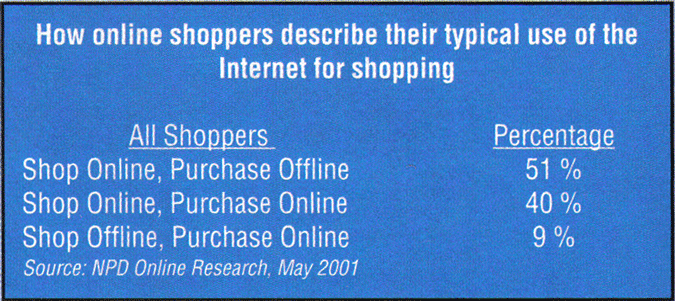
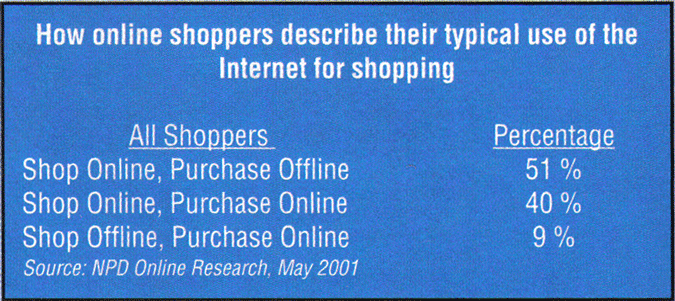
While online sales may not be increasing at the same rate they once were, shoppers are still surfing the Web. Ninety-two percent of online consumers use the Internet to shop and/or purchase online, according to E-tailers vs. Retailers, the newest e-Visory report from the NPD Group, Inc., Port Washington, NY.
The report shows that even those consumers who aren’t making purchases online are still influenced by what they see on retailer’s Web sites.
Eighty-four percent of occasional buyers, those who say they have made an online purchase only once in the past six months or less often, describe their unusual purchase, describe their usually use of the Internet for shopping as “I usually shop online and go offline to purchase.”
Measuring online sales alone cannot capture the full benefit of a retailer having an Internet presence. We know that even consumers who don’t typically purchase online are using retailers’ Web sites to browse and decide what to buy,” says Pamela Smith, vice president of NPD online research. “Although it may not result in a purchase at that time, it could translate directly into an offline sale.”
The report also focuses on the consumers’ reaction when presented with more than one way to purchase from particular channels. Consumers who currently shop at mass merchandisers say they will likely remain more loyal to traditional store locations for future purchases, while others who have traditionally shopped through catalogs say they are turning to the Web to make more purchases.
Beijing choice not a winner
Fewer than one in 10 Americans consider Beijing an excellent choice as a host site for the 2008 Summer Olympics, and almost three in five give it negative marks (59 percent rate it an only fair or poor choice), according to research from Ipsos-Reid. Two-thirds of people age 45 and older (68 percent) give the choice negative marks, as do half (50 percent) of adults under age 45.
Toronto would have been the first choice of almost half (46 percent) of all Americans, far outpacing Paris (which places second), Beijing, Osaka and Istanbul. Paris generates a gender gap, with 23 percent of women but only 14 percent of men preferring Paris.
Preference for Toronto is greatest among American adults in the regions where Toronto is more accessible to Americans in the Northeast (53 percent make Toronto their first choice) and the Midwest (51 percent). Preference for Toronto is lower where Toronto is further away, in the South (40 percent) and West (43 percent).
When asked to specifically focus on the politics of the choice (setting aside the issue of whether Beijing can handle the logistics of hosting an Olympics), half (55 percent) assess this as a bad choice rewarding bad behavior on human rights, rather than a good choice that could promote reform and a new opening of China to the world. Republicans (61 percent) and adults age 45 and older (60 percent) are especially negative.
Few (35 percent) have much confidence that China will improve its human rights record. Among those who think Beijing was an excellent or good choice, 64 percent have at least some confidence that China will improve its human rights record as a result of getting the games. Among those who think Beijing was an only fair or poor choice, 81 percent say they have little or no confidence that China will change its behavior.
Reality TV: why do we watch?
What fuels the phenomenal success of Survivor, Big Brother and a host of other so-called reality programs? Through an online survey of more than 2,100 television viewers, E-Poll, Encino, Calif., asked the people who love and/or hate (and sometimes love to hate) reality TV what motivates their viewing of this genre and what specific show elements separate the hits from the misses.
The appetite for reality TV remains especially strong for the "committed" viewer (those who "make a point, to watch" reality TV): 92 percent of this group are open to watching new reality shows, sffxing into three levels ofinterest - those who say "the more, the better" (39 percent), those interested in watching one or two new reality programs (36 percent), and those who will only watch if the show is as good or better than their favorite reality show (17 percent).
While 61 percent of "casual" reality TV viewers (those who "sometimes watch") are open to watching a new reality show, this group is more discriminating in their tastes, with 23 percent willing to watch a new show only if it’s as good as or better than their favorites. Thirty-nine percent of this "casual" group has no interest in watching a new reality show at all, which means that the number of people available to sample a new show is shrinking. Producers will have to pay even closer attention to viewer needs and desires if they want to capture this increasingly elusive audience.
As with audiences of other TV genres, the reality viewer watches for involvement: identification with contestants and playing along with the TV game. The top two reasons for watching, among both committed and casual viewers, are "guessing who will win/be eliminated" and "seeing real people face challenging situations." Interestingly, one of the lower-ranking reasons for watching was "romance/ relationships among contestants," perhaps why the relationshiporiented shows failed to have the trajectory of Survivor.
"Moral" concerns - the perceived trashiness of the content and the unappealing human values these shows present- are among top reasons given by those who do not watch reality TV. Fifty-five percent of non-viewers chose "too trashy or low-class" as one of their reasons for avoiding reality TV, 49 percent chose "don’t like the human values/traits they present," 38 percent believe that "contestants are just trying to get famous," and 33 percent find the shows "too voyeuristic" (multiple selections were allowed).
One finding which turned up across several questions was a very clear audience concern over potential fakery involved with these shows. Thirty-five percent of non-viewers have rejected reality TV because they believe "the shows are fake or rigged." This sentiment is also reflected in an unprompted open-end question asking for the "one biggest complaint about reality programs." The #1 most-cited complaint (mentioned by 20 percent of the entire sample) was a concem over fake, scripted, and staged situations.
Viewers seem less tolerant of allowing reality contestants their 15 minutes of fame: 44 percent said they felt contestants were flat-out boring, while another question found that 38 percent of non-viewers cite "contestants just trying to get famous" as reason for avoiding the genre altogether. And, similar to the prior point, viewers brisfie at phoniness: 45 percent of the total sample claimed "phony/over-dramatized situations" led to them rejecting a reality show they had sampled.
German internet audience world’s most heavily male
More than 63 percent of the Intemet audience in Germany is male, making that country’s online community the most predominantly male of the 26 countries measured by Nielsen//NetRatings, Stamford, Conn. In contrast, the audiences in the U.S. and Canada are the only audience's in the world where females are the majority, while Asia-Pacific is experiencing strong growth in the number of women on-line.
"Germany is an established Intemet market with the third-largest Internet universe in the world," says Richard Goosey, chief of measurement science and analytics, Nielsen/NetRatings. "Where are the women in this market?"
In June, German men spent nearly eight-and-a-half hours online during 18 online sessions, while German women spent seven hours online during 14 sessions. "Surprisingly, for an audience so heavily skewed towards men, sites mainly focused on sports were the second-least popular category in Germany in June," Goosey says. "Followed only - not as surprisingly - by family and lifestyle sites, which were the least popular category last month."
Goosey also pointed to France, where the Interact audience was nearly 62 percent male. "The time difference in Interact usage between the genders in France was much more pronounced in France," he says. "French men spent more than eight-and-a-half hours online across 19 sessions, while French women spent haft as much time online - just over four-and-a-half hours across 11 Internet sessions. French women are obviously not as enamored of the Intemet as their male counterparts."
On the other hand, a Nielsen/NetRatings study of women’s Internet activity in Asia-Pacific found that females in that region - while still in the minority - are fast gaining ground on their male counterparts. That study found that since January of this year, the number of female surfers has grown an average of 36 percent across the region, with the number of Korean women online increasing 55 percent, followed by Taiwan at 27 percent, both Singapore and Australia at 16 percent, Hong Kong at 11 percent and New Zealand trailing the region at 10 percent.
In both Germany and France, telecorn and Internet services Web sites were the most popular category, reaching nearly 80 percent of the active audience in both markets. In France, despite the heavily male audience, certain categories that would be expected to attract male Intemet users, such as sports and automotive sites, ranked very close to the bottom of the category list for June, attracting well under 10 percent of the active audience.
In contrast, the U.S. and Canada were the only markets where females comprised the majority of the Intemet audience in June. In the U.S., where 52 percent of the audience was female in June, the time spent online by each gender was more even - 10-1/2 hours for men and just over nine hours for women. Search engines, portals and online communities were the most popular category in the U.S. The first category that could be construed as favoring one gender - computers and consumer electronics - ranked sixth on the list of most popular U.S. categories, attracting 24 percent of the active audience. Family and lifestyle Web sites, which would be expected to bring in female suffers, was the eighth-most popular category, attracting 17 percent of the active audience.