
DTC ads work
One out of four consumers reported that direct-to-consumer (DTC) advertising prompted them to call or visit their doctor to discuss the prescription drug they saw advertised, according to a PharmTrends study. The PharmTrends study, based on a survey conducted among 26,000 individuals by marketing research firm Ipsos-NPD, found that 47 percent of the U.S. representative sample population have seen advertising for prescription medication products in the 12 months prior to the study, which fielded in February 2002.
"The consumers confirmed that direct-to-consumer advertising gives them information to take better control of their personal health care," says Fariba Zamaniyan, director and spokesperson for Ipsos PharmTrends. The study, conducted and paid for by Ipsos PharmTrends, also found that:
- 25 percent of respondents stated that direct-to-consumer advertising educated them of alternate drug options for their condition(s).
- 15 percent of respondents stated DTC advertising prompted them to request the prescription drug they saw advertised from their doctor.
- 6 percent of respondents were prompted to switch from current drug therapy to a different drug that they saw advertised.
"Advertising can be beneficial not only to drive Rx branded drug awareness to ultimately encourage trial but also serves as a reminder for patients to comply with their doctor’s instructions to fill or refill their prescriptions," Zamaniyan says. Just over one in 10 of respondents (13 percent) stated that advertising reminded them to refill a prescription for a drag they are currently taking.
"Consumers are telling us that they like receiving information about their health care options. The key to successful Rx advertising is whether or not the ads prompt an action by consumers and generate prescription fulfillment," Zamaniyan says.
Consumers who purchase Rx drags as part of their treatment regimens report high levels of ad recall for that Rx medication, reports PharmTrends. For example, Viagra tops the list for ad recall among buying consumers. Ninety-five percent of the consumers who purchased Viagra recalled seeing an ad for the brand.
"With more ’blockbuster’ brands going off-patent over the next few years, it will be more important than ever for drug manufacturers to raise the bar on awareness for existing and upcoming formulations," Zamaniyan says. "Consumers are receptive to what drug manufacturers have to say about their brands, particularly if they or a family member suffer from the ailment. Drug companies who can use DTC advertising effectively to convert consumers to well-informed buyers and build longterm loyalty and persistent behavior will be most successful in extending the life of their brands. These companies should continue to support the use of DTC advertising in their market."
During the month of February, 2002, Ipsos PharmTrends interviewed a representative sample of over 26,000 adults 18+ years of age nationwide using InstaVue, an omnibus mail survey. The study was conducted and paid for by Ipsos PharmTrends.
Awareness of satellite radio high
Less than a year on the market, and with only one service fully operational, satellite radio appears to have captured broad-based awareness among Americans as an altemative to broadcast radio. New findings from Minneapolisbased research firm Ipsos-Reid show that nearly half (47 percent) of the American population aged 12 and over are aware of satellite radio services such as XM or Sirius Satellite Radio. This translates into over 100 million people within the current U.S. population (2000 U.S. Census figures), according to data from the company’s quarterly study examining consumer digital music behavior, TEMPO 2002: The Digital Music Tracker.
The two aforementioned companies have spent an estimated $1.5 billion on a complex satellite broadcast network offering both original and pre packaged digital music, news, sports and talk programming that can be heard anywhere in the U.S. in cars and home radios. The services promise superior sound and transmission quality, and fewer or no commercials. While satellite radio is still very much in the early stages, some industry experts predict that as many as 25 millionAmericans will be paying for this service by the end of the decade.
Twenty- and 30-something males are most likely to be aware of satellite radio services, as approximately three-fifths of 18-to-34-year-olds report they have heard of these new radio services (60 percent of 18-to-24-year-olds, and 57 percent in the 25-to-34 age group). Other age groups hold strong awareness levels as well, however. Nearly half of both U.S. teenagers and baby-boomers (47 percent of both 12 to 17 and 35 to 54- year-olds), and one-third (33 percent) of Americans aged 55 and older indicate they are aware of this recently launched technology, which requires the purchase of satellite-enabled audio hardware and a monthly subscription fee for operation.
Interestingly, American men are significantly more likely to be aware of satellite radio than American women are: roughly three-fifths (59 percent) of U.S. men aged 12 and older claim to have heard of this new radio broadcasting system, compared to only 34 percent of American women.
"Despite the relatively recent roll-out of satellite radio services in the U.S., awareness levels are surprisingly strong among the general population, especially among men in their 20s and 30s," says Matt Kleinschmit, a senior research manager for Ipsos-Reid and the TEMPO research initiative. "Moreover, this awareness exists despite the fact that there’s only one provider fully launched and heavily advertising. With Sirius scheduled to be fully operational nationwide in early July, we anticipate further gains in the awareness levels regarding the technology in general - as well as regarding the individual providers - as competition for consumers’ attention and wallet increases."
Not surprisingly, Americans who frequently purchase music are significantly more likely than non-music purchasers are to be aware of satellite radio. Roughly half of recent CD purchasers report being aware of satellite radio (53 percent of Americans aged 12 and older who have purchased two or more prerecorded compact discs, and 49 percent of who have purchased one compact disc in the past 6 months), compared to only 35 percent of Americans who have not purchased any compact discs in the past six months.
Data on Satellite Radio awareness was gathered from TEMPO 2002: Keeping Pace with Online Music Distribution, a quarterly Ipsos-Reid shared-cost research study examining the ongoing influence and effects of digital music around the world. Data for this release was collected between April 25 and May 1 via a nationally representative U.S. sample of 1,113 respondents aged 12 and over.
"Whether the currently strong awareness levels will translate into subscriptions for both XM and Sirius remains to be seen, but certainly the pump has been primed," says Kleinschmit. "Clearly, many in the general population - music enthusiasts in particular - are aware that this new radio service exists, and as new automobiles with satelliteenabled audio systems move from the showrooms to the streets, many may become de-facto subscribers through bundled leasing agreements and financing plans."
Teenagers fuel sports drinks brand wars
Brand name does make a difference when it comes to choosing a sport drink. Since the arrival of sports drink beverages, consumers have seen the overwhelming presence of market leaders such as Gatorade. But the past few years have showed that more than one product can make an impression. This recent market invasion allows younger consumers to have choices when selecting their brand, while older consumers might be accustomed to what they are used to. According to The Sports Drinks Market report from Chicago-based Mintel Consumer Intelligence, when comparing attitudes of adults to those of teens, only one third of adult respondents said that they see different benefits between brands while half of teen respondents felt that this was true. Another industry movement in this market is the consumption of sports drinks as an "anytime" drink rather than just for exercise. Nearly 60 percent of adults and three-quarters of teens see the beverage as being in the refreshment arena.
Consumers have reacted to the increase in product development in the drinks industry by now constantly looking for novelty and variety in beverages. As the sports drinks category matures and evolves, a host of related products are coming out and new categories are being created. Energy drinks appeal to many of the same core of young male consumers, although offering a much different package of benefits. New flavors and enhanced water products are blurring the line between bottled water and sports drinks with sports drink giant Gatorade one of the leading manufacturers of these new water brands. These new products will help further broaden the appeal of sports drinks, or certainly that of sports drink-like beverages, both in terms of usage occasions for existing products and helping bring new consumers (especially women) into the larger sports drink environment.
The most promising element of research regarding future growth of sports drinks, then, is the relatively high levels of interest in the category among female teens. They are not heavy consumers, but unlike the adult market, where women are not significantly attracted, female teens are only slightly behind their male contemporaries. Another positive sign is that teen girls say that they like the new flavors that have hit the market in 2001-2002 at rates much higher than for teenage boys. Teen results for sports drinks are substantially higher than that for adults: while just about half of adults surveyed have consumed sports drink, 79 percent of teens say that they have used the product. Heavy users - who take sports drinks four times per week or more - are almost three times more likely to be found in the teen sample than in the adult one. In the medium category (one to three times per week), teens are again three times more likely to consume than adults. And while 54 percent of adults have never consumed sports drinks, only 21 percent of teens respond similarly. Finally, those age 12-17 are also substantially more likely to be users than the youngest adult group, age 18-24, indicating that the core user group is age 12-24, and possibly younger.
Given the long-term marketing strategies of the major players, it should be no surprise that research finds this category to be heavily skewed towards male consumption. A huge 60 percent of men have ever consumed the products, almost twice as high a rate as for women. Men are also much more likely to be frequent consumers (once per week or more) while women have barely started to register with the category. Indeed, a large majority of women users do so less than once a week. These results imply that the easiest way for the category to grow is by appealing to women, as market penetration among men is probably approaching a practical limit, though certainly current users are prime targets to increase usage.
Mintel estimates that the retail market for sports drinks will near $3 billion in 2002, up 8 percent from 2001. By the year 2007, Mintel projects that the market will be worth over $4.1 billion. This is a significant rate of growth compared to other foods and beverages, but it is down from the spectacular growth rates notched by the category in prior periods.
College students spend $200 billion per year
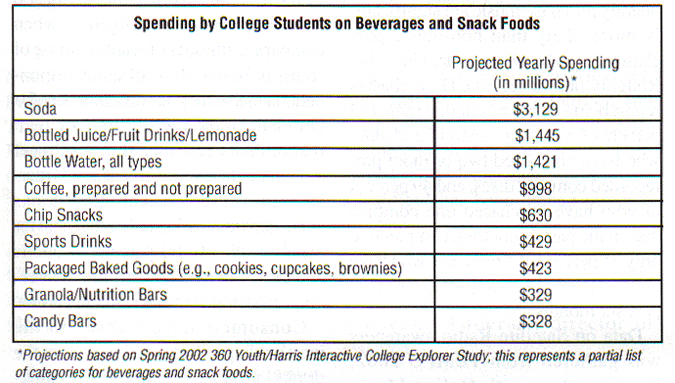
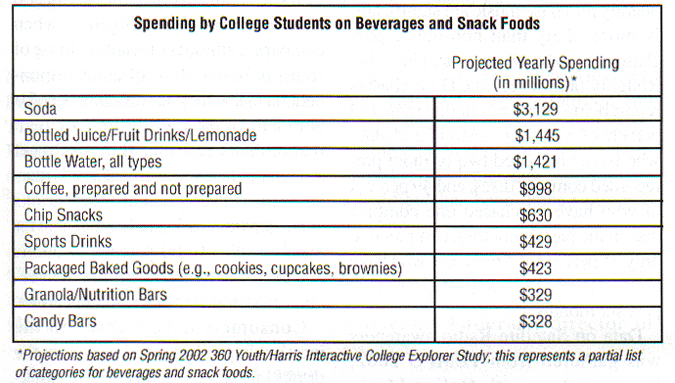
Findings from the 360 Youth/Harris Interactive College Explorer Study demonstrate the power of the U.S. college market, with spending at nearly $200 billion dollars a year. It is a large and influential market, with over 15.6 million students, and is a vital segment for marketers concerned with serving the needs of young consumers. The national study, fielded online by Rochester, N.Y.-based Harris Interactive during the spring 2002 semester, measured spending among college students aged 18-30, a group that represents 72 percent of all college students. The sample included all types of students (fulltime, part-time, two-year, four-year, graduate) and looked at a range of consumer behaviors and category buying habits. The study covered technology, entertainment, travel, transportation, telecommunications, personal care products, financial services, snack foods and beverages.
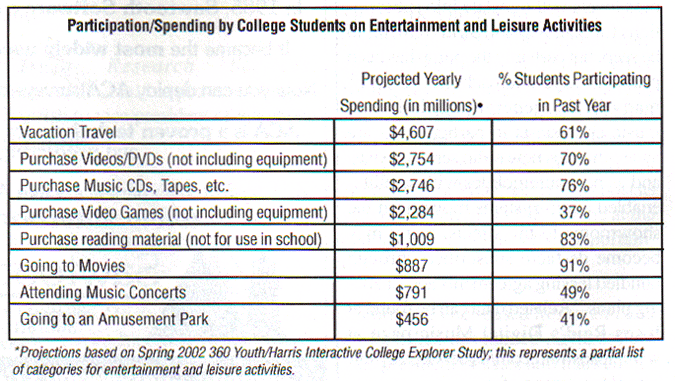
According to the study, college students spend an average of $287 a month on discretionary items (spending on anything other than tuition, room/board, rent/mortgage, books/school fees). A good portion of that discretionary spending is on beverages and snack foods, with total spending on those categories projected at $11.4 billion per year. Including weekend days, college students average 11 hours per day of unscheduled time (when they’re not sleeping, working, studying or attending class). It is not surprising then, that spending on entertainment and leisure activities represents a significant portion of discretionary spending.
Technology, and, therefore, spending on technology, plays a central role in the lives of college students. With 93 percent accessing the Intemet, college students are the most connected segment of the population. Ninety-two percent own a computer, and 13 percent say they plan to buy one in the next year. Cell phone ownership is at 69 percent, with 18 percent of students planning to buy one in the next year. Fifteen percent of college students say they are among the first to buy a new technology device or gadget, and another 53 percent say they are likely to buy one after seeing others try it. Only 32 percent say they tend to wait a long time before purchasing a new technology.
Car ownership is another important consumer behavior among this group. Whether they live on or off campus, 80 percent of college students have a vehicle for their personal use. Seventy-one percent of those that have a car either own it individually or jointly with a spouse, with only 29 percent using a car owned by a parent or other relative. Seventeen percent of students say they plan to buy a vehicle before the end of
2002.
The 360 Youth/Harris Interactive College Explorer Outlook Study is an online college survey from 360 Youth, Inc. and Harris Interactive. The study is conducted online twice yearly (fall and spring semesters) completing a minimum of 6,000 interviews annually with both college students (two-year/four-year, full-time/part-time, undergraduate/graduate) and 18-24 year-olds not enrolled in college. Data in this release were collected in April 2002. Complete data from this study are available on a subscription basis.
Canada’s credit card mail volume hit all-time high in 2001
2001 was the biggest year ever for credit card solicitations sent to Canadian households, reaching a record high of 208.3 million offers. This represents a 6 percent jump over Canada’s 2000 annual mail volume of 196.7 million, according to Mail Monitor, the direct mail acquisition tracking service from BAIGlobal Inc., Tarrytown, N.Y.
"This is the highest mail volume we’ve seen since Mail Monitor first began tracking Canadian credit card offers three years ago," says Andrew Davidson, vice president of competitive tracking services for BAIGlobal. The record high volume in Canada followed a similar trend in the U.S., where 2001 mail volume hit an alltime high despite terrorist threats, anthrax fears and an economic slowdown.
According to Davidson, Canada’s record-breaking mail volume is the result of several factors, primarily a renewed emphasis on platinum card offers and a high number of mailings from U.S.-based monoline companies now operating in Canada. (Monoline companies offer credit products, yet do not have retail banking locations, and include such firms as MBNA and Capital One, among others.)
The majority of mailings offered platinum credit cards to Canadian households. "Most Canadian cardholders now own either a standard or gold card. Yet most of the new credit cards solicitations were for platinum cards," says Davidson. "Out of 208.3 million offers received by Canadians in 2001, 67 percent were for platinum bank cards, compared with 14 percent for gold bank cards, 11 percent for standard bank cards, and 8 percent for other types of offers, such as Diners Club and American Express cards."
While the majority of Canadian cardholders now own cards through their local retail banks, most of the card solicitations mailed in Canada were from U.S. monoline companies. "U.S. monolines accounted for 64 percent of all offers to Canadian households during the fourth quarter of 2001. This was up from 51 percent for the previous quarter," says Davidson. Among these solicitations, the majority of offers were for platinum cards, which supported the overall trend towards platinum as issuers attempted to upgrade standard and gold cardholders.
The average response rate for 2001 was much higher in Canada than in the U.S., with a 1.4 percent annual response rate for Canada compared to 0.6 percent for the U.S. Davidson attributes this to several factors: the lower level of clutter in Canadian mailboxes, consumers’ continuing need for credit and attractive pricing. "Typically, as the volume of mail increases and mailboxes become more cluttered with offers, response rates drop," says Davidson. "The Canadian market is still much less cluttered than the U.S. For instance, in the fourth quarter of 2001, 63 percent of Canadian households received an average of 2.6 offers per month, compared to the same period in the U.S. where 79 percent of households received an average of 5.4 offers each month. The lower level of clutter in Canada helped make the full year response rate much higher than the U.S."
In addition, there was a fourth quarter surge in response rates in Canada. "Often consumers seek out additional credit in anticipation of holiday shopping, and as the Canadian prime rate dropped, offers with variable APRs became very attractive," says Davidson. "These factors, plus the
ongoing demand for credit in a slow economy, made quarterly response rates peak in the last months of 2001."