Some bank tellers come up short
In a survey conducted by New York-based Barry Leeds and Associates, bank customers reported that many tellers and bankers did not take extra measures to assure rapport with them. Two out of three customers indicated that tellers addressed them by their name, while 78 percent indicated the use of their name by a banker. Also, 68 percent of customers reported that the teller did not discuss any additional needs, while 53 percent said the banker did not discuss any additional needs, therefore limiting cross-sell potential.
The study reports that 96 percent of customers meeting with a teller indicated that the teller completely satisfied their needs and 94 percent stated that the teller gave them full attention. Concurrently, 94 percent of customers meeting with a banker said the banker completely satisfied their needs and 97 percent indicated that the banker gave them full attention.
Additionally, customers indicated that both bank tellers and bankers were knowledgeable, courteous and handled the transaction accurately.
When asked, "How satisfied are you overall with your bank?" 62 percent of customers indicated that they were completely satisfied. Most (84 percent) said that they are very likely to maintain their current accounts and 74 percent are very likely to recommend their bank to someone that they know.
In order to exceed customer expectations, a bank must compensate where other banks have failed. Exploring and satisfying customers’ additional needs, cross-selling appropriate products, developing a closer relationship with customers and improving customer rapport are the key ingredients necessary to make a significant impact on customer satisfaction.
Barry Leeds and Associates conducted the study in June among consumers that visited a branch in the last two weeks. Consumers were selected at random and interviewed by telephone.
No such thing as loyalty?
Customer satisfaction as a measure is a myth, says market research company CrestwoodAssociates following a recent survey it conducted. The survey questioned whether customers have any loyalty to merchants who satisfy their needs but offer no added or unexpected value.
Sixty-five percent of customers surveyed said they continue cross-shopping alternative vendors even if a particular vendor meets their expectations for customer service and value. Crestwood Associates’ Edgar Kully contends that customer satisfaction, the much-measured benchmark of company service and likely success, has become little more than a commodity and should be considered as such by marketers.
"The absence of negatives is not a positive," Kully says, citing additional survey results that over half of consumers (56 percent) place higher value on a company that "keeps doing more and is trying to get better" than one that simply "doesn’t make mistakes." That’s because customer satisfaction, as a measure, doesn’t really measure true satisfaction, he says.
Customer loyalty, based on satisfaction, is another myth, according to Kully, and the proof of this is that most consumers who use and carry supermarket loyalty cards have several of them - so they can shop where it’s most convenient. Customers carry multiple cards to obtain discounts and promotions. They don’t carry them with the belief they’re being rewarded for shopping a particular store often or more frequently than other supermarkets. The myth is that the grocers believe they are rewarding loyalty. The reality is they are conditioning customer behavior by making them use cards to obtain discounts.
Results are based on telephone interviews with a randomly selected national sample of 1,657 adults, ages 18 and older, conducted in November and December 2002.
Back-to-school expenditures up this year
Consumers planned a trip back to the stores before sending their children off to school this year, according to the fmdings of a National Retail Federation (NRF) survey. The NRF 2003 Back-to-School Consumer Intentions and Actions Survey, conducted by BIGresearch for NRF, found that families with school-aged children were planning to spend an average of $450.76 on back-to-school items, up from $441.60 in 2002. Spending for the back-to-school season was estimated to pump $14.1 billion into the economy, with kids adding another $750 million to the total.
Nearly every family with school-aged children intended to purchase clothes, shoes and school supplies this year (95 percent, on average), with almost half of consumers (45.7 percent) planning to buy electronics or computer-related equipment as well.
The average consumer expected to spend $206.24 on clothing, $84.44 on shoes, $74.04 on school supplies and $86.03 on electronics and computerrelated equipment.
NRF projected a 4.5 percent growth in GAFS sales (general merchandise stores, apparel stores, furniture and home furnishings stores, electronics and appliances stores, and sporting goods, hobby, book and music stores) in the second half of 2003, up from 2.2 percent in the first half. NRF partially credits the boost in back-toschool spending to the $13 billion in tax credit checks that were sent to more than 25 million families.
Kids and teenagers also planned to hit the stores before heading back to school. Nearly half of parents (43.6 percent) said their teenagers would be spending their own money on back-to-school items. Teenagers who were to spend their own money planned to spend an average of $62.71, according to parents. Also, 26.0 percent of parents said that their 6-12-year-olds would spend their own money. The average amount of their own money spent by a 6-12-year-old is $32.63.
Most consumers shopping for back-to-school items shop at discount stores (78.1 percent). Many consumers also planned to purchase products at department stores (49.5 percent) and office supply stores (31.9 percent). Also, 20.2 percent planned to purchase goods at specialty stores and 16.4 percent will shop at drug stores.
The survey, which polled 8,835 consumers, was conducted for NRF by BIGresearch from July 2-9. The consumer poll has a margin of error of +/-1 percent.
Connecting trend drives stationery market
A new research study from Unity Marketing points to connecting as the next major trend on the consumer horizon. Connecting relates to consumers’ need to reach out and communicate meaningfully with others, using everything from electronic networked communications to paper greeting cards to a handwritten note on hand-laid paper.
The study, entitled "Stationery & Greeting Card Report, 2003: The Market, The Competitors, The Future Trends," cites connecting as key driverof the $14 billion stationery and greeting card market. "Consumer trends reflect the emotions of the times, and our time is all about reconnecting to the outside world after spending the past decade wrapped up in our personal ’cocoons,’" says Pam Danziger, president of Unity Marketing and author of the study.
"The consumer psychology of the ’90s gave rise to conspicuous consumption and a passion for collecting more and more stuff to fill up our ’nests.’ In the new millennium, however, consumers are focusing on enhancing their relationships with others. So the collecting frenzy of the ’90s morphs into a passion for creatively collecting and sharing one’s memories through scrapbooking."
Scrapbooking is an important new consumer passion that is just emerging on the horizon. With a sales jump of 29 percent in 2002, scrapbooking is the fastest growing segment in the stationery market, with $1.2 billion in consumer sales.
Despite vibrant growth, the scrapbooking market has only begun to hint at its full potential. Today only 20 percent of adult consumers have purchased scrapbooking supplies in the past year, trailing behind the 67 percent of consumers who bought greeting cards; 61 percent who bought gift bags and wraps; 44 percent who bought calendars; and 37 percent who bought boxed greetings, notes and invitations.
"Scrapbooking is a hobby that uniquely fits our stressful post-9/11 era," Danziger says. "It creatively connects families with their past, present and future. Its appeal crosses generations, genders and age ranges. Key to the future success of the scrapbooking market will be its ability to make the quantum leap from the niche-focused craft market into the mass-market realm. The Michael’s craft chain just opened the first of a chain of stores devoted to scrapbooking, called Recollections. This launch may broaden exposure beyond the traditional crafting market and bring scrapbooking into the mainstream where it will really blossom."
Today with all the major greeting card brands, like Hallmark and American Greetings, firmly entrenched in discount channels selling greeting cards in the 99 cents or under price range, the industry has sunk to the bottom of the pricing specmnn and little future growth will be achieved at these depths.
But the luxury realm of specialty paper, including handmade paper cards, specialty stationery, books and journals along with luxury writing implements, offers marketers significant growth opportunities. "Writing and receiving a beautiful hand-written note is the ultimate expression of luxury communication. The New York specialty store Kate’s Papefie, which offers a selection of over 4,000 luxury paper products, perfectly reflects the trend toward luxury stationery and personal connecting in the market today," Danziger says,
"Our survey of some 50 stationery companies identified a huge missed opportunity in the marketplace: less than 10 percent of the stationery companies surveyed offer products to the scrapbooking market. Stationery companies need to venture beyond their comfort zone of greeting cards and traditional stationery products to capture some of the dynamic growth and market potential available in the scrapbooking trend," Danziger says.
Electricity providers top satisfaction ratings among utilities
Although Americans are generally satisfied with the service provided by their utilities, electricity providers receive the highest marks, according to a study by Opinion Research Corporation, Princeton, N.J. Of the three major utilities - electricity, water and local telephone - with very widespread (i.e., at least 87 percent) usage across the country, customers are most satisfied with electric companies (69 percent), followed by water (65 percent) and local telephone service providers (60 percent). Satisfaction is defined as rating the utility an 8, 9 or 10 on the 0-10 scale. At the bottom end of the satisfaction scale, dial-up Intemet users reported only a 36 percent level of satisfaction.
Among the other findings of the study:
- Long-distance telephone service, with an 80 percent usage by Americans, achieved a 52 percent satisfaction level. Southern customers (58 percent) are most satisfied with service they get from their long-distance phone carrier.
- Customers in the South (66 percent) and Northeast (65 percent) are more satisfied with their local phone service than those in the Midwest (55 percent) or West (52 percent).
- Although fewer Americans use DSL/cable modems than dial-up services to connect to the Intemet (33 percent vs. 46 percent), the level of sarisfaction among DSL/cable users is notably higher (53 percent vs. 36 percent).
The Utility Satisfaction study was conducted by Opinion Research Corporation’s CARAVAN among a nationally representative sample of 1,015 adults 18 and older. The survey was conducted February 21-24. The margin of error for the percentage using each utility is +/-3 percent. Satisfaction ratings have a margin of error from +/-3 percent for local phone and electricity to +/- 7 percent for oil, at the 95 percent confidence level.
Wi-Fi not taking off yet
While consumer awareness of Wi-Fi hot spots has reached a fairly high mark, the market for these services has not grown beyond today’s business travelers, according to "Public Hot Spots: One Truth and Two Myths," a new white paper released by Parks Associates, a Dallas research firm.
The white paper offers consumer perspectives on public Wi-Fi hot spots, gathered from a survey conducted by Parks Associates which asked Internet households about their usage history and interest in hot spots, as well as their work-related travel habits, and found that 90 percent of the people interested in using hot-spot services travel nationally for professional purposes.
"Road warriors and business travelers are likely to be the early adopters of hot-spot services - the industry has that one right," says Yuanzhe (Michael) Cai, research analyst with Parks Associates. "However, the frequently quoted market inkibitors such as limited coverage and poor consumer awareness only tell part of the story. Service providers have to re-examine their value propositions and customer services. In addition, they should not overlook narrowband Internet users."
Among the white paper’s conclusions is a challenge to the common industry ideal "build it and they will come." Whereas more than 60 percent of U.S. Intemet households are aware of hot spots, only a small fraction have used the services. Also, broadband was not a differentiator in terms of interest in hot spots. Broadband and narrowband Interact users reported similar usage rates regarding hot-spot services, and the difference between their levels of interest in adopting the services is not overwhelmingly significant.
Based on consumer surveys and interviews with service providers, Parks Associates estimates the 2003 service revenues for hot spots will be $105 million. Further, the firm estimates that the U.S. hot-spot service market will exceed revenues of $800 million by 2007. The compound annual growth rate (CAGR) between 2003 and 2007 is approximately 50 percent.
Broadband users are big shoppers
A study by New York-based Scarborough Research shows that American adults with at-home broadband connections accounted for almost one-third (31 percent) of all consumer online spending last year totaling 15 billion dollars. At home broadband users - those who used an ISDN, DSL technology or a cable modem to access the Interact in the past 30 days - currently represent 19 percent of online adults. America’s 23 million broadband users are twice as likely as all Internet users to have spent $2,500 or more online in the past 12 months. Broadband users are 39 percent more likely to purchase jewelry online; 64 percent more likely to purchase toys and games online; and 64 percent more likely to purchase cars, trucks and SUVs. Furthermore, broadband users are more likely to use the Interact to view traditional media content than other Interact users. This escalating category of Interact users is the next generation of Web users and information seekers.
Broadband users are 68 percent more likely than all Interact users to have read a magazine online and 40 percent more likely to have read a newspaper online in the past 30 days. One-fifth (20 percent) of broadband users listened to the radio online in the past 30 days, making them 72 percent more likely than all Interact users to do so. As compared to all Interact users, broadband users are 42 percent more likely to have visited a broadcast television network Web site in the past 30 daysand one-third (33 percent) more likely to have logged onto a local television station Web site. They are also 45 percent more likely to have accessed Interact yellow pages in the past 30 days.
"Traditional media Web sites, which have often been perceived mostly as extensions of their broadcast or print counterparts, are able to provide richer online experiences to those with broadband connections and offer rich content like streaming audio and video, interactive games, and sophisticated graphics and downloads," says Gary Meo, senior vice president, Interact and print sales, ScarboroughResearch. "Their ability to integrate traditional content with rich media also allows online marketers to present advertising in new and exciting formats. The continued adoption of broadband is one of the key drivers of the advertising growth that online companies have been experiencing this year."
Compared to all Interact users in the U.S., broadband users are welleducated (12 percent more likely than all adults accessing the Interact to hold a college degree and 17 percent more likely to have a post-graduate degree) and affluent (32 percent more likely than total Interact users to have household incomes of $75,000 or more). Slightly more than a quarter (26 percent) of broadband users are between the ages of 35 and 44 and almost half (49 percent) have one or more children in the household.
"At-home broadband consumers spend more money online than the average Interact user and their affluence and education levels make them a favorable marketing target," says Meo. "Local media outlets can take advantage of broadband penetration in their markets - and the expanded creativity of rich content - to reach this valuable consumer group with content and advertising."
The data for this report was compiled from August 2001 to September 2002 from Release 2 of the 2002 Scarborough USA+ Study. Data is gathered from more than 200,000 interviews with adults, age 18 and over, in 75 of the county’s largest marketskets.
Consumers show little commitment to fast-food brands
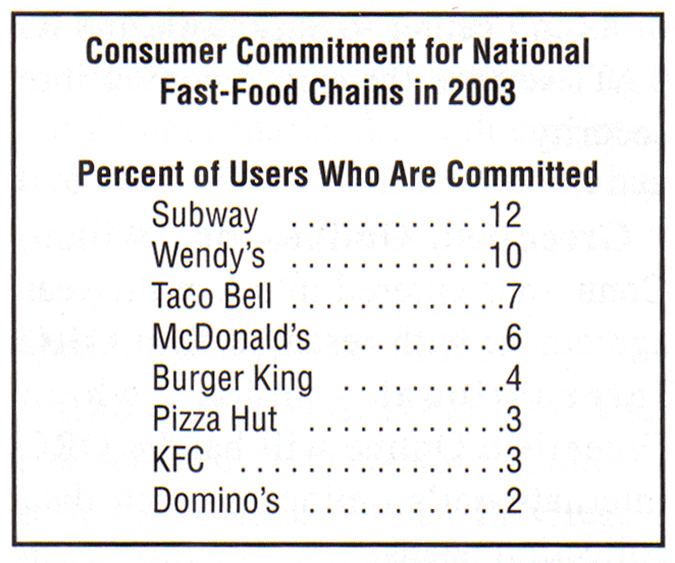
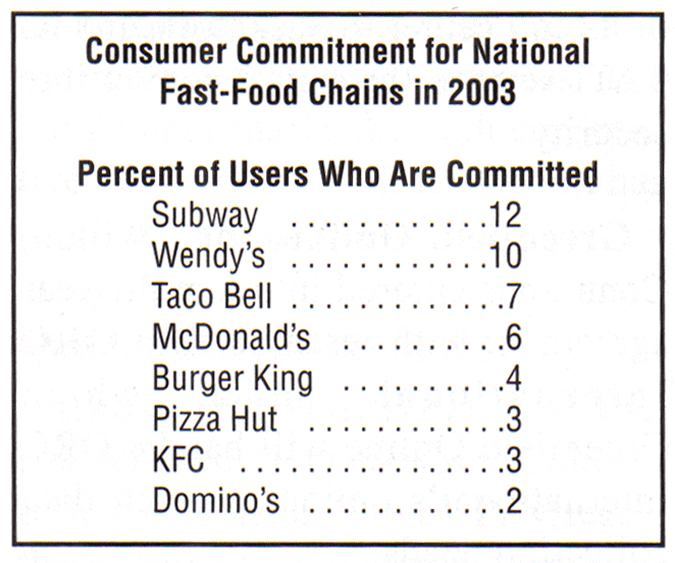
Despite heavy investment in marketing, fast-food consumers show a very weak commitment to national fast-food chains, according to a study conducted by TNS Intersearch, Horsham. Pa. Of the national chains, Subway and Wendy’s have the highest consumer commitment. McDonald’s and Burger King have a weaker base of committed customers, and a high proportion of consumers at risk of defecting - this despite the fact that the larger chains spend more on advertising (a combined $909,439,500 versus a combined $498,712,900 for the year 2002, according to TNS Media Intelligence/CMR).
Despite competition from the majors, regional chains are coming on strong in terms of consumer commitment with Panera Bread, In-n-Out, Chipotle Mexican Grill and Chick-Fil-A among the top performers.
The study found that three out of 10 fast-food consumers are not committed to any specific brand because the decision of where to go for fast-food is not considered important.
According to the TNS Intersearch Fast Food Consumer Commitment study, half of fast-food consumers either choose their brand over and over again by autopilot or spread their fast-food spending over several brands that they like equally. Compared to the commitment level in a broad range of other categories, for example automobiles or soft drinks, this appears to place fast-food brands at the bottom of the list from a consumer commitment standpoint.
There is one bright spot for fast-food chains, however. The survey showed that one-fifth of fast-food consumers are especially loyal to the brand they choose, and although they may sometimes frequent other brands, they are committed to only one.
The results also indicate that among the national chains, Subway and Wendy’s stand out with above-average consumer commitment, with 12 percent consumer commitment for Subway and 10 percent for Wendy’s.
"Both chains also show a strong ability to attract new customers," says Ken Athaide, executive manager and senior vice president, TNS Intersearch, Restaurant Practice. "The data suggests that these chains have provided offerings to meet the needs of more than one single target."
In contrast, fast-food market leaders McDonald’s and Burger King have applied a consistent and prolonged promotion of value pricing that seems to have led to the positioning of fast food as a commodity, resulting in low tommitment levels.
"Hence, the fast-casual chains have prospered in the midst of the battle in the value space," says Athaide. "This subcategory offers quality and newness without value pricing."
As a group, the regional, fast-casual chains achieve a higher consumer commitment than the traditional burger, Mexican and chicken subcategories, with Panera Bread and Chipotle Mexican Grill in the lead. Taking both regional and national players into account, the sub-category winners are In-n-Out Burger, Papa John’s Pizza, Chick-Fil-A and Taco Bell.
The study indicates that in the mature fast-food category, traditional national chains are faced with the challenge of building commitment among a broader consumer base while maintaining their core brand identity. The study is based on the results of research conducted among over 1,000 fast-food customers in March 2003. Consumer commitment is calculated using the Conversion Model.