
Editor's note: Michael Lieberman is founder and president of Multivariate Solutions, a New York research firm. He can be reached at 646-257-3794 or at michael@mvsolution.com. Mitch Markel is senior vice president of Benenson Strategy Group, a New York communications consultancy. He can be reached at 212-702-8777 or at mmarkel@bsgco.com. This article appeared in the July 9, 2012, edition of Quirk's e-newsletter.
The Net Promoter Score (NPS) is a simple metric that aims to capture consumers' willingness to recommend a product to a friend or family member. Improving this measure can increase sales or visit frequency to a retail outlet or restaurant. Of course, higher NPS ratings also mean it's more likely your brand will benefit from a friend's mention and recommendation based on their experience.
NPS can also be a good metric when assessing damage in a corporate crisis. Maintaining NPS could be the key to retaining current customers in the face of damaging allegations and the future key to growing market share once the storm has passed.
Though a valuable metric, NPS is best employed when incorporated within a strong voice-of-the-customer (VOC) program. In "9 Recommendations For Net Promoter Score (NPS)", Bruce Temkin says:
"Look for magic in the 'why.' To some degree, it's useless to know if someone is likely or unlikely to recommend you if you don't also understand why they feel that way. So you need to make sure customer feedback helps you understand why customers feel the way that they do. Which leads to my next recommendation.
"Focus on improvements, not questions. Feedback is cheap, but customer-insightful actions are precious. The goal for any feedback mechanism (like NPS) is to drive improvements in your business. Successful NPS programs have strong closed-loop VOC programs that go from detection of customer perceptions to deployment of improvements."
Taking Temkin's advice, we are focusing on the why of NPS. We would also like to take the process a step further and focus on improvement of NPS. That is, if a respondent originally rates a brand a 7, then is read a series of statements about the brand and rates the brand a 9 and becomes a promoter, which statements specifically caused him to raise his rating?
This article will run through an example of how to answer these questions. Using multivariate analysis, marketers can isolate which part of their brand story is most impactful and results in individuals feeling better about the brand. This technique relies on regression analysis.
Regression analysis
Regression analysis measures the strength of descriptive statements or performance ratings in relation to a strategic characteristic. What is driving your brand in its market segment? What would make its market share rise? What makes your competitors' market share rise? In regression analysis, the strategic characteristic is called the dependent variable. In our example, the dependent variable is NPS.
Regression analysis also has independent variables, which are used to estimate the dependent variable. In our study, these will be statements that describe our client.
After the regression is run, statements are sorted by their scores. Statements with a p-value of less than .10 (i.e., are 90 percent likely to affect NPS) are highlighted and labeled key drivers.
Example case study
In this example, let's say that our client is the fictional Vision Cable, a Philadelphia-based communications company that has been plagued by scandal. Vision Cable's founding family collected $3.1 billion in off-balance-sheet loans backed by the Vision Cable pension fund and overstated results by inflating capital expenses and hiding debt. It is currently under SEC investigation. Meanwhile, Vision Cable is losing market share to competitors such as Time Warner and Comcast.
Of course, Vision Cable does not want to lose market share. So it has undertaken a PR campaign to promote its programming. The question is, what should be emphasized in the new campaign?
Constructing the survey
Our technique requires a specific survey construction. Respondents (current and/or potential Vision Cable customers) are asked early in the survey how likely they are to recommend Vision Cable to their friends. We refer to this as pre-concept.
They are then asked to rate several statements on a 1-to-5 scale based on how much it impacts their opinion of Vision Cable.
Respondents are queried again regarding NPS: "Now, given what you've heard about Vision Cable, how likely are you to recommend Vision Cable to your friends?" We call this post-concept.
The magic in why
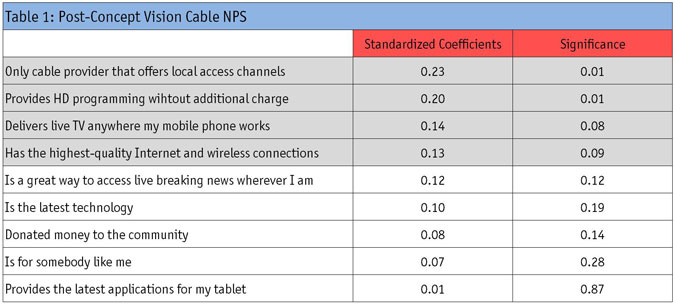
The magic in why is found with a regression using post-concept likelihood because it is measured after respondents have seen the array of descriptors and can assess Vision Cable with more information. Table 1 shows the regression outcome.
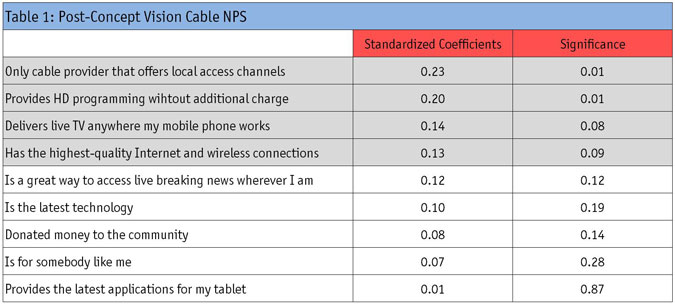
Examining the output, we see that Vision Cable customers enjoy their cable service for the usual reasons: local programming choice, quality and mobility. These are the backbone to Vision Cable loyalty.
Focus on improvements
The next step in our analysis is to focus on improvements. After being read the array of Vision Cable statements, a large percentage (roughly 30 percent) of respondents increased their NPS. Why? Which statements drove improvement of NPS?
To run the next step, a variable we will call Improvement will be created:
- Improvement = Post-Concept - Pre-Concept
- Recode Improvement: 1 = Improved NPS; 0 = Not Improved NPS
Additionally, all descriptors of Vision Cable are recoded to 1/0, with 1 = top-two box rating (4 or 5); 0 = all other ratings (1, 2 or 3). The linear regression results are shown in Table 2.
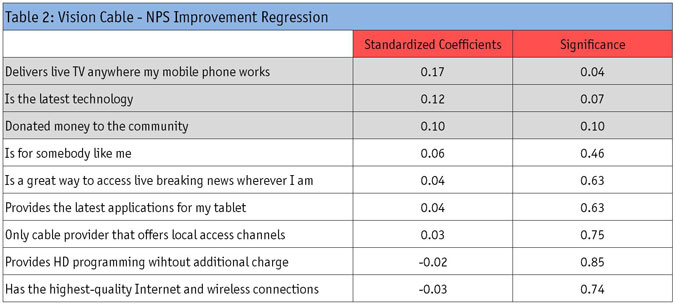
Two of the three drivers of improvement were not significant in Table 1. Thus, these are the hidden information that will expand Vision Cable's NPS. So, besides the key drivers of quality and programming, Vision Cable should incorporate "Is the latest technology" and "Donated money to the community" in its next messaging strategy.
A proven way
As the importance of measuring and tracking a brand's NPS grows, it is critical that marketers also understand how to improve these scores. Focusing on why a score is what it is or what is driving its change is essential. But understanding what a brand can do or say to help drive the change should be the priority of corporate marketing departments and brand owners.
Our technique is a proven way to assess the potential of various statements a brand could make. While traditional techniques might evaluate the statements individually on a more stated-impact basis, this approach focuses on the impact of the statements. Identifying which statement has the greatest positive impact - not necessarily which is the most liked or well-received - is the key to improving NPS.