
Editor’s note: Becki Southern is marketing manager, APAC at research firm Lightspeed Research, Sydney. This is an edited version of a post that originally appeared here under the title, “AU Open: Tennis sticks with tradition for viewer media consumption.”
The world just finished tuning in to watch fast and sometimes nerve-wracking play at the Australian Open. Being British, my affiliation with Wimbledon and the tradition of the sport is high. When we ran a study (403 participants, national representation) around the ways in which Australians are consuming the 2017 Australian Open, I was still surprised at the seemingly traditional approach viewers have for this competition.
85.9 percent of respondents told us they were watching via free-to-air TV. In a world where we are constantly reminded of mixed channels and a more complicated landscape of media consumption, this seems incredibly high. Granted, the Open, as with many other sporting competitions, is owned by a TV channel which no doubt has a bearing on the way in which people follow the coverage. However, Channel 7 offers an app and there are many other means to watch play and the data showed that no viewer was choosing this as their most preferred way to watch the tournament. The second most popular means was via pay TV (i.e., Foxtel and Optus) at 10.2 percent.
When broken down by age, there are fewer surprises. Although high across the board, we see that younger groups are those with a more mixed viewership type, with 1.5 percent of 18-to-24 year-olds and 3.7 percent of 25-to-34-year-olds watching via pay TV as well as 0.9 percent (18-24) and 1.7 percent (25-34) streaming online.
Given the propensity to follow by free-to-air TV, it was no surprise to see that TV led in the devices viewers’ choose to use, at 90.8 percent with the largest share by ages 65+. What was a slight surprise was the use of desktop computers being most prominent in the 18-24 age group, less so based on the streaming online reported in the prior question but in comparison to tablet or phone which we often see as a rising method by Gen Y.
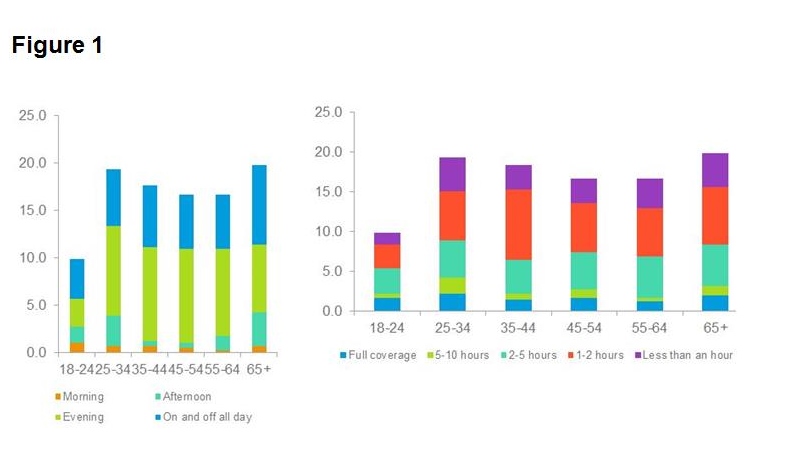
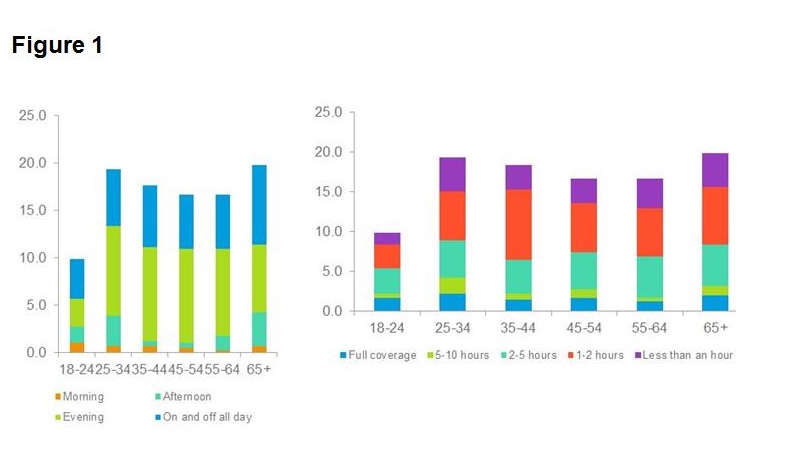
Viewing took place for the most part in the evening (48.6 percent), followed by on and off all day (36.5 percent). Given this tendency to dip in and out, we looked at how long people were tuning in and found that most were watching one-to-two hours a day (36.7 percent) but two-to-five hours was also a common period (27.3 percent). Evening was most popular with 25-to-64-year-olds and on and off all day for the two ends of the scale: 18-to-24-year-olds and those 65+, which is no doubt a reflection of a more flexible day. Those ages 25-to-34 and 65+ watched the most by a margin, while those ages 18-24 watched the least (Figure 1).
At the time of the study, in terms of winners, 40.8 percent selected Novak Djokovic as their men’s singles champion, followed by Andy Murray (30.0 percent) and Rafael Nadal (10.4 percent). For the women’s, Serena Williams still holds hearts with 66.3 percent (correctly) predicting her to win, followed by Venus Williams (4.7 percent) and Agnieszka Radwanska (3.2 percent). Does this choosing of classic players – notably that there was no mention of Roger Federer in the Top 3, though he went on to win men’s singles – suggest sticking with tradition rather than up and coming players here too?
It will be interesting to see the reasons for the barriers to consumption via the app ahead of 2018 and the Australian Open and Tennis Australia might take note in seemingly less interest by 18-to-24-year-olds and question if tradition and heritage are prominent now but might cause a future drop in followers of future generations.