
Sponsored content
Editor's note: Shanon Adams is chief revenue officer at AYTM.
Automation has become a buzzword among marketers and researchers but its roots come from the automobile industry and it refers to the implementation of mechanized product lines. Simply defined, automation is the adoption of technology to streamline time-consuming and expensive tasks typically performed manually by humans.
Some people vilify the concept, relating automation to robots taking over, but I prefer to think of automation as complementing the workforce and research. Our time is better spent pursuing creative and intellectual endeavors than manually tabulating a column of figures when software will do it for us in a click of a button.
Market research automation has gone through a few transformations including data collection, methodology and data visualization. From paper to mobile surveys, the automating of advanced research methodologies such as conjoint is streamlining the process and improving the respondent experience while delivering higher-quality insights in a fraction of the time.
By embracing automation, researchers are changing and improving how we communicate to consumers, stakeholders and beyond.
Communications gaps in a rapidly evolving industry
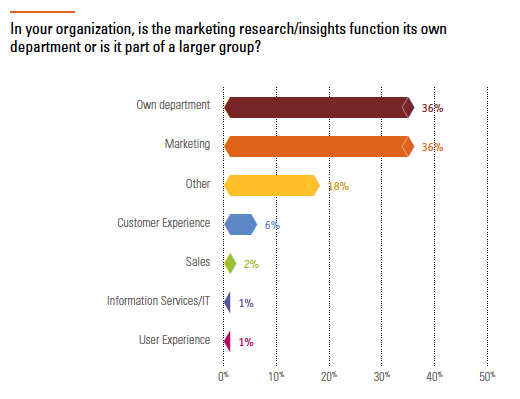
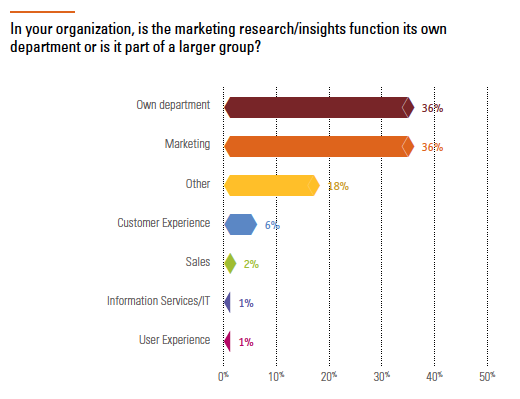
Based on the 2018 Q Report, which surveyed research and insights professionals, we are seeing a shift in how businesses operate and structure teams, especially research departments. While 36 percent are still stand-alone departments, concurrently 36 percent are under the umbrella of their marketing department. The rest are organized in cross-functional teams sometimes supporting multiple departments. The challenge that is emerging is how these teams communicate – or do not, as indicated by one respondent on a research team.
“People were unaware of our role and what we could be doing to help them. Recently, as I’ve joined the organization it’s been a big focus to get out my team’s name within the organization. People were/are doing a lot of things on their own, results and findings are very silo-ed. We’re trying to be more of a connector of things that are happening.”
Automation tools can not only streamline tasks and processes, it can also become a central space to bring these newly “distributed teams” together and increase the visibility of the research team as a solutions provider in their organizations.
In-house is the new normal but doesn’t mean you are on your own
Also noted in the report is that while 33 percent of respondent companies are still fully outsourcing research and 18 percent partially outsource their research, a growing number (49 percent) are doing research in house. This continued shift to in-house research programs is driven by growing adoption of self-service and DIY tools. Often the major reason people still outsource is lack of internal staff (33 percent) followed by lack of expertise in certain areas (31 percent). Based on comments in the survey, bringing at least some research in house has allowed teams to provide insights faster with a cost savings to the company.
“Survey design tools and data analysis tools have provided better leverage of insights for the company.”
While the majority (46 percent) state their budgets will remain the same, how companies utilize those budgets is changing as they adopt new technologies and bring more research in house. Market research automation of tried-and-true methodologies means you have the expertise at your fingertips and can quickly gather results. As one respondent stated:
“‘Quick’ surveys allow us to make faster decisions for more tactical projects.”
When asked what they plan to focus on the upcoming year, data visualization and dashboards seemed to dominate the responses.
“Developing KPI and customer insight dashboards has been the biggest push this past year.”
“Focus on more data visualization and launching dashboards for senior staff.”
While data collection and methodology automation have made great strides automating data, reporting and analytics is gaining momentum.
“Online dashboards enable me to deliver results in real time.”
As more and more companies bring their research in house it’s important to remember that while DIY is self-service it doesn’t mean “you’re on your own.” Your DIY and automation platform of choice should still come armed with resources who have the knowledge and expertise to train your team as well as guide you on best practices. Launching an automated conjoint study without understanding the methodology is akin to jumping out of a plane without understanding how your parachute works. Needless to say, it’s not a good idea to learn on the way down.
Automating collaboration from design to analysis
One way data collection has evolved is from paper surveys to mobile surveys, in turn reducing the time it takes to collect data in field from weeks to hours. The evolution of quantitative surveys has kept pace with emerging technology. Today it’s important not to only be mobile-friendly but truly device-agnostic. We at AYTM have spent a great deal of time and resources designing surveys that are truly device-aware, which means a survey will look the same no matter what device your respondent uses. This consistency not only improves the survey design and data, it also increases respondent engagement.
Speaking of survey design and programming, collaboration is another emerging use for automation. Bringing the collaboration process into the survey platform makes it much easier for cross-functional teams to work together under tight deadlines. For instance, on our platform you can now share and edit surveys in real time with your team, stakeholders and/or clients and seamlessly switch between editor and viewer as you program the survey. This reduces the time spent on programming and editing, streamlining the design process and leading to optimized output and higher-quality results, faster.
Collaboration in automation doesn’t stop at design. As soon as a survey is fielding you can instantly access your results vs. waiting weeks. You can then share your results in real-time with your team and/or clients. Plus, with robust filtering and analytical tools like crosstab analysis you can empower your internal clients to interact with data without waiting for the survey to even complete. Automation provides real-time data visualization for every question that can be filtered, customized and shared.
Whether you are a corporate researcher working with internal teams or a consultant working with clients, automation will do the heavy lifting for you. DIY tools allow you to communicate directly with your internal client without adding a supplier to the conversation, thus making things faster and easier. You save time and money while being able to tell the story of your consumer and shape your brand.
Communicating effectively with respondents is important
The purpose of market research is to collect insights and listen to your consumers or potential consumers, so why do we tend to treat respondents as if they are just numbers? We often forget to talk about how to optimize the most important conversation, the one between researcher and respondent. One of the main reasons for research automation adoption is the need for higher-quality data that is faster and cheaper. What people often forget is that technology cannot replace the human element of a survey – the respondent, panelist and survey taker. Essentially this is your consumer and there is not an endless supply of them, so their experience should be a priority.
This requires us to evaluate how we approach research and improve communication between researcher and respondent. Did we communicate our objectives to the respondent, do they have the tools they need to succeed and are they a good fit for this survey? Approaching these questions as if you were assigning something to an employee will not only improve data quality but increase respondent engagement for future surveys.
DIY survey tools built with the respondent experience in mind naturally guide researchers to higher respondent engagement, which leads to better data. From making your survey truly agnostic (not just mobile-friendly) to implementing advanced automated methodologies like max-diff and conjoint that once were cumbersome or expensive but are now easy and affordable to deploy, with automation the respondent benefits and that means you do as well.
Automation does not replace humans, it just unlocks our potential
So in conclusion, automation is not a buzzword that will disappear in a year or two, it’s becoming the new normal. For newer companies it’s their foundation and the core of their business. Established companies are also adopting automation rapidly to stay relevant and competitive. By embracing the use of automation in market research we are changing how we work and communicate with consumers, respondents and stakeholders for the better. Research automation tools that empower teams to improve survey design, collaborate and improve the respondent experience will generate better data, allowing more time for storytelling and making data actionable. This is where we truly unlock the greatest human potential, which no robot could ever replicate.